
Apply for Disability Oregon A Practical Guide
"I was satisfied once John Bell took over my case."
"Communication was always timely."
Apply for Disability Oregon A Practical Guide
When you can no longer work because of a health condition, figuring out how to get disability benefits can feel overwhelming. Here in Oregon, the process primarily involves two federal programs: Social Security Disability Insurance (SSDI) and Supplemental Security Income (SSI).
This guide will walk you through the entire journey, step by step. We'll start with the basics of which program might be right for you, what you need to gather, and how to get your application started.
Your Guide to Oregon's Disability Application
Applying for disability is a detailed process, but it's one that thousands of Oregonians navigate successfully every year. For many, these benefits are an absolute lifeline. The first step is getting a handle on the two main programs you'll hear about: SSDI and SSI. They sound similar, but they work very differently.
SSDI is essentially an insurance program. You've paid into it through FICA taxes taken out of your paychecks over the years. Now that a severe medical condition is keeping you from working, you're filing a claim on that policy.
SSI, on the other hand, is a needs-based program. It's not tied to your work history at all. Instead, it's designed to provide a safety net for people who are disabled, blind, or over 65 and have very limited income and financial resources.
SSDI vs SSI in Oregon at a Glance
It’s really important to know the difference between these two programs because the rules for who qualifies are completely separate. This table breaks down the core distinctions.
| Funding Source | Funded by your past Social Security tax contributions (FICA). | Funded by general U.S. Treasury funds (tax revenue). |
| Primary Eligibility | Based on your work history and earning enough "work credits." | Based on strict financial need (low income and few assets). |
| Financial Limits | No limits on your personal assets or unearned income. | Strict limits on income and countable assets (e.g., cash, bank accounts, stocks). |
| Health Insurance | Qualifies you for Medicare after a 24-month waiting period. | Qualifies you for the Oregon Health Plan (Medicaid) immediately. |
| Payment Amount | Varies based on your lifetime average earnings. | A fixed federal benefit rate, which can be reduced by other income. |
Understanding this table is the first step to figuring out which benefit you might be eligible for. In some cases, if you have a recent work history but now have very few resources, you might even be able to apply for both at the same time. This is what's known as a "concurrent claim."
To give you some real-world context, about 81,748 people in Oregon receive SSDI benefits, with the average monthly payment hovering around $1,510.19. While every case is unique, these numbers show that the system is there to provide crucial support. If you want to dive deeper, you can explore more detailed statistics on disability benefits in Oregon.
The Role of Oregon's Disability Determination Services
While your application starts with the federal Social Security Administration (SSA), a key part of the decision-making happens right here in Oregon. Once the SSA checks that you meet the basic non-medical rules (like work credits for SSDI or income limits for SSI), they send your case file to a state agency called Disability Determination Services (DDS).

The Oregon DDS has one job: to make the medical decision on your claim. Their team of claims examiners and medical professionals will comb through your health records to see if your condition is severe enough to meet the SSA’s definition of disability.
This is why your medical evidence is everything. The strength of your entire case rests on the documentation that the DDS reviewers see in your file. Getting your medical history organized and complete is the single most important thing you can do to build a strong claim from the very beginning.
First Things First: Are You Eligible?
Before you dive headfirst into the mounds of paperwork, let's take a crucial first step. We need to make sure you meet the strict eligibility rules set by the Social Security Administration (SSA). I can't stress this enough—getting this right from the start is the foundation of your entire claim.
Think of it like this: if you're building a house, you have to pour the concrete foundation correctly before you even think about putting up walls. This is that step. When you apply for disability in Oregon, the SSA examines two different kinds of requirements: medical and technical. You have to clear both hurdles to have a shot at getting approved.
The Medical Side of the Equation
The medical rules are the same whether you're applying for SSDI or SSI. The SSA’s definition of "disability" is very specific, and it's often a lot stricter than your own doctor's. A diagnosis alone isn't enough; what matters is how your condition actually limits your ability to function and work.
To meet the SSA's medical standard, your condition must:
- Keep you from working: The SSA calls this being unable to perform "Substantial Gainful Activity" (SGA). It’s a key term. Essentially, if your medical impairment is so severe that you can't earn over a certain amount each month, you might meet this rule. This income limit changes each year, so if you're consistently earning above it, the SSA will likely decide you aren't disabled.
- Be long-term or terminal: This isn't for temporary problems. Your condition must be expected to last for at least 12 months straight or, unfortunately, be expected to result in death. A broken arm that will heal in a few months, for example, won't qualify.
Here in Oregon, a state agency called Disability Determination Services (DDS) is the one that actually reviews all your medical files to see if you meet this definition. They are looking for hard, objective evidence—things like X-rays, lab results, and detailed notes from your doctor that prove the limitations you're claiming.
SSDI vs. SSI: Understanding the "Technical" Rules
This is where things get different depending on which program you’re applying for. The technical rules for SSDI and SSI are worlds apart, and there’s no wiggle room.
For Social Security Disability Insurance (SSDI), it’s all about your work history. You must have worked long enough—and recently enough—to have paid into the Social Security system through your FICA taxes and earned enough "work credits." The exact number of credits you need depends on how old you were when your disability began.
On the other hand, for Supplemental Security Income (SSI), your work history doesn't matter at all. SSI is a needs-based program, which means it comes down to your financial situation. The SSA will scrutinize your:
- Income: This covers everything from a part-time job to pensions, gifts from family, or any other benefits you receive.
- Assets: This includes cash, money in the bank, stocks, and any property you own besides the home you live in. The limits are incredibly low: just $2,000 for an individual and $3,000 for a couple.
A Tale of Two Oregonians:
Imagine a 58-year-old mill worker from Salem who has a long, steady work history but suffers a debilitating back injury. He's paid into the system for decades, so he has more than enough work credits to be technically eligible for SSDI.
Now, picture a 28-year-old from Portland who has a severe chronic illness but has only been able to work odd jobs here and there. She won't have the work credits for SSDI. However, if she has very little income and her assets are under the $2,000 limit, she could be eligible for SSI.
Figuring out which conditions qualify and how to present your case can feel overwhelming. To get a better handle on the types of impairments the SSA recognizes, you can learn more about what qualifies for disability benefits and see how to build a strong argument around your specific health issues. Taking the time to assess your medical and technical eligibility is truly the most important first move you can make.
Gathering Your Essential Documents and Evidence
When you apply for Social Security Disability, you're essentially telling the story of your life and your limitations, but you're telling it through official documents. A strong claim needs solid proof, and pulling all this paperwork together is one of the most important things you can do upfront. This isn't just about ticking boxes on a checklist; it's about understanding why each document matters to the claims examiner in Oregon who holds your future in their hands.
Think of it like building a case. The more organized and detailed you are, the easier it is for Disability Determination Services (DDS) to see the full picture. Getting this right from the start can save you from the frustrating delays that come with missing information.

Key Personal and Work Documents
Before you even touch your medical files, you need a core set of personal and financial papers. These documents confirm who you are, what you've done for work, and your financial situation—all critical pieces for both SSDI and SSI claims.
Here’s a quick rundown of what to have on hand:
- Proof of Identity: You'll need your original birth certificate or a certified copy. If you weren't born in the U.S., get your proof of legal citizenship or resident status ready.
- Marriage and Divorce Records: If you’ve ever been married, have the dates and locations for any current or past marriages. This can impact potential benefits for your dependents.
- Social Security Information: Your Social Security card is obvious, but also gather the numbers for your spouse and any children who might be eligible for benefits through your record.
- Work History: This is a big one. You need to create a detailed list of every job you've had in the last 15 years. Include your job titles, a description of your duties, and the exact dates you worked there.
- Financial Records: For anyone applying for SSI, this is absolutely essential. Pull together recent bank statements, pay stubs, and any records of other income or assets.
The Cornerstone: Your Medical Evidence
While the personal documents lay the foundation, your medical records are the true heart of your disability claim. The Oregon DDS examiner is looking for objective medical proof that spells out your diagnosis, the treatments you've tried, and—most critically—how your condition limits your ability to function day-to-day.
Start by making a complete list of every single place you've received medical care for your condition. This includes:
- Hospitals and emergency rooms (like OHSU or Providence)
- Specialists (orthopedists, neurologists, psychiatrists, etc.)
- Your primary care doctor and any local clinics
- Physical, occupational, or mental health therapists
- Imaging centers where you had X-rays, MRIs, or CT scans
Once you have your list, you'll need to request your entire medical file from each provider. Be very clear that you need everything—lab results, imaging reports, notes from surgery, and the doctor's own clinical notes. Our guide on how to get your medical records effectively breaks down the best ways to tackle this crucial step.
Pro Tip: Don't just dump a mountain of records on the SSA's desk. The single most helpful document you can get is a Medical Source Statement from your main doctor. This is a letter or form where your doctor explains exactly what you can and can't do—how many pounds you can lift, how long you can sit or stand, or how your concentration is affected. It translates the medical-speak into the real-world limitations the SSA needs to see.
The goal is to show why you cannot maintain substantial, gainful employment. While Oregon has made strides in inclusive hiring, with 29.8% of Oregonians with disabilities employed in 2023, your evidence needs to clearly explain why your specific condition prevents you from being part of that workforce.
Remember, you're dealing with incredibly sensitive medical and financial data. If you choose to send documents electronically, it’s worth understanding the security risks of online fax services to protect your information. Taking the time to gather and organize these documents is the best investment you can make when you apply for disability Oregon.
Time to File: How to Submit Your Oregon Disability Application
You've done the hard work of gathering your documents and medical records. Now it's time to officially file your claim. This is the moment all that preparation really starts to matter.
In Oregon, the Social Security Administration (SSA) gives you three ways to get your application started: online, over the phone, or in person at a local office. Each path has its own feel, and choosing the right one for you can make a big difference in how smoothly things go.
Choosing Your Best Path: Online, Phone, or In-Person
For most people I work with, filing online is the way to go. The SSA's website is open 24/7, which means you can work on the application when you feel up to it, save your progress, and come back later. Given how detailed these forms are, that flexibility is a lifesaver.
If you're not comfortable with computers or just prefer talking to a person, you can apply by phone. Just call the SSA's main number at 1-800-772-1213. A representative will walk you through everything, asking the questions and filling out the forms for you. It's a great option if you want to ask questions as you go.
The third option is a face-to-face appointment at a local SSA office, whether you're near Portland, Salem, or down in Medford. This gives you in-person help, but you'll almost always need to schedule it in advance, and you might be in for a bit of a wait.
Tackling the Online Application Forms
If you decide to file online, you'll be focused on two main documents: the primary application for disability benefits and the Adult Disability Report. That second one is your real opportunity to show the Oregon Disability Determination Services (DDS) examiner what your life is actually like.
The Adult Disability Report is where you'll lay out the nitty-gritty details of your situation. They'll ask for:
- A deep dive into your medical conditions and symptoms.
- Every single treatment, test, and medication you've tried.
- Your full work history.
- A section on how your condition limits your day-to-day activities.
That last part is critical. This is where so many applications go wrong because people are too vague. You have to connect the dots for the examiner.
Expert Tip: Paint a Vivid Picture. Don't just say, "My back pain makes cooking hard." That tells them almost nothing. Instead, get specific: "Because of my severe lumbar stenosis, I can't stand at a kitchen counter for more than five minutes without sharp, radiating pain. This means I can't chop vegetables or watch something on the stove. I'm also unable to lift anything heavier than a half-gallon of milk, so I can't even lift a small pot of water."
See the difference? That kind of detail transforms a medical diagnosis into a real-world limitation, which is exactly what the DDS needs to understand why you can't work.
Getting Ready for a Phone or In-Person Interview
If you opt for a phone or in-person application, think of it as a guided interview. A Social Security employee will ask you the same questions from the forms and type in your answers. They can't offer legal advice, but they are there to make sure the information is entered correctly.
The key to a successful interview is being prepared. Have all your paperwork organized and right in front of you.
Your checklist should include:
- Your full list of doctors and hospitals, complete with addresses and treatment dates.
- A current list of all your medications and dosages.
- Your work history from the last 15 years.
- Basic documents like your Social Security card and birth certificate.
When you're organized, you can provide clear, consistent answers without having to stop and search for information. This helps avoid simple mistakes or omissions that can cause delays down the road. Whichever method you choose, your goal is to submit a thorough, accurate, and compelling application that truly shows why you can no longer work.
What to Do If You Get a Denial Letter
Getting that denial letter from Social Security can feel like a punch to the gut. After all the paperwork, the waiting, and the stress, seeing your claim rejected is deeply discouraging. But I want to be very clear about this: it is not the end of the road.
In fact, most people who apply for disability in Oregon get denied the first time. It’s an unfortunate reality of a very backlogged system. Think of that initial denial not as a final "no," but as the first step in a longer conversation. The good news is that there’s a formal appeals process built for exactly this situation, giving you several more chances to make your case.
Understanding the Four Levels of Appeal
When you decide to fight a denial, you’re entering a structured, multi-stage process. The most important thing to know right away is the deadline. You have only 60 days from the date on your denial notice to file an appeal. If you miss that window, you’ll likely have to start the entire application over from scratch.
Here’s a look at the journey ahead:
- Reconsideration: This is the first stop. You’re essentially asking the Social Security Administration (SSA) to take a second look. Your file goes back to Oregon's Disability Determination Services (DDS), where a brand new examiner reviews everything—your original application plus any new medical evidence you've gathered.
- Hearing with an Administrative Law Judge (ALJ): If the reconsideration is also denied, you can request a hearing. For most people, this is the most critical stage and the best opportunity to win. You'll appear before a judge (often in Portland or Eugene) and get to explain, in your own words, how your condition truly prevents you from working.
- Appeals Council Review: If the ALJ's decision doesn't go your way, you can ask the Appeals Council to review it. They aren't re-evaluating your disability; instead, they are looking for specific legal or procedural mistakes the judge might have made during the hearing.
- Federal Court Review: This is the final option. It involves filing a civil lawsuit in U.S. District Court, a complex legal step where you argue that the SSA incorrectly applied the law in your case.
This visual shows the different ways you can start a claim, which is the first step before any of these potential appeals come into play.
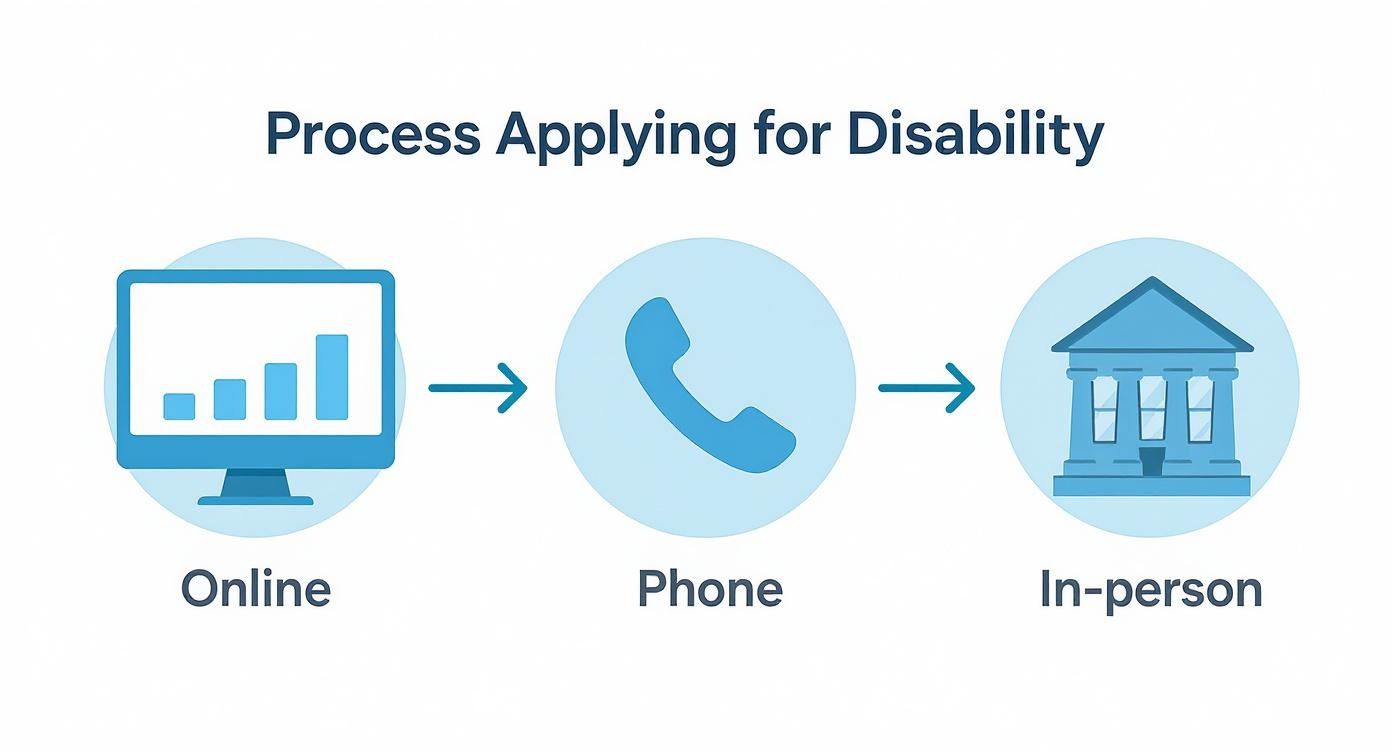
Whether you start online, over the phone, or at a local office, a denial can launch you into this exact appeals process.
Below is a table that breaks down these stages and what you can generally expect for wait times here in Oregon.
Oregon Disability Appeals Stages and Timelines
| Reconsideration | A different examiner re-reviews your entire file and any new evidence you provide. | 3-6 months |
| ALJ Hearing | You appear before a judge to testify about your limitations. This is your best chance to win. | 12-18 months from hearing request to decision. |
| Appeals Council | A review to see if the ALJ made a legal or procedural error in their decision. | 6-12 months |
| Federal Court | Filing a lawsuit in U.S. District Court to challenge the SSA's legal reasoning. | 12+ months |
These timelines can feel incredibly long, which is why it's so important to be persistent and prepared for each stage.
Why the ALJ Hearing is So Important
For the vast majority of Oregonians, the ALJ hearing is the make-or-break moment. The initial stages are just a review of paperwork. This is your first and often only chance to sit in front of the person making the decision and tell your story.
Your testimony is the single most powerful piece of evidence at this stage. It's not enough to say, "I'm in pain." You have to paint a picture. Explain how that pain prevents you from sitting for more than 20 minutes, or how your fatigue makes it impossible to lift a gallon of milk. Specific, real-world examples are what convince a judge.
The hearing is also the perfect time to submit updated medical evidence showing that your condition hasn't improved. Having an experienced attorney by your side here is invaluable. They know the right questions to ask, how to challenge the testimony of a vocational expert, and how to present your medical file in the most persuasive way. You can learn more about how to appeal a disability denial to better prepare for this crucial hearing.
Common Questions We Hear About Oregon Disability Claims
When you're trying to navigate the disability process here in Oregon, it's natural to have a ton of questions. After years of helping folks with their claims, we've found that most people run into the same hurdles and have the same worries. We put this section together to give you clear, no-nonsense answers to the questions we get asked the most.
Our aim is to shed some light on the confusing parts of the process—the things you can't easily Google. From how long you'll be waiting to whether you really need a lawyer, here's what you need to know based on our real-world experience.
How Long Does a Disability Decision Take in Oregon?
This is the big one, and the honest answer is: it really depends. There's no single timeline. How long you'll wait is a mix of your specific medical situation and how backed up the system is at that moment. Patience, unfortunately, is a huge part of the process when you apply for disability Oregon.
Here’s a realistic look at what you can probably expect at each stage:
- Initial Application: Once you submit your file, it lands with Oregon's Disability Determination Services (DDS). Their first look at your case usually takes somewhere between 4 to 7 months.
- Reconsideration: If you get denied initially, your first appeal is called Reconsideration. A different examiner at DDS takes a fresh look, which typically adds another 3 to 6 months to the clock.
- ALJ Hearing: This is often the longest wait. If you have to go before an Administrative Law Judge (ALJ), getting a hearing scheduled at the Portland or Eugene offices can take anywhere from 9 to 18 months.
There's a small exception for very severe conditions on the Compassionate Allowances (CAL) list. Those cases can sometimes get a decision in a matter of weeks, but they are a tiny fraction of the total claims filed.
Can I Work While Applying for Disability Benefits?
You can, but you have to be incredibly careful. The Social Security Administration (SSA) has a very strict income limit called Substantial Gainful Activity (SGA). It's a specific dollar amount that changes each year, and it’s the main way the SSA decides if you're "too busy" working to be considered disabled.
If your gross monthly earnings go over that SGA limit, they'll almost certainly issue a technical denial without ever reviewing your medical files. Their logic is simple: if you can earn that much money, you aren't disabled by their definition.
Working part-time and staying under the SGA limit is technically allowed, but it can still make your case more difficult. The examiner might see it as proof you have the ability to hold down a job, which could be used against you. It's absolutely essential to report any and all work you do to the SSA. It's also a good idea to talk with a disability lawyer to figure out how your specific work situation might affect your chances.
Do I Need a Lawyer to Apply for Disability in Oregon?
Legally, no, you don't need a lawyer to file for disability benefits. Plenty of people handle their initial application by themselves. The real value of having a professional in your corner often becomes crystal clear if your claim is denied and you're heading into the appeals process.
It's a fact: statistics consistently show that people with legal representation have a much higher chance of getting approved, especially when their case gets to a hearing with a judge.
An experienced Oregon disability lawyer knows exactly what the SSA and an ALJ are looking for to say "yes." They can help you:
- Track down the most important medical records and get supportive opinions from your doctors.
- Prepare you so you know what to expect and what to say at your hearing.
- Skillfully question the vocational expert—the person the SSA brings in to testify about jobs they think you can still do.
Most disability attorneys work on a contingency fee. That means you don't pay them anything unless you win your case. Their fee is just a limited percentage of your back-due benefits. For most people, that peace of mind and expert guidance is a worthwhile investment.
What Happens After My Disability Claim Is Approved?
Getting that approval notice is a huge moment of relief. Soon after, you'll receive an official award letter in the mail from the SSA. This is a critical document, so keep it safe—it spells out all the details of your benefits.
The award letter will officially confirm your approval and tell you:
- Your monthly benefit amount.
- The date your monthly payments will start.
- The total amount of any past-due benefits (your "back pay") that you're owed.
For SSDI, keep in mind there's a five-month waiting period from the date your disability began, so back pay starts from the sixth full month. You'll also get access to health insurance. SSDI recipients can get Medicare after a 24-month wait, while people on SSI usually qualify for the Oregon Health Plan (Medicaid) right away. From then on, your main job is to keep the SSA updated on any changes to your work, income, or health.
Trying to win a Social Security Disability claim can feel like one of the toughest fights of your life. At Bell Law, our attorneys focus exclusively on guiding Oregonians through this maze. If you’ve been denied or just need help getting started, we're here to give you the expert legal support you need. Contact us today for a free consultation to protect your rights and get the benefits you've earned.
Disclaimer: The information on this page is provided for general informational purposes only and is not legal advice. Reading this content does not create an attorney-client relationship. For advice about your specific situation, please contact a licensed attorney.