
Applying for Disability in Oregon A Complete Guide
"I was satisfied once John Bell took over my case."
"Communication was always timely."
Applying for Disability in Oregon A Complete Guide
If you're in Oregon and can no longer work because of your health, navigating the disability benefits system can feel like a monumental task. The good news is that federal programs like Social Security Disability Insurance (SSDI) and Supplemental Security Income (SSI) are in place to provide a critical financial lifeline. This guide is here to cut through the confusion and give you a clear roadmap for the journey ahead.
Your Guide to Getting Disability Benefits in Oregon

Let's be honest—facing a future where a medical condition keeps you from working is incredibly stressful. The process of applying for disability can feel just as intimidating, with its maze of complex forms, strict deadlines, and unfamiliar jargon. But you don't have to figure this out on your own.
We’re going to walk through the system step-by-step, starting with the two main federal programs available to you as an Oregon resident. Understanding which one fits your circumstances is the first, most important move you can make.
SSDI vs. SSI: Which Program Is Right for You?
The Social Security Administration (SSA) runs both of these programs, but they are built for different situations and have entirely separate eligibility rules. Getting this part right from the start is key.
- Social Security Disability Insurance (SSDI) is what's known as an "earned benefit." Think of it like an insurance policy you've been paying for with every FICA tax deduction from your paychecks. Your eligibility hinges entirely on your work history and whether you've earned enough "work credits."
- Supplemental Security Income (SSI), on the other hand, is a needs-based program. It's designed to help people with very limited income and financial resources, regardless of how much they've worked. This is often the right program for children with disabilities or adults who haven't been in the workforce long enough to qualify for SSDI.
In some cases, you might even qualify for payments from both programs simultaneously, which is known as receiving "concurrent benefits."
The simplest way to remember the difference is this: SSDI is based on what you’ve paid into the system through your work. SSI is based on your current financial need.
To give you a better sense of how these programs work in practice, here’s a quick comparison of their core features.
Key Differences Between SSDI and SSI in Oregon
| Eligibility Basis | Based on your work history and FICA tax contributions. | Based on your current income and financial resources (e.g., savings, assets). |
| Financial Test | No income or asset limits. | Strict income and resource limits apply. |
| Medicare/Medicaid | Automatically eligible for Medicare after a 24-month waiting period. | Often immediately eligible for Medicaid (the Oregon Health Plan). |
| Payment Amount | Varies based on your lifetime earnings record. | A fixed federal monthly rate, which may be reduced by other income. |
| Who It Covers | You, and potentially your spouse and dependent children. | Only the individual who is blind, disabled, or aged 65+. |
Understanding these distinctions will help you and your family figure out the best path forward when you're ready to apply.
The Impact of Disability Benefits in Oregon
These aren't small programs; they provide essential support for tens of thousands of your neighbors. In Oregon alone, 81,748 people receive Social Security Disability Insurance benefits.
A significant majority of them—50,937 individuals—are working-age adults between 18 and 64, which shows just how much a disability can impact someone during their prime career years. With the average monthly SSDI payment in Oregon hovering around $1,510.19, this support is what helps many families keep a roof over their heads. You can explore more state-specific SSDI statistics to get the full picture.
Do You Even Qualify for Disability Benefits?
Before you dive into what can be a long and frustrating application process, it's smart to take a hard look at whether you meet the basic criteria set by the Social Security Administration (SSA). This first step can save you a mountain of paperwork and a lot of heartache.
The SSA runs two different disability programs, SSDI and SSI, and each has its own gatekeeping rules. One hinges on your work history, the other on your financial situation. Let's break down what they're looking for, so you can figure out where you might stand.
SSDI: Did You Pay In Enough?
Think of Social Security Disability Insurance (SSDI) as a long-term disability policy you've been paying for your whole working life through FICA taxes. Because you paid in, your eligibility is all about your work history. The SSA measures this in "work credits."
In 2024, you earn one credit for every $1,730 you make, up to four credits per year. How many you need really depends on how old you were when your disability knocked you out of the workforce.
- If you're under 24: The rules are a bit more lenient. You generally need 6 credits earned in the three years right before your disability began.
- Between 24 and 31: You'll typically need to have worked about half the time between age 21 and when you became disabled. So, if you're 27, you'd need credit for about three years of work (or 12 credits).
- Over 31: This is where it gets tougher. Most people will need a total of 40 credits, and the key part is that 20 of those must have been earned in the 10 years just before you stopped working.
The easiest way to see where you stand is to set up a "my Social Security" account on the SSA's official website. It's free and will give you a clear, personalized report of your earnings and credits. No guessing required.
SSI: Is Your Financial Need Great Enough?
Supplemental Security Income (SSI) is a completely different animal. It’s a needs-based program, so your work history is irrelevant. What matters here is your current financial picture: your income and your resources (the things you own).
The SSA is extremely strict about these limits because the program is designed for people with very little.
- Income Limits: This isn't just a paycheck. It includes any money you have coming in, from any source—other benefits, freelance gigs, even regular cash from a family member helping you out.
- Resource Limits: For 2024, an individual can't have more than $2,000 in countable assets. For a couple, it's $3,000. They don't count everything, thankfully. The house you live in and one car are usually exempt from this calculation.
Key Takeaway: With SSI, your financial situation is the first hurdle. If you don't meet these low-income and resource thresholds, the SSA won't even move on to review your medical condition.
The Medical Hurdle Everyone Must Clear
No matter if you're applying for SSDI or SSI, you have to pass the same medical test. Honestly, this is where most applications fall apart. The SSA’s definition of "disabled" is incredibly rigid.
First, your condition has to be severe enough to prevent you from doing what they call Substantial Gainful Activity (SGA). It's a fancy term for working and earning over a certain amount. For 2024, that magic number is $1,550 a month (or $2,590 if you're blind). If you're earning more than that, you'll almost certainly get a technical denial, end of story.
Second, your medical problems must be long-term. The SSA requires that your condition:
- Has lasted or is expected to last for at least 12 consecutive months, or
- Is expected to end in death.
This is a critical point. A broken leg that will heal in six months, even if it's a terrible injury, won't qualify. The system is designed to help people with long-lasting, debilitating impairments.
Let’s look at a real-world example here in Oregon. Imagine a logger from Tillamook who suffers a severe spinal injury. Multiple surgeries leave him with chronic pain, and his doctor says he can never again handle the physical demands of that job—or any other physical labor. His condition is clearly permanent and prevents SGA. He has a strong medical case.
Now, think about a software developer in Portland who develops severe carpal tunnel syndrome. It prevents her from typing for 8 hours a day, so she can't do her old job. However, with accommodations, she could potentially transition into a project management or training role that doesn't require constant typing. The SSA might argue that even though she can't do her past work, she could adjust to other work.
That distinction is everything in a disability claim. It’s not about whether you can do your old job; it’s about whether you can do any job that exists in the national economy.
Gathering Your Documents and Medical Evidence

A successful disability application is built on a foundation of solid, undeniable proof. Think of yourself as building a case—the more organized and thorough you are with your evidence, the stronger your claim will be. This preparation phase is your chance to gather everything the Social Security Administration (SSA) will need, which can help prevent frustrating delays and strengthens your argument from the very start.
We can break down the paperwork into three main buckets: your personal info, your work history, and the most critical component, your medical evidence. If you tackle each one methodically, the whole process will feel a lot less overwhelming.
Your Personal and Work History Checklist
Before we dive deep into medical records, let's get the basic identity and employment details sorted out. The SSA needs to verify who you are and confirm your work history to figure out if you're eligible for programs like SSDI.
Have these items ready to go:
- Proof of Identity: Your original birth certificate or a certified copy is an absolute must-have. You’ll also need to show proof of U.S. citizenship or lawful alien status.
- Marriage and Family Information: If it applies to you, have your marriage certificates, divorce decrees, and the birth certificates for any dependent children on hand.
- Work History Overview: The SSA wants a detailed look at your employment for the last 15 years. You'll need to compile a list of your jobs, the dates you worked, your job titles, and a straightforward description of your duties.
A common mistake I see is people underestimating the level of detail needed for their work history. Be specific about the physical tasks—like how much you had to lift, stand, or walk. This information is crucial for proving you can no longer do the work you used to.
The Power of Comprehensive Medical Evidence
This is the absolute heart of your disability claim. Your medical records have to paint a clear, consistent picture of your condition and—this is the key—how it limits your ability to function day-to-day and hold a job. Just having a diagnosis isn't enough; the SSA needs to see objective proof of the severity and persistence of your limitations.
Your goal is to collect every single relevant piece of medical information. Good organization is your best friend here; looking into document management best practices can give you a system for keeping everything in order.
Start by creating a master list that includes:
- Names, addresses, and phone numbers for every doctor, therapist, hospital, and clinic you've been to.
- A complete list of your medications, including dosages and any side effects you experience.
- Detailed records of all your treatments, from physical therapy sessions to surgeries.
Getting your hands on these records can sometimes be a hassle, but it's a step you cannot skip. We have a guide on how to get medical records that walks you through the process of requesting and collecting these essential documents from your providers.
Why a Doctor's Statement Is Your Strongest Tool
While lab results and MRI reports are important, a detailed statement from your treating physician can be the single most persuasive piece of evidence you submit. This isn't just a quick note confirming you have a certain condition. It's a professional medical opinion that directly connects your diagnosis to your functional limitations.
A strong statement from your doctor should clearly explain:
Your specific medical diagnosis and the objective findings (like lab tests or imaging results) that back it up.
Your functional limitations in concrete, real-world terms. For instance, "The patient cannot sit for more than 20 minutes at a time," or "Due to chronic pain and medication side effects, the patient struggles with concentration and short-term memory."
Your prognosis, which confirms that your condition is expected to last for at least 12 months.
Don't be afraid to have a frank conversation with your doctor about this. Let them know you're applying for disability and ask if they would be willing to write a letter or fill out a form that spells out exactly how your impairments impact your ability to perform work-related activities. This one document can truly be the difference-maker.
How to File Your Application in Oregon
Once you’ve gathered all your medical records and personal documents, it’s time to take the next step and officially file for disability in Oregon. The Social Security Administration (SSA) gives you three ways to do this.
There’s no single “best” way; it really comes down to what you’re most comfortable with.
- Online: Through the SSA's official website.
- By Phone: By calling the SSA's national toll-free number.
- In-Person: At a local Oregon Social Security office.
Let's break down what each option looks like in the real world so you can figure out which path makes the most sense for you.
Filing Your Disability Claim Online
For most people, applying online is the simplest and most efficient route. The SSA's online portal is open 24/7, which is a huge plus. This means you can work on your application when you feel up to it, save your progress, and come back to it later. That flexibility is a lifesaver if you're dealing with fatigue or the "brain fog" that often comes with chronic conditions.
The online application will ask you the same questions you'd get in an interview. You’ll enter your personal details, a full work history, and information about your medical conditions. Make sure you have that pile of documents you collected right next to you, because you'll be pulling information from them constantly. Get ready for very specific questions about your daily limitations—this is where you paint a clear picture of how your disability affects your day-to-day life.
Expert Tip: When you describe your limitations, don't be vague. Instead of just saying "I have back pain," explain what that means for your ability to function. For example: "My back pain makes it impossible to sit for more than 15 minutes at a time, and I can no longer lift anything heavier than a gallon of milk, which is about five pounds."
Applying for Benefits Over the Phone
If you'd rather talk to a real person or aren't comfortable navigating websites, applying by phone is a great alternative. You can get the ball rolling by calling the SSA’s national line at 1-800-772-1213. A representative will then set up a time for a telephone interview to complete the application with you.
During the call, an SSA agent will walk you through all the questions and fill out the forms for you. Just like with the online application, have all your documents organized and ready to go. These interviews can take a while, so try to find a quiet spot where you won't be disturbed. The agent's role is simply to gather the facts, so just focus on answering their questions as clearly as you can.
Visiting a Local Oregon SSA Office
Sometimes, nothing beats face-to-face help. If you feel your situation is complicated or you just prefer in-person support, you can file at a local Social Security office. You can find the closest one in cities like Portland, Eugene, or Salem by using the SSA's office locator tool. I strongly recommend calling ahead to schedule an appointment—it can save you from a very long wait.
Meeting with an SSA employee in person lets you ask questions directly as you go. They can help you make sense of the paperwork and ensure everything is filled out correctly. Don't forget to bring all of your original documents with you.
It's also smart to understand what these benefits could look like financially. The cost-of-living adjustments (COLA) change the benefit amounts each year. To give you an idea, the average monthly SSDI payment for a disabled worker recently went up to $1,580, while SSI payments for individuals are around $967. You can learn more about how these adjustments affect Oregon benefits to help with your financial planning.
No matter which method you choose, filing the application is a major step forward. For a more detailed look at the forms and the types of questions you'll face, our guide on how to apply for SSDI benefits offers even more valuable insights.
What Happens After You Apply
You've submitted your application—that's a huge step. But it's also where the waiting game really begins. After your local Social Security office gives your file a once-over for basic requirements, they'll forward it to a state-level agency for the deep dive.
In Oregon, that agency is Disability Determination Services (DDS). Think of them as the medical detectives for your case. Here, a claims examiner and a medical consultant will pour over every piece of evidence you sent in.
The Medical Review at DDS
The main job of the DDS examiner is to assemble a complete puzzle of your health. They'll scrutinize every doctor's note, lab result, and hospital record you provided to see if your condition is severe enough to meet the SSA’s strict definition of disability.
What if they think something is missing? They won't just deny your claim outright. More often than not, they'll take extra steps to track down the information they need. This is a very normal part of the process, so don't be alarmed if it happens.
This flowchart shows the different ways you can get your application started, which all lead to this same DDS review process.
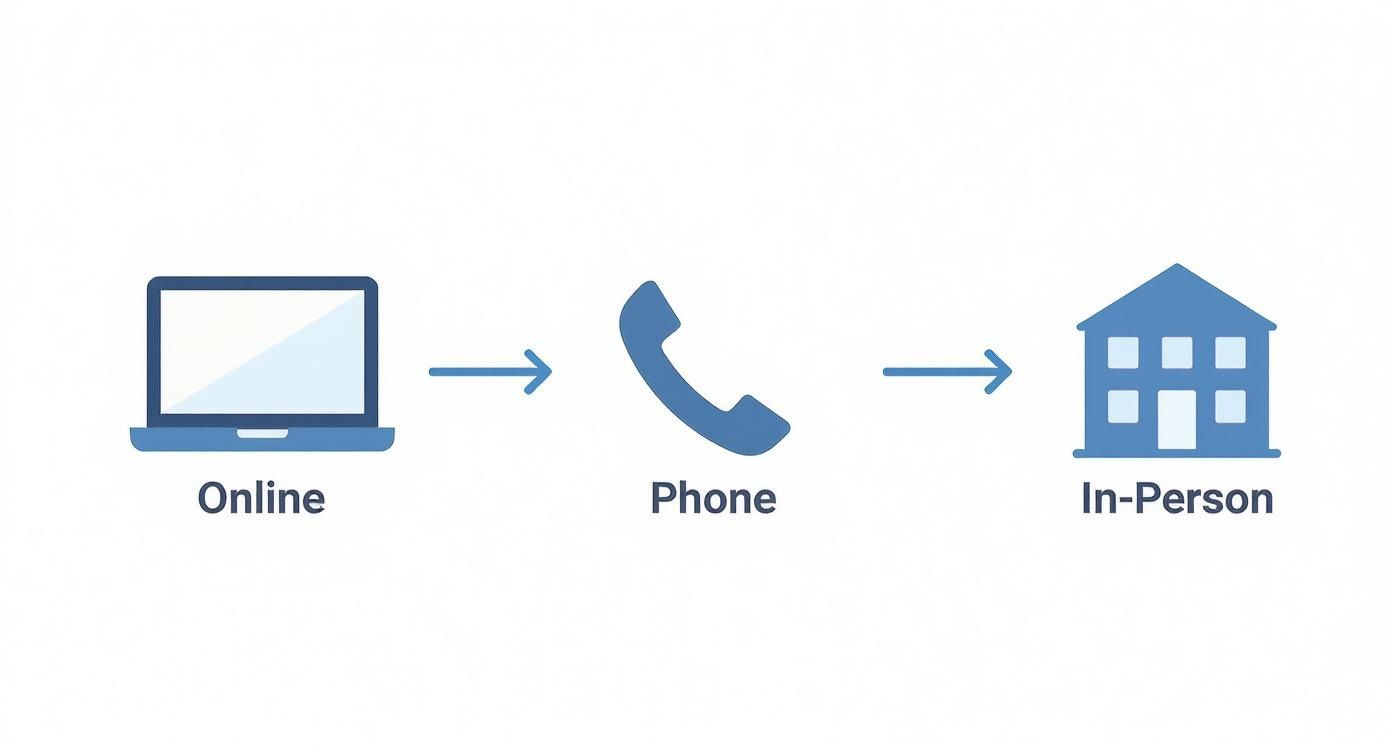
Whether you choose to file online, over the phone, or by visiting an office, your case ends up in the same hands for a thorough medical evaluation.
The Consultative Examination
Sometimes, your existing medical records just don't paint a clear enough picture for the DDS examiner. When that’s the case, they might schedule you for a Consultative Examination (CE).
Don't worry about the cost—the SSA pays for it. They'll send you to an independent doctor who contracts with the state. This isn't for treatment or a second opinion; this doctor's sole purpose is to gather specific information and report back to the SSA.
A CE is your chance to give the state fresh, focused medical evidence directly related to your claim. Be completely honest and detailed with the doctor about how your symptoms limit you. Their report carries a lot of weight.
A CE can feel a little nerve-wracking, but it’s a standard procedure. The exam will be tailored to your disability claim—it could be a physical exam, questions about your daily struggles, or simple memory tests.
Waiting for the Decision
Now comes the hard part: waiting. The initial decision process in Oregon can easily take several months, sometimes more than six. It’s critical to keep up with your medical treatments during this time and let the SSA know immediately if your condition changes.
Eventually, a decision letter will arrive in the mail.
- An Approval Letter means you've been found disabled. It will detail your monthly benefit amount, when payments start, and the official date your disability began.
- A Denial Letter will outline the specific reasons why the SSA believes you don't meet their criteria for disability.
I have to be upfront: most initial applications are denied. This isn't a reflection on you or the validity of your condition. It’s simply how the system works. Think of a denial not as an end, but as the first step toward the appeals process, which is where a surprising number of people ultimately get approved.
The financial lifeline these benefits provide is significant. Across Oregon, about 231,696 disabled workers receive benefits, with total payments topping $188 million each month. You can dig into more detailed Oregon disability benefit statistics to see the full scope of the program's impact.
Appealing a Denial and Finding Legal Help

Getting that denial letter in the mail is disheartening, to say the least. But I want to be very clear: this is not the end of the road. In fact, it's pretty common for initial disability applications to be denied.
The most important thing is to act fast. The Social Security Administration (SSA) gives you a strict 60-day deadline from the date on your letter to file an appeal. If you miss it, you have to start the entire, lengthy process all over again.
The first step in an appeal is called Reconsideration. Essentially, you're asking for a second opinion. Your file, along with any new medical evidence you've gathered, goes to a different examiner at Disability Determination Services (DDS) for a fresh look.
The Administrative Law Judge Hearing
If the Reconsideration is also a "no," your next move is to request a hearing with an Administrative Law Judge, or ALJ. This is, without a doubt, the most important stage of the appeals process. For the first time, you get to speak directly to the person who will actually decide your case.
This is where a huge number of Oregonians who were previously denied finally get approved.
The hearing itself is where the details really come into focus. The judge will have specific questions for you about your health, your past work, and exactly how your condition impacts your ability to function day-to-day. The SSA often brings in a vocational expert to suggest jobs they think you could still do, so be prepared for that.
Think of an ALJ hearing less like a dramatic courtroom trial and more like a very serious, structured interview. The judge's job is to see the whole person behind the paperwork. Your honest, detailed testimony is the most powerful tool you have.
Deciding to Hire a Disability Attorney
Trying to handle the appeals process, and especially an ALJ hearing, on your own is a tall order. It's often at this point that people realize they need professional legal help. A good Oregon disability attorney brings a lot more to the table than just form-filling.
A lawyer can make a real difference by:
- Gathering the Right Evidence: They know precisely what medical records and doctor's opinions an ALJ finds persuasive and can help get that crucial documentation.
- Prepping You for Questions: An attorney will walk you through the types of questions the judge will ask, helping you explain your limitations clearly and effectively.
- Challenging the Vocational Expert: This is a big one. A lawyer can cross-examine the expert and poke holes in their testimony, showing why the jobs they propose simply aren't realistic for someone with your condition.
I know the first question on everyone's mind is, "How can I afford this?" Thankfully, most disability lawyers work on a contingency fee basis. This means they don't get paid unless you win. Their fee is a percentage of your back pay, and if you don't get approved, you owe them nothing for their time. It's a no-risk way to get an expert in your corner.
For a more detailed look at the appeal itself, check out our guide on how to appeal a disability denial.
Answering Your Top Questions About Applying for Disability
When you're starting the disability application process in Oregon, you're bound to have questions. It's a confusing system, and knowing what to expect can make a world of difference. Let's walk through some of the most common things people ask.
How Long Will I Be Waiting for an Initial Decision?
This is probably the number one question, and the honest answer is: a while. It’s important to set your expectations realistically from the start.
After you've submitted everything, your file goes to a state agency called Disability Determination Services (DDS). From there, it's not unusual to wait six to eight months just for the initial decision. I know that's a long time, but it's the standard timeline for most applicants in Oregon.
Can I Still Work While My Application Is Pending?
You can, but you have to be very careful. The Social Security Administration (SSA) has a specific income threshold they call Substantial Gainful Activity (SGA).
For 2024, that magic number is $1,550 per month. If you earn more than that, the SSA will almost always deny your claim on the spot, assuming that if you can earn that much, you aren't disabled. It's a tough situation, trying to make ends meet without jeopardizing your entire case.
What if My Medical Records Are a Little Thin?
This is a really common worry. Maybe you haven't been able to see a specialist, or your doctor's notes just aren't very detailed. The good news is that the SSA won't just deny you outright.
If they feel they need more information, they'll schedule you for what's called a Consultative Examination (CE) with an independent doctor.
The SSA pays for this exam. Its goal is simple: to get a clear, objective look at your condition and how it limits you. It's absolutely crucial that you attend this appointment and are completely open about your symptoms and struggles.
Think of the CE as a chance to strengthen your case. A report from this exam can provide the specific medical evidence the SSA needs to approve your claim, especially if your own records don't paint the full picture.
Navigating these rules and waiting periods can be overwhelming. This is where having an expert in your corner can be invaluable. The attorneys at Bell Law have guided people across Oregon through this exact process and know how to build the strongest case possible. For a consultation, you can find us at https://www.belllawoffices.com.
Disclaimer: The information on this page is provided for general informational purposes only and is not legal advice. Reading this content does not create an attorney-client relationship. For advice about your specific situation, please contact a licensed attorney.