
Can you get ssi for depression and anxiety - A Fast Guide
"I was satisfied once John Bell took over my case."
"Communication was always timely."
Can you get ssi for depression and anxiety - A Fast Guide
Yes, you absolutely can get Supplemental Security Income (SSI) for depression and anxiety, but it’s never a given. The Social Security Administration (SSA) won't approve your claim based on a diagnosis alone. You have to prove that your conditions are severe enough to prevent you from working.
Yes, You Can Get SSI—But Proving Your Case Is Critical

Living with severe depression or anxiety can feel like you’re trying to run a marathon with weights tied to your ankles. Everyday tasks feel monumental, and the thought of holding down a full-time job seems completely out of reach. The good news is that the Social Security Administration recognizes this reality. Mental health conditions like yours are legitimate reasons to apply for disability benefits.
But here’s the hard part: securing those benefits is a serious challenge. It takes a lot more than a doctor’s note. You have to build a powerful, evidence-based case that leaves no room for doubt.
Think of your SSI application as the story of your struggle, backed by hard evidence. Your diagnosis is just the opening chapter. The real proof is in the details—how your symptoms directly impact your ability to function in a workplace. The SSA operates with a very specific, and very strict, definition of disability. Your job is to connect the dots and show them exactly how your daily life fits their rules.
Understanding the Two Pillars of an SSI Claim
For your claim to be successful, it must be built on two solid pillars: medical eligibility and non-medical eligibility. If either one is weak, the whole thing comes crashing down. You have to satisfy both, no exceptions.
- Medical Eligibility: This pillar is all about the severity of your depression and anxiety. You'll need to submit comprehensive medical records that clearly show your symptoms are so debilitating you cannot perform what the SSA calls "Substantial Gainful Activity" (SGA). That's just their term for a regular job.
- Non-Medical Eligibility: This part is purely about your finances. SSI is a needs-based program, meaning it's for people with very limited income and few resources. You have to prove your financial picture falls below a strict threshold set by the government.
The table below breaks down the key hurdles you'll face when trying to meet these requirements.
Key Hurdles in an SSI Claim for Depression and Anxiety
| Medical Evidence | The consistency and severity of symptoms documented by doctors, therapists, and psychiatrists. |
| Functional Limitations | Your documented inability to concentrate, interact with others, manage yourself, or adapt to change. |
| Treatment History | Proof that you've followed prescribed treatments and that they haven't been enough to restore your ability to work. |
| Income Limits | Your monthly earned and unearned income must fall below the strict SSI threshold. |
| Resource Limits | The total value of your countable assets (like cash and bank accounts) must be under the program limit. |
Ultimately, winning an SSI claim for mental health is about showing, not just telling.
The core challenge is this: You must prove that your depression and anxiety are not just difficult, but functionally disabling according to the SSA’s complex regulations.
This guide will walk you through exactly how to build that case. We’ll break down the SSA's medical rules, explain the kinds of evidence you need to collect, and map out the application and appeals process. By understanding the road ahead, you can prepare yourself to present the strongest claim possible.
How the SSA Defines Disability for Mental Health

If you want to get SSI for depression and anxiety, you first have to learn to think like the Social Security Administration. The SSA has its own very specific definition of "disability," and it's a lot more than just having a doctor's diagnosis. It’s never about what you have; it’s about what your conditions prevent you from doing.
Think of the SSA's official rulebook—what's known as the "Blue Book"—as a set of strict legal codes. Your medical records and other evidence have to prove, beyond a doubt, that your situation matches the criteria written in that book. A diagnosis, on its own, is like knowing the name of a law but having no evidence to show how it applies to you.
This is exactly where so many initial applications fall apart. People successfully prove they have a diagnosis but fail to provide enough evidence showing how severely it impacts their day-to-day life. The whole key is to connect your depression and anxiety to limitations so significant that you simply cannot hold down a job.
Decoding the Blue Book Listings for Mental Health
The SSA evaluates all mental health conditions under a specific section of the Blue Book: the 12.00 Mental Disorders listings. For depression and anxiety, two listings are front and center:
- Listing 12.04: Depressive, bipolar and related disorders.
- Listing 12.06: Anxiety and obsessive-compulsive disorders.
Meeting one of these listings is the most direct route to getting your claim approved. To do that, your evidence must satisfy both "Paragraph A" and "Paragraph B" criteria for your condition. Paragraph A outlines the specific medical symptoms you need to have, while Paragraph B gets into how those symptoms limit your functional abilities.
And make no mistake, the SSA recognizes these as legitimate, disabling conditions. In a single recent year, depressive and bipolar disorders were the basis for 24,864 disability awards. That shows these claims are approved when they are documented correctly.
The True Test: Functional Limitations
Proving your functional limitations—the Paragraph B criteria—is really the heart and soul of your claim. The SSA isn't just looking at a list of symptoms on paper; they need to understand how those symptoms actively disrupt your ability to function in four critical areas of life.
To be approved by meeting a listing, your medical evidence must prove you have an extreme limitation in one of these four areas, or a marked limitation in at least two of them.
This is the standard you have to meet. A "marked" limitation is one that seriously interferes with your ability to function independently and effectively. An "extreme" limitation means you are essentially unable to function in that area at all.
These four areas of mental functioning are the battleground where most claims are won or lost.
Understand, Remember, or Apply Information: This looks at your ability to learn new things, follow instructions, and use good judgment. A marked limitation here might be an inability to follow multi-step directions without someone constantly reminding you what to do next—a very common struggle with severe depression.
Interact with Others: This is all about your ability to get along with supervisors, coworkers, and the general public in a work setting. For someone with debilitating social anxiety, a marked limitation could mean being completely unable to handle constructive criticism or participate in a team meeting without triggering a panic attack.
Concentrate, Persist, or Maintain Pace: This measures your capacity to stay focused on a task and complete it in a reasonable amount of time. The "brain fog" that often comes with depression can make it impossible to concentrate for more than a few minutes at a time, which is a clear and significant limitation.
Adapt or Manage Oneself: This area examines your ability to regulate your emotions, control your behavior, and handle changes in a work environment. A marked limitation could be having frequent, uncontrollable emotional outbursts or being unable to cope with routine changes to a work schedule.
To build a strong case, you have to connect your specific symptoms to these functional areas. For more detailed insights, especially if your condition has overlapping symptoms, understanding anxiety symptoms can be a helpful resource. Getting a clear handle on your symptoms is the first step toward explaining them to the SSA.
And for a much deeper dive into how these principles work specifically for depression claims, check out our guide on securing Social Security disability benefits for depression.
Building an Unshakeable Medical Case
If you think of the Social Security Administration's (SSA) rulebook—the "Blue Book"—as the law, then your medical records are the evidence you bring to court. A diagnosis of depression or anxiety is really just the opening statement. To win your SSI case, you need to build a deep, consistent, and detailed medical history that paints a clear, undeniable picture of how your condition keeps you from working.
I often tell my clients to think of it like building a bridge. Each medical record, therapy note, and prescription history is a steel beam. If you only have a few scattered records, you've got a rickety rope bridge that’s not going to support the weight of your claim. But a long-term, well-documented history creates a solid structure that the SSA can't easily poke holes in.
This is precisely why consistent treatment is non-negotiable. Gaps in your treatment history, missed appointments, or a record of not following your doctor's advice are huge red flags for SSA examiners. They can look at those gaps and conclude that your condition isn't as severe as you say it is, and that’s a fast track to a denial letter.
Assembling Your Core Medical Evidence
Your main goal here is to gather every single piece of medical paperwork related to your mental health. This isn't just about proving you have a condition; it’s about documenting its severity, your consistent efforts to treat it, and the relentless impact it has on your ability to function.
You'll want to start by collecting these critical documents:
- Initial Diagnostic Evaluations: This is the formal report from a psychiatrist or psychologist where you were first diagnosed. It’s crucial because it often contains details from a Mental Status Examination (MSE), which is a key piece of objective evidence.
- Ongoing Therapy and Psychiatry Notes: These are the progress notes from every single appointment. They are the lifeblood of your claim, documenting your symptoms, the clinician's observations, how you're responding to treatment, and any medication side effects.
- Medication History: Make a comprehensive list of every medication you've tried. Be sure to include the dosage, how long you took it, whether it helped, and a detailed description of any side effects you experienced. This shows the SSA you’ve been proactive in trying to get better.
- Hospitalization Records: If your symptoms have ever been severe enough to require inpatient or emergency psychiatric care, these records are extremely powerful. They provide objective proof of the intensity of your condition.
To make sure the SSA examiner can easily follow your story, organizing medical records effectively is a vital first step. A messy, incomplete file is much easier to deny.
The Power of a Personal Symptom Journal
While your doctor’s clinical records are the official foundation of your case, they don't always tell the whole story. A doctor’s notes are often brief and stick to the medical facts. They rarely capture the full reality of your day-to-day struggle. This is where keeping a personal symptom journal can be a game-changer.
A journal translates your diagnosis from medical jargon into real-world limitations—which is what the SSA actually cares about. It connects the dots between a doctor's clinical notes and the functional problems that prevent you from holding a job.
Your journal is your opportunity to show, not just tell, the SSA how your depression and anxiety make work impossible. It fills in the gaps with the specific, concrete examples of your limitations that medical records often miss.
For instance, a psychiatrist’s note might simply state, "Patient reports difficulty with concentration." That's pretty generic. But your journal entry for that day could say, "Tried to read the instructions for the new coffee maker. I had to re-read the first sentence six times and still couldn't make sense of it. I got so frustrated I started crying and just gave up." That's the kind of powerful detail an examiner needs to see. For more insight on documenting anxiety specifically, check out our guide on how to get disability for an anxiety disorder.
What to Track in Your Symptom Journal
Your journal needs to be a consistent, honest log of your daily life. Don't exaggerate, but don't downplay your struggles, either. The key is to capture specific examples that tie back to the four main areas of mental functioning the SSA evaluates.
Try to track these details on a daily or weekly basis:
Symptom Severity: On a scale of 1-10, how bad was your anxiety or depression today? What did it feel like? (e.g., had a 20-minute panic attack, couldn't stop crying for an hour, felt too paranoid to leave my room).
Impact on Daily Tasks: Write down your struggles with basic activities. Did you forget to eat? Were you too exhausted to shower? Did the thought of doing laundry feel completely overwhelming?
Social Interactions: Note every time you had a hard time dealing with people. Did you ignore phone calls because you were too anxious to talk? Did a simple conversation with a cashier make you want to flee the store?
Concentration and Memory: Document specific examples of memory lapses or focus problems. Did you get lost driving to the grocery store you've been to a hundred times? Were you unable to follow the plot of a 30-minute TV show?
Medication Side Effects: Keep a running log of how your medications make you feel. Do they cause severe fatigue, dizziness, or "brain fog" that would make it impossible to stay on task at a job?
By meticulously building both your formal medical file and your personal symptom journal, you're doing more than just filling out forms. You're transforming your application from a simple claim into a compelling, undeniable story about why you need SSI benefits.
Navigating the SSI Application and Appeals Maze
Applying for SSI when you're dealing with depression and anxiety can feel like being thrown into a maze with no map. It’s a long road, the rules are confusing, and frankly, most people get denied the first time they apply. But here's the most important thing to know: a denial isn't the end. It's just the start of the real process.
Thinking about this journey from the beginning helps set realistic expectations and prepares you for what's ahead. It’s not a one-shot deal; it's a series of stages, and each one requires a different approach.
Your initial application is your first chance to lay out your case for the Social Security Administration (SSA). This is where you hand over all the medical evidence and personal notes you’ve been gathering. The tough reality, however, is that claims for mental health conditions face an especially steep climb at this stage.
Studies show that initial disability claims are denied at a rate of about 62%, but claims for mental and affective disorders like depression can see denial rates as high as 76%. This statistical reality means you should be prepared for an appeal.
That high denial rate doesn't mean your claim isn't valid. It often boils down to the massive number of applications the SSA has to get through and their very specific, sometimes rigid, methods for reviewing evidence. That’s exactly why the appeals process exists. We go into more detail about these challenges in our article on securing mental health disability benefits.
The Four Levels of the Appeals Process
If your first application is denied, don't lose hope. The system gives you several more chances to make your case, usually in front of someone who can dig deeper into your situation. There are four distinct levels to the appeals process.
Reconsideration: This is your first stop. You’re essentially just asking a different SSA reviewer—someone who didn’t touch your original application—to take a second look. It's a required step, but honestly, very few claims (less than 15%) get approved here.
Hearing by an Administrative Law Judge (ALJ): This is the most critical stage of the whole ordeal and your best shot at getting approved. You actually get to appear before a judge, either in person or by video, and explain in your own words how your depression and anxiety make it impossible to work. An attorney can present new evidence, make legal arguments, and even question expert witnesses for you.
Appeals Council Review: If the ALJ denies your claim, your next option is to ask the Appeals Council to review that decision. They aren't re-evaluating your disability; they're looking for legal or procedural mistakes the judge might have made. The Council can approve your claim, deny it, or send it back to the judge for another hearing.
Federal Court Review: The last resort is filing a lawsuit in U.S. District Court. This is a formal legal action where a federal judge examines your entire case file to see if the SSA followed its own rules and the law correctly.
The infographic below shows what it takes to build a solid case from day one.
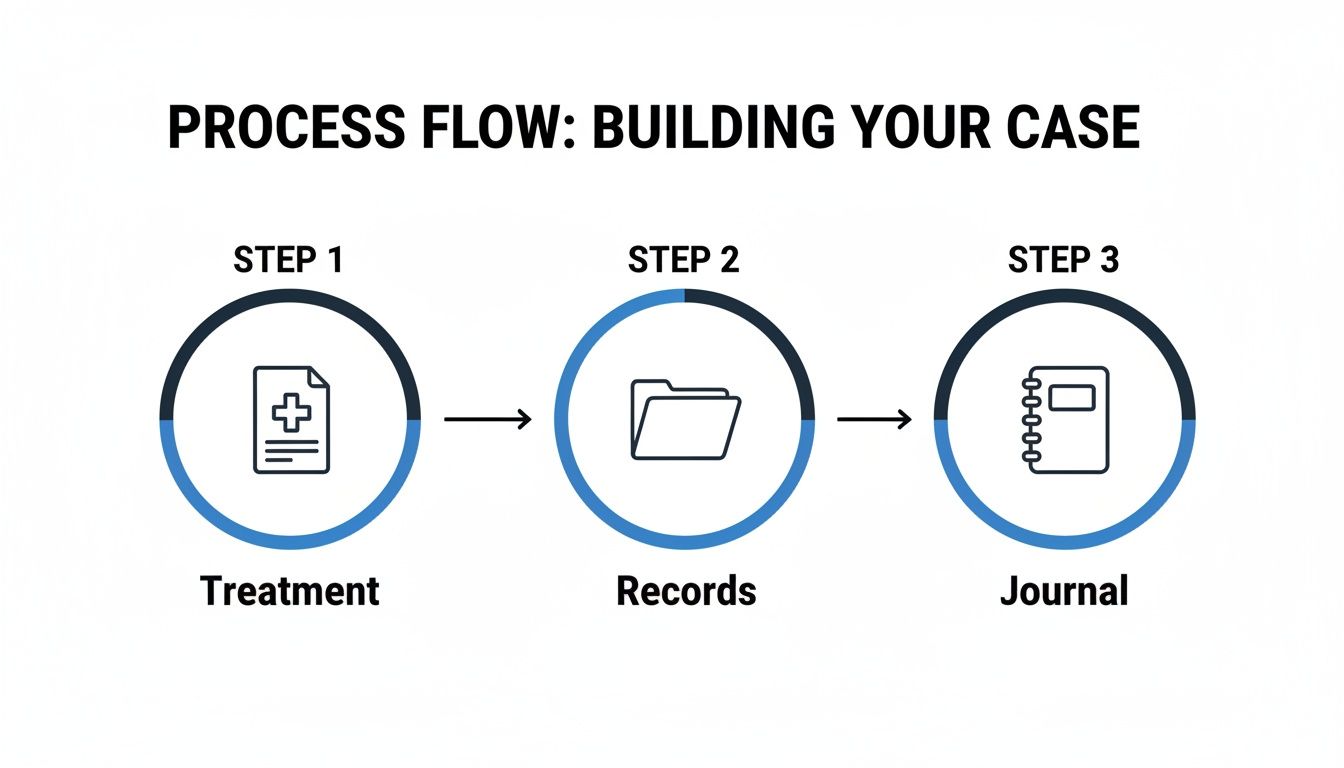
As you can see, consistent treatment, complete records, and your own personal journal are the foundation of a strong claim, no matter what stage you're at.
Why Perseverance Is Your Greatest Asset
Getting through this system takes an incredible amount of patience. The timelines are notoriously slow—you might wait months for an initial decision and often over a year just to get an ALJ hearing.
For someone already fighting depression and anxiety, the waiting game can feel unbearable. But knowing that these delays and initial rejections are just part of the standard process can give you the strength to keep going. The system is truly built for appeals, and the ALJ hearing is designed to be the place where you finally get a fair look. With the right preparation and support, you can find your way through the maze.
Why a Disability Attorney Can Be Your Best Ally
Trying to navigate the Social Security Administration (SSA) on your own while dealing with depression and anxiety is an uphill battle. The paperwork is overwhelming, the rules seem to change on a whim, and getting a denial can feel like a punch to the gut. Honestly, this is why bringing in a seasoned Social Security disability attorney is often the best move you can make.
Think of it this way: your attorney is a professional guide who has climbed this mountain a thousand times before. They know every treacherous step, every hidden crevasse, and the clearest path to the top. While you put your energy into managing your health, they put their expertise into building the strongest possible case for you.
And you're not alone in this fight. Psychiatric conditions are one of the most common reasons people need and receive disability benefits. Back in December 2021, around 3.3 million adults were receiving SSI benefits, and mental health disorders were a huge part of that picture. You can dig into some of the disability program statistics from Allsup to see the numbers. An attorney’s job is to make sure your application rises above the noise with solid, undeniable proof.
What an Attorney Actually Does for Your Claim
A good disability lawyer does so much more than fill out forms. They become your advocate and strategist, taking on the most complex and draining parts of the process so you can breathe a little easier. They translate your day-to-day struggles into the specific legal language the SSA requires.
Here’s a look at what they handle behind the scenes:
- Building Your Case: They'll comb through every page of your medical records, pinpointing the most crucial evidence. They then work directly with your doctors to get the detailed statements and forms needed to prove exactly how your condition limits you.
- Managing the SSA: Forget wrestling with the agency's bureaucracy. Your lawyer will handle all the phone calls, letters, and deadlines, ensuring everything is submitted correctly and on time.
- Preparing You for a Hearing: If your claim is initially denied, a hearing is the next step. Your attorney will walk you through what to expect, practice potential questions with you, and make sure you feel as comfortable as possible telling your story to the judge.
- Cross-Examining Experts: The SSA often brings in its own medical and vocational experts. Your lawyer will be there to question them and challenge any opinions that don't accurately reflect your limitations.
Having this kind of expert in your corner can be a game-changer, especially on days when you feel too worn out to fight for yourself.
Addressing the Biggest Concern: How Can I Afford It?
This is usually the first question on everyone's mind, and the answer is a huge relief. Social Security disability attorneys work on a contingency fee basis. It’s a system designed to give everyone a fair shot.
A contingency fee means you pay absolutely nothing upfront. Zero. Your attorney only gets paid if you win your case and are awarded past-due benefits. The fee is a set percentage of that back pay, and it's legally capped. Even better, the SSA pays them directly from that award, so you never get a bill.
This setup means you can get top-tier legal help without any financial risk. It also gives your attorney a powerful incentive to win. Professional legal help isn't a luxury in these cases; it's a vital tool that dramatically improves your odds of getting the benefits you need to live.
Common Questions About SSI for Mental Health
As you start to look into applying for SSI for depression and anxiety, you're bound to have questions. It’s a confusing process, and getting straight answers can feel like finding a needle in a haystack. Let's tackle some of the most common questions head-on to give you a clearer picture.
Think of this as your final check-in, where we'll firm up the key ideas and give you the practical details you need to move forward with a bit more confidence.
What Is the Main Difference Between SSI and SSDI?
This is probably the biggest point of confusion for most people. While both SSI and Social Security Disability Insurance (SSDI) fall under the Social Security Administration's umbrella and use the same medical standards, they are fundamentally different programs.
Here’s the simplest way to break it down:
- SSI (Supplemental Security Income) is a needs-based program. It’s designed for people with very low income and few resources, regardless of their work history.
- SSDI (Social Security Disability Insurance) is an insurance-based program. You pay into it through FICA taxes taken out of your paychecks. To qualify, you need to have worked long enough and recently enough to have earned sufficient "work credits."
You don't get to choose which one to apply for. Your financial situation and work history will determine which program, if any, you're eligible for.
Can I Work Part-Time While Applying for SSI?
This is a really tricky one. The short answer is yes, but you have to be incredibly careful. The SSA has a very strict income limit called Substantial Gainful Activity (SGA). If you earn over that specific monthly amount—which changes nearly every year—the SSA will almost certainly deny your claim right away. To them, it's black-and-white proof you can work.
Even if you stay under the SGA limit, part-time work can still muddy the waters. A claims examiner might look at your file and think, "Well, if they can work 10 hours a week, maybe they could handle 15 or 20." It can unintentionally poke holes in your argument that your depression and anxiety are truly disabling. It's a fine line to walk.
How Does My Age Impact My Disability Claim?
Your age is a huge factor in how Social Security decides your case, especially if they agree you can no longer do your past jobs. The system is built to be more lenient for older claimants.
For people aged 50 and older, and especially those over 55, the SSA uses a special set of guidelines known as the "grid rules." These rules look at your age, education, and work experience to determine if it's realistic to expect you to learn and adapt to a new line of work.
On the flip side, it's generally much tougher for younger applicants (under 50) to get approved. The SSA tends to assume that someone younger can more easily be retrained for a different, less demanding job. This means that if you're younger, the medical proof showing you can't handle even simple, unskilled work has to be airtight.
How Important Is My Doctor's Opinion?
Your doctor’s opinion is absolutely critical, but only if it's presented the right way. A simple note that just says you're "disabled" or "can't work" is practically useless to the SSA. They see that as your doctor trying to make the final decision, which is their job, not your doctor's.
What makes a doctor's opinion powerful is detail. It needs to be specific and directly supported by what’s in your medical records. The most compelling statements come from a specialist who has treated you for a long time, like your psychiatrist, who can:
- Pinpoint your exact functional limitations (e.g., "Patient is unable to maintain concentration for more than 15-minute intervals due to intrusive thoughts.").
- Tie those limitations directly to your diagnosed conditions.
- Back it all up with concrete examples from your treatment history.
A well-written, well-supported statement from your doctor can be the single most persuasive piece of evidence you have.
Trying to win an SSI claim for depression and anxiety can feel like an uphill battle, but you don't have to fight it alone. The experienced team at Bell Law is here to guide Oregon residents through every confusing step of the Social Security Disability process. If you're feeling overwhelmed, let our attorneys provide the skilled support you deserve. Contact us today for a consultation.
Disclaimer: The information on this page is provided for general informational purposes only and is not legal advice. Reading this content does not create an attorney-client relationship. For advice about your specific situation, please contact a licensed attorney.