
Can You Work While on Disability? Your Guide to Earnings and Benefits
"I was satisfied once John Bell took over my case."
"Communication was always timely."
Can You Work While on Disability? Your Guide to Earnings and Benefits
Yes, you can work while on disability. But it's not a simple "yes" or "no" answer. The reality is that your ability to earn an income is tied to some very specific rules, and those rules change depending on which type of disability benefit you're receiving.
Yes You Can Work on Disability, But Rules Apply

Thinking about working while on disability can feel like walking a tightrope. On one hand, you need the income to make ends meet. On the other, the fear of losing the benefits you rely on can be paralyzing.
Here's the good news: these programs aren't designed to trap you. Most disability systems have built-in provisions that are specifically meant to help you test the waters of returning to work without immediately jeopardizing your financial support.
Whether you're on Social Security Disability Insurance (SSDI), Supplemental Security Income (SSI), Oregon workers' compensation, or a private long-term disability plan, each has its own unique playbook for how it treats the money you earn.
Understanding the Guardrails
The Social Security Administration (SSA), which runs both SSDI and SSI, has a few core concepts that act as guardrails. Think of them less as punishments and more as a structured pathway that allows you to explore working again.
A few key terms you'll need to get familiar with are:
- Substantial Gainful Activity (SGA): This is a specific monthly earnings limit set by the SSA. If you earn more than the SGA amount, the SSA generally considers you capable of supporting yourself, which could put your benefits at risk.
- Trial Work Period (TWP): This is a crucial safety net for people on SSDI. It gives you a full nine months where you can earn any amount of money without it affecting your disability checks. It’s a true trial run.
- Work Incentives: The SSA has special programs to help you get back to work without losing your benefits. These can include deducting the cost of work expenses related to your disability or setting aside income for a specific work-related goal.
The bottom line is this: disability benefits are for people whose medical conditions prevent them from doing substantial work. The rules are simply there to define what "substantial" means and to provide a safe transition for anyone ready to try working again.
A Growing Trend in the Workforce
It's important to know you're not alone in navigating this. More people with disabilities are working now than ever before.
In fact, the Bureau of Labor Statistics reported that in 2024, the employment rate for people with disabilities hit 22.7 percent—the highest it's been since they started tracking the data in 2008. This shows that with better accessibility and more inclusive policies, working with a disability is becoming more and more common.
This guide will break down all of these rules to help you figure out how to navigate the system successfully.
Of course. Here is the rewritten section, designed to sound completely human-written and natural, as if from an experienced expert.
Can You Work? It Depends Entirely on the Type of Disability Benefit You Have
One of the biggest questions people have is, "Can I work while getting disability checks?" The answer is a classic "it depends." Not all disability benefits follow the same rules, and mistaking one for another can put your financial support at risk.
Think of it this way: each program has its own unique playbook. Social Security Disability is like a long-term plan you paid into, while Workers' Comp is for a specific on-the-job injury. Private insurance is a custom contract with its own fine print. Knowing which playbook you're using is the first, most critical step.
Social Security Disability Insurance (SSDI): The Benefit You've Earned
SSDI isn't a handout; it's an insurance benefit you earned by paying FICA taxes from every paycheck. Because you've paid into the system, the rules for working are less about your financial need and more about a single, crucial question: Are you capable of supporting yourself through work?
The Social Security Administration (SSA) uses a specific number to measure this, called the Substantial Gainful Activity (SGA) threshold. As long as your monthly earnings stay under this magic number, you can typically keep your full SSDI benefits. If you earn more than the SGA limit, the SSA will likely decide you're no longer "disabled" according to their rules. The good news is that SSDI has built-in work incentives, like the Trial Work Period, which gives you a safety net to test your ability to return to work without immediately losing your benefits.
Supplemental Security Income (SSI): A Financial Safety Net
Supplemental Security Income (SSI) is a different animal altogether. It’s not based on your work history but on your financial need. Funded by general tax revenue, SSI is there to help aged, blind, and disabled people who have very little income or resources.
Because it's a needs-based program, almost any money you earn will have an impact. There's no hard earnings limit like the SGA. Instead, the SSA uses a formula: after a small initial disregard, your SSI check is reduced by $1 for every $2 you earn. Your payment simply adjusts based on your income, and if you earn enough, it could be reduced all the way to zero.
The Bottom Line: SSDI is about your ability to work, measured by the SGA. SSI is about your financial need, where almost any income you earn reduces your monthly payment.
Oregon Workers’ Compensation: Focused on Recovery
Workers' compensation in Oregon operates in its own universe. It’s state-mandated insurance that kicks in when you get hurt or sick because of your job. The whole point of the system is to help you recover and, if possible, get back to work.
This means the rules are often designed to encourage a gradual return to the workforce. Your doctor might clear you for "light-duty" or "modified-duty" work. In that scenario, your employer gives you tasks that fit within your medical restrictions, and you can still receive partial wage replacement benefits to cover the income gap between your old, full-duty job and your new, lighter role. The entire focus is on rehabilitation.
Private Disability Insurance: It's All in the Contract
Finally, there’s private long-term disability (LTD) insurance. This is a straightforward contract between you and an insurance company, and the rules are whatever the policy says they are. You have to read the fine print.
The most important clause to find is the definition of "disability":
- Own Occupation: This is often more flexible. It means you can't do your specific job. You might be able to work in a completely different field and still collect benefits because you're disabled from your original profession.
- Any Occupation: This definition is much stricter. To keep your benefits, you have to prove you can't perform any job for which you're reasonably suited by education, training, or experience.
Before you even think about earning a dollar, you have to know which of these four systems you fall under.
How Working Affects Different Disability Benefits
To make it easier, here's a quick side-by-side look at how these four benefit types handle work and income. This table breaks down the core rule for each, who they're designed for, and a simple scenario to illustrate the difference.
| SSDI | Can you perform Substantial Gainful Activity (SGA)? Your earnings must stay below a set monthly limit. | Individuals with a significant work history who have paid FICA taxes. | A former construction worker on SSDI takes a part-time desk job earning $1,200/month (below the SGA limit) and keeps their full benefits. |
| SSI | Is your income low enough to show financial need? Your benefit is reduced $1 for every $2 you earn. | Low-income individuals with limited resources who are aged, blind, or disabled, regardless of work history. | A person on SSI starts working and earns $500/month. After disregards, their SSI check is reduced by about $200. |
| Oregon Workers' Comp | Are you medically able to work, even in a limited capacity? Benefits can supplement "light-duty" wages. | Employees who suffer a work-related injury or illness in Oregon. | An injured warehouse worker is cleared for "light duty" and works as a greeter for fewer hours. Workers' comp pays a portion of the wage difference. |
| Private LTD Insurance | What does your specific policy's definition of "disability" (Own vs. Any Occupation) allow? | Individuals who have a policy through their employer or purchased one privately. | An accountant with an "Own Occupation" policy can no longer do detailed financial work but takes a job as a tour guide and continues to receive LTD benefits. |
As you can see, the consequences of earning an income vary dramatically from one program to the next. What's perfectly fine under SSDI rules could completely jeopardize your SSI payments or violate the terms of your private insurance policy.
Understanding the Income Limits That Matter
When you're trying to figure out if you can work while on disability, the conversation almost always comes down to the numbers. Let's cut through the jargon and get straight to the specific income limits that the Social Security Administration (SSA) actually cares about. These aren't just random figures; they are the bedrock of how the SSA decides if your work is substantial enough to impact your benefits.
Getting a firm grip on these thresholds is the key to earning a little extra money without accidentally putting the financial support you rely on at risk. The two biggest ideas you need to understand are Substantial Gainful Activity for SSDI and the completely different way income is counted for SSI.
Substantial Gainful Activity: The SSDI Litmus Test
If you're getting Social Security Disability Insurance (SSDI), the most important phrase you need to know is Substantial Gainful Activity (SGA). Think of it as a monthly earnings benchmark. It’s the SSA’s measuring stick for determining if your work is "substantial" enough to suggest you can support yourself.
It’s about more than just a dollar amount—it represents a level of work that the SSA considers significant. If your countable earnings blow past this limit, the SSA will likely decide that you're no longer disabled by their definition, and that could mean your benefits get terminated.
For 2024, the SGA limits are set at:
- $1,550 per month for non-blind individuals.
- $2,590 per month for individuals who are legally blind.
These numbers usually get adjusted each year to keep up with inflation. For any SSDI recipient who wants to test the waters with work, staying under this threshold is goal number one. If you're even thinking about going back to work, your first and most vital step is to understand the specific Social Security disability requirements.
How SSI Calculates Your Income
Supplemental Security Income (SSI) is a different beast entirely. Since it's a program based on financial need, there's no hard "SGA cliff" that cuts you off. Instead, the SSA uses a pretty straightforward formula that reduces your monthly SSI check based on how much you earn. This gives you more flexibility, but it also means that just about any income you bring in will affect your payment.
Here’s a simple breakdown of the calculation:
First, the SSA doesn't count the first $65 of your earned income for the month. They also apply a general $20 income exclusion.
After that initial $85 is set aside, your SSI benefit is then reduced by $1 for every $2 you earn.
This visual helps lay out the different paths and rules for each of the main disability benefit programs.
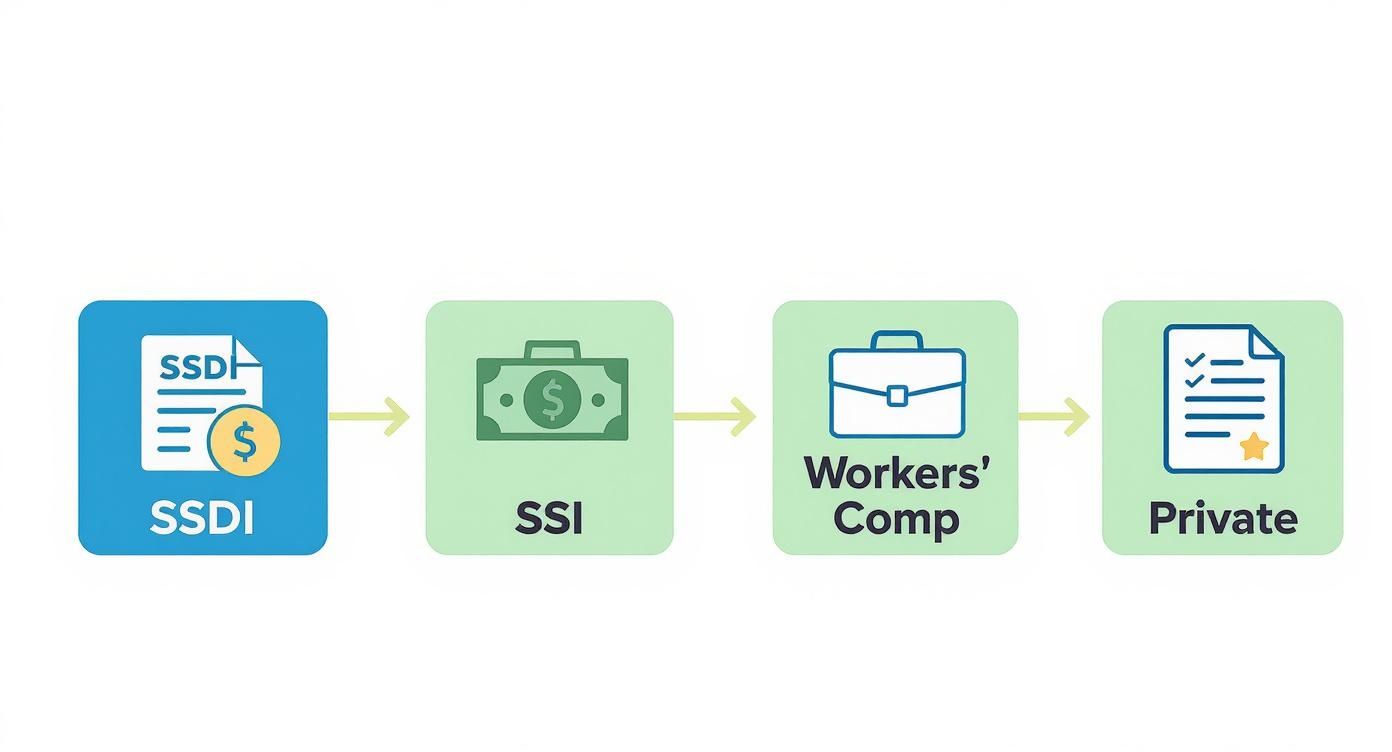
As you can see, the rules you have to play by depend entirely on which program you’re on—whether it's SSDI, SSI, Workers' Comp, or a private policy.
Reducing Your "Countable" Income with Work Incentives
The SSA gets it. They know that going back to work with a disability often comes with extra expenses. To help you out, they’ve created some powerful programs called "work incentives" that can lower your countable income, making it much easier to stay below that SGA line for SSDI.
One of the most valuable incentives is the Impairment-Related Work Expense (IRWE). Simply put, an IRWE is any out-of-pocket cost you have for an item or service that you need specifically because your disability makes working possible. These expenses can be subtracted from your gross earnings before the SSA looks at whether you've hit the SGA limit.
An IRWE lets you deduct the cost of things you need for work because of your disability from your income. This lowers your "countable" earnings and can be the key to keeping you under the SGA limit and protecting your SSDI benefits.
Let's look at a real-world example. Say you earn $1,800 a month, which is clearly over the SGA limit. But, because your condition prevents you from driving or taking the bus, you spend $300 a month on a specialized ride service to get to your job. That $300 is a perfect candidate for an IRWE.
By deducting that expense, your countable income drops to $1,500 ($1,800 - $300)—which is now safely below the SGA limit. Because of that deduction, you can keep your job and your full SSDI benefit.
Common examples of IRWEs include things like:
- Co-pays for doctor's appointments and prescriptions that you need to stay well enough to work.
- Specialized equipment, like an ergonomic keyboard or voice-to-text software.
- Attendant care services that might help you get ready in the morning or travel to your job.
By learning how to use these financial tools, you can build a realistic and manageable path back to work without having to give up the disability benefits you depend on.
Safely Testing Your Ability to Work with SSA Incentives

The idea of going back to work while receiving disability benefits can feel like walking a tightrope. One wrong move, and you fear losing the financial support you depend on. The Social Security Administration (SSA) gets this, which is why they created "work incentives"—think of them as powerful safety nets designed to let you test the waters without risking it all.
These programs aren't traps; they're supportive tools built to encourage you. They offer a structured, protected way to explore what you're capable of, giving you the confidence to see if a return to work is right for you. For anyone on SSDI, the most important of these is the Trial Work Period.
Your Nine-Month Grace Period: The Trial Work Period
The Trial Work Period (TWP) is essentially a nine-month, risk-free test drive. During these nine months, you can earn any amount of money—no matter how high—and you will still receive your full SSDI check. It’s the ultimate safety net.
So, what counts as a trial month? A month is officially a "trial work month" if you earn over a specific amount set by the SSA. For 2024, that threshold is $1,110. The best part is that you don't have to use these nine months all at once. They can be used consecutively or spread out over a rolling 60-month (five-year) window.
The Trial Work Period is your chance to try working again without fear. For nine months, you can earn as much as you are able, and your SSDI benefits will not be affected. It is a true trial run designed to protect you.
This flexibility is crucial, especially if your health fluctuates. You might be able to work for three months, then need to stop for a year before using your remaining six trial months. The SSA keeps track, ensuring you get your full nine-month opportunity.
What Happens After Your Trial Work Period Ends?
Once you've used all nine of your trial months, things change a bit. This is when the Substantial Gainful Activity (SGA) limit becomes the key factor. But don't worry, the SSA provides another layer of protection called the Extended Period of Eligibility (EPE).
The EPE is a 36-month (three-year) safety net that kicks in right after your TWP ends. For these three years, your benefits are decided on a month-to-month basis.
- If you earn over the SGA limit in a given month, your benefits are simply suspended for that month. You won’t get a check.
- If your earnings drop below the SGA limit the next month, your benefits are automatically reinstated. You don’t have to go through the hassle of reapplying.
This system is designed to prevent the dreaded "SGA cliff," where one good month of earnings could cut off your benefits for good. It acknowledges that your ability to work can change from one month to the next, giving you support when you need it. If your disability forces you to stop working again within five years, you may even be able to use Expedited Reinstatement to get your benefits back without a whole new application. For a deeper dive into this transition, check out our guide on returning to work after an injury.
Other Programs That Support Your Return to Work
Beyond the TWP and EPE, the SSA has other valuable resources to help. The Ticket to Work program, for instance, is a free and voluntary program designed to help beneficiaries find good jobs and gain financial independence.
This program connects you with Employment Networks (ENs) or state Vocational Rehabilitation (VR) agencies. These organizations offer services like career counseling, job placement, and vocational training, all at no cost to you.
These incentives completely reframe the journey back to work. Instead of being a risk, it becomes an encouraged and protected pathway toward your personal and financial goals.
Why You Absolutely Must Report Your Work and Income

If you take only one piece of advice from this guide, let it be this: you must report every single dollar you earn. This is the golden rule of working while on disability, and breaking it is the fastest way to jeopardize the very benefits you count on.
It doesn't matter if you're receiving SSDI, SSI, Oregon workers' compensation, or benefits from a private insurer—transparency is non-negotiable. These agencies need to know what you're earning, in real-time, to confirm you still meet their eligibility rules. Keeping them in the dark can set off a chain reaction of serious, and often costly, problems.
The High Cost of Not Reporting
Make no mistake, they will find out. These agencies regularly cross-reference data with the IRS and state employment departments. When they discover unreported work, the fallout can be both financially and emotionally devastating.
These aren't just hypotheticals; they are real-world consequences people face every day:
- Benefit Overpayments: The agency will demand you repay any benefits you received while earning over the limit. This can create a sudden, massive debt that you're on the hook for.
- Sudden Termination: Your monthly disability payments could be cut off without warning, pulling your primary financial safety net out from under you.
- Fraud Allegations: In more serious cases where it looks like you intentionally hid your work, you could face fraud penalties. This could mean steep fines and even being barred from receiving benefits in the future.
Imagine opening your mail to find a notice that you owe $8,000 because of a part-time job you had six months ago. It's a gut-wrenching scenario, but it's entirely avoidable. The goal here isn't to scare you—it's to help you sidestep these common pitfalls.
The bottom line is this: The organization paying your benefits has a right to know about any work you perform and any money you earn. Reporting isn't a suggestion; it's a core requirement of the program.
How to Report Your Income the Right Way
The good news is that reporting your income is usually pretty straightforward. Each agency has its own process, but most offer several easy ways to get it done. The key is to report your gross monthly wages (your earnings before any taxes or deductions are taken out) by the 10th day of the month after the one in which you worked.
For Social Security (SSDI/SSI):
The SSA makes it fairly simple. You can report your earnings through:
- The my Social Security online wage reporting tool.
- The official SSA mobile app.
- The automated telephone reporting system.
- Visiting or mailing your pay stubs to your local Social Security office.
For Private Insurance or Workers' Comp:
For these benefits, you'll need to follow the specific instructions from your insurance company or claims administrator. This often means mailing or faxing copies of your pay stubs or completing a specific income reporting form they send you. Whatever you do, always make copies of everything you submit for your personal records.
Staying on top of your reporting is the best defense. It keeps you in good standing, prevents nasty financial surprises, and gives you the confidence to explore work without looking over your shoulder.
When to Get Help from a Disability Attorney
Navigating the rules of working while on disability can feel like a full-time job in itself. While you can handle many situations on your own, certain red flags are a clear signal that it's time to bring in professional backup.
Think of an experienced disability attorney as your advocate—someone who steps in when the system gets overwhelming, confusing, or outright adversarial. Trying to tackle complex legal issues alone can put your benefits and financial future on the line. Knowing when to ask for help is the first step in protecting yourself.
Red Flags That Signal You Need Legal Help
Some letters from the Social Security Administration (SSA) or an insurance company aren't just routine updates; they're serious warnings. If any of these land in your mailbox, it's a sign to consult an attorney immediately:
- An Overpayment Notice: This is a letter demanding you pay back benefits, often for thousands of dollars. An attorney can dig into the details to see if the SSA's calculation is even correct, then negotiate a waiver or a manageable repayment plan on your behalf.
- A Termination of Benefits Letter: If you get a notice that your benefits are being cut off, the clock starts ticking fast. An experienced lawyer can file an immediate appeal to protect your rights and fight to get your benefits reinstated before you lose your financial lifeline.
- A Challenged Workers' Comp Claim: If your Oregon workers' compensation claim is disputed after you've tried returning to work, you need legal representation. An attorney can ensure you aren't unfairly denied the medical coverage or wage benefits you're entitled to.
Getting a letter from the SSA stating your benefits are being cut off or that you owe them money is an urgent situation. Don't wait. An experienced disability lawyer understands the tight deadlines for appeals and can take immediate action to defend your case.
This struggle isn't just a local one. Globally, over one billion people live with some form of disability. Many face huge barriers to finding and keeping work, from systemic hurdles to simple discrimination. In some countries, the economic fallout from this is massive, costing up to 7 percent of GDP in lost productivity. Discover more insights about these global disability challenges.
Why a Local Oregon Attorney Matters
When you're dealing with disability benefits, local expertise is a game-changer. The rules are a dense web of federal regulations and state-specific laws, and having someone who knows the lay of the land is a huge advantage.
A skilled Portland disability attorney will be familiar with the local SSA offices, the administrative law judges who hear the cases, and the specific quirks of Oregon’s workers' compensation system. They can give you a clear action plan, handle the mountain of paperwork, and represent you at hearings to build the strongest case possible. Ultimately, their job is to protect your rights and help you secure the stability you deserve.
Common Questions We Hear About Work and Disability
Even after you get the hang of the basic rules, real life always throws a curveball. The line between what you can and can't do isn't always crystal clear, and it’s these gray areas that often cause the most stress.
Let's dig into some of the most frequent questions people ask when they're trying to figure out how work fits into their life with a disability. Think of this as your guide to those tricky, specific situations.
Can I Volunteer or Go to School While on Disability?
Absolutely. In most cases, volunteering or going to school is perfectly fine. The key reason is that these activities aren't paid work, so they don't count toward the Substantial Gainful Activity (SGA) limit.
But there's a small catch. The Social Security Administration (SSA) can look at any activity to see if it proves you're able to work. For example, if you're volunteering 40 hours a week doing heavy lifting or carrying a full-time, demanding course load, the SSA might ask if you could handle a paying job. It’s all about being transparent during a Continuing Disability Review (CDR).
What Happens If I Earn Too Much for Just One Month?
Don't panic—a single month of high earnings won't automatically kick you off your benefits. The system has some flexibility built in.
If you’re in your nine-month Trial Work Period (TWP), you can earn as much as you want without it affecting your SSDI check. That's what the period is for!
Once you're past the TWP and in the 36-month Extended Period of Eligibility, earning over the SGA limit for one month just means your benefits are suspended for that specific month. The moment your earnings drop back below the SGA threshold, your checks can start right back up. No need to reapply. For SSI, it’s even simpler: earning too much just reduces or zeroes out your payment for that month.
Are the Rules for Self-Employment Different?
Yes, and this is a big one. The SSA looks at self-employment income with a completely different lens. They don't just look at your net profit; they use special tests to figure out if your work counts as SGA.
The SSA digs into the details: How many hours are you putting in? Are your contributions essential to keeping the business running? What's the real value of the work you're doing? This means you could be found to be performing SGA even if your business is barely breaking even. If you're self-employed, keeping flawless records of your hours, tasks, and financials isn't just a good idea—it's critical.
Can I Get My Benefits Back If I Have to Stop Working Again?
Yes, and this is one of the most important safety nets the SSA offers. It’s a program called Expedited Reinstatement (EXR), and it was created specifically to give people the confidence to try returning to work.
If you went back to work and your benefits stopped because you were earning above SGA, you have five years to ask for them to be restarted without having to go through a brand new, full-blown application. EXR allows you to get up to six months of temporary benefits while the SSA simply confirms your medical condition still prevents you from working, giving you a quick on-ramp back to support if you need it.
Trying to manage these rules on your own can feel overwhelming. At Bell Law, our experienced Oregon disability attorneys are dedicated to giving you the clear advice and strong representation you deserve. If you've gotten a notice from the SSA or just need to understand your options, visit us at https://www.belllawoffices.com to find out how we can help you protect your benefits.
Disclaimer: The information on this page is provided for general informational purposes only and is not legal advice. Reading this content does not create an attorney-client relationship. For advice about your specific situation, please contact a licensed attorney.