
Deposition Preparation Prepare: Your Essential Guide to Confident Testimony
"I was satisfied once John Bell took over my case."
"Communication was always timely."
Deposition Preparation Prepare: Your Essential Guide to Confident Testimony
Think of your deposition as a formal interview, but one where every word you say is under oath and on the record. It's a question-and-answer session that happens outside of the courtroom, usually in a conference room, with the opposing attorney asking the questions.
Your answers are critical. They create an official record that can dramatically influence settlement talks and even the outcome if your case goes to trial. This isn't something to wing; preparing thoroughly with your attorney is the absolute key to telling your story clearly and consistently.
What a Deposition Is and Why It Matters
A deposition is a standard part of the "discovery" phase of any lawsuit. This is the period where both sides exchange information to understand the facts of the case. Don't picture a dramatic courtroom scene from a TV show. There's no judge or jury, just a few key people in a room or on a video call.
The opposing lawyer's goal is straightforward: they want to hear your side of the story, get a feel for you as a witness, and lock in your testimony. A court reporter will be there to type down everything that's said, word-for-word. That transcript becomes a permanent, official record.
Who Is in the Room
Knowing who to expect can take a lot of the anxiety out of the process. When you sit down for your deposition, here’s who you’ll typically see:
- Your Attorney: They are your advocate, sitting right beside you. Their job is to protect you, object to any unfair questions, and give you guidance when you need it.
- The Opposing Attorney: This is the lawyer for the defendant or their insurance company. They will be the one asking you questions to build their case.
- The Court Reporter: This is a neutral professional who records the entire session on a special machine to create the official transcript. They'll be the one to have you swear an oath to tell the truth at the very beginning.
- You (The Deponent): As the person giving testimony, your only job is to answer questions truthfully and to the best of your ability.
Why Your Testimony Carries So Much Weight
It’s a common mistake to think of a deposition as just a minor hurdle. In reality, it's one of the most critical moments in your entire personal injury or workers' compensation claim.
A deposition isn’t just a conversation; it’s sworn testimony that creates a permanent record. Any contradictions between what you say in your deposition and what you say later can seriously harm your credibility and sink your case.
Let's take a real-world example. Imagine a client in an Eugene car accident case. In her deposition, she says she felt okay right after the wreck and only started feeling neck pain the next morning. But later, she tells her doctor she had immediate, sharp pain at the scene. You can bet the insurance company's lawyer will use that deposition transcript to argue that her injuries aren't as severe as she's claiming. That one inconsistency can cost her thousands.
On the flip side, strong and consistent testimony builds a rock-solid foundation for your claim. When your answers are honest, clear, and match the other evidence, it shows the other side you are a believable witness with a strong case. This is often what pushes them toward offering a fair settlement, because they know you'll be compelling if the case ever gets in front of a jury.
The time you spend getting ready is an investment in your case's success. To dive deeper, you can prepare for a deposition with our complete guide. Proper preparation is the best way to make sure your story gets told accurately, setting you up for the best possible outcome.
Your Pre-Deposition Preparation Game Plan
Getting ready for a deposition isn't something you do the night before. Think of it as a process that starts weeks ahead, giving you plenty of time to get comfortable with the facts of your case. Breaking it down into smaller, manageable steps is the secret to walking in with confidence.
Your first job, and the most important one, is to become the undisputed expert on your own story. While your attorney is there to guide you, you lived it. Start by going through all the important documents. The goal isn't to memorize every word, but to refresh your memory so the details are sharp and easy to recall.
Reviewing the Core Case Documents
In a deposition, consistency is everything. The other side’s attorney will have every document you’ve ever submitted, and you can bet they'll be listening for any little contradiction between what you've said before and what you say now.
Make sure you get familiar with these key pieces of evidence:
- Your Answers to Interrogatories: These are the written questions you answered under oath early in your case. Your testimony in the deposition needs to match these answers.
- Accident or Incident Reports: Go back and read the official report. It will help lock in the sequence of events and remind you of what was officially documented right after it happened.
- Medical Records: This is a huge one. You need to be crystal clear on the timeline of your medical care, the names of the doctors you saw, what they diagnosed, and the treatments they prescribed. If you need help gathering these, our guide on how to get your medical records is a great place to start.
Creating Your Personal Timeline
After a traumatic injury, memories can get fuzzy. The stress and passage of time can blur the details. A great way to fight this is by creating a simple, chronological timeline of everything that happened. Start with the day of the incident and work your way forward.
Jot down key dates: doctor's appointments, physical therapy sessions, days you missed from work, and how your symptoms changed over time. This little exercise acts as a mental roadmap, making it much easier to recall specific details when you're on the spot. To really sharpen your ability to think on your feet, running through some critical thinking exercises can be incredibly helpful.
The point of all this prep isn't to invent a perfect story. It’s to help you accurately and confidently tell your story. When you combine total honesty with solid preparation, you're in a very strong position.
It also helps to understand who will be in the room (or on the video call) with you.
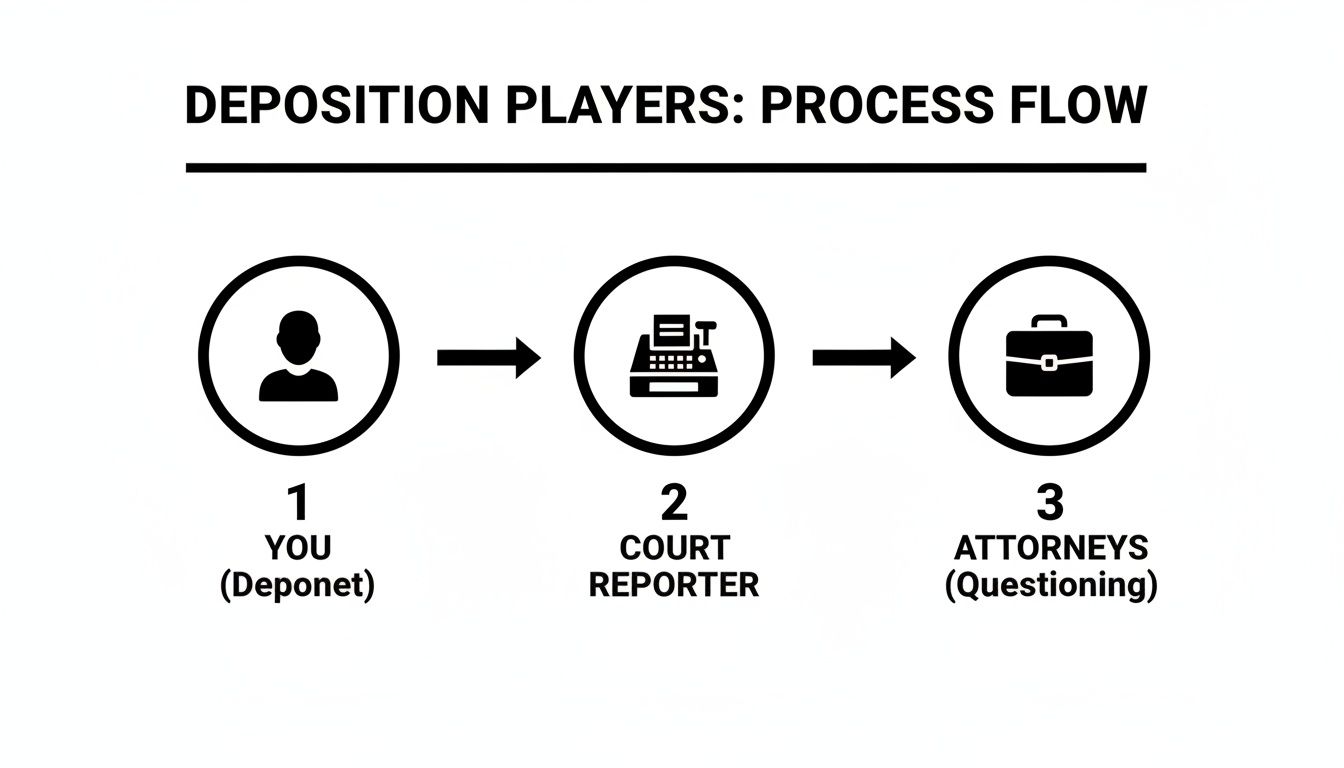
Seeing this laid out can remind you that while you are the focus, it's a structured, professional process, and you have experts on your side.
Handling the Logistics Like a Pro
Knowing the facts of your case is half the battle; the other half is managing the day-of logistics to keep your stress levels down. The legal world has gone high-tech, especially when it comes to things like depositions. The global court reporting market alone is valued at USD 1.50 billion in 2024, which shows how central this technology has become.
Run through this final checklist to make sure you're ready:
- Confirm Date, Time, and Location: Double-check everything on the official deposition notice. If it's a remote deposition, make sure you have the right link and any login details you'll need.
- Test Your Tech: For a video deposition, do a trial run with your camera, microphone, and whatever platform you're using (like Zoom). A technical glitch is the last thing you want to deal with.
- Plan Your Attire: Dress as if you were going to court. Clean, professional, and conservative clothing helps convey that you're taking this seriously.
- Prioritize Rest: You'd be surprised how much a good night's sleep can help. Being rested keeps you sharp, helps your memory, and makes it easier to stay calm. Your prep should be done by the night before—don't cram.
Navigating Your Deposition on the Day

The day is finally here. After all the hard work reviewing your case and meeting with your attorney, it’s time to put that preparation into action. All that effort has built a solid foundation. Now, it's all about executing with confidence.
Remember, how you handle yourself during the deposition is just as crucial as the facts you provide. The setting can feel a little stiff, maybe even intimidating, but you are the one in control of your answers. The other attorney asks the questions, but you dictate the flow of information by being careful, thoughtful, and precise.
The Golden Rules of Testifying
I always tell my clients to think of testifying as a skill governed by a few simple, powerful rules. If you can internalize these, you’ll sidestep the common traps that can weaken a case.
- Listen to the Entire Question. It's so tempting to jump in with an answer, especially when you think you know where the lawyer is going. Don't do it. Let them finish their entire question before you even start to think about your response. Answering too early often means you're answering a question they didn't actually ask, which just creates a mess.
- Pause Before You Speak. This is probably the single most important piece of advice I can give. After you hear the question, take a deliberate pause. Just a second or two. This tiny gap does three critical things: it lets you fully process the question, it gives you a moment to frame your answer, and it gives your own attorney a window to object if the question is out of line.
- Answer Only the Question Asked. Your job isn't to be a storyteller. It's to answer questions directly. If the lawyer asks, "Did you see Dr. Jones on Tuesday?" the right answer is a simple "Yes," "No," or "I don't recall." It is not "Yes, I did, and then on Wednesday I went to physical therapy and my back was really hurting..." Volunteering extra details just opens up new, unnecessary lines of questioning.
The Strategic Power of "I Don't Know"
So many people feel like they have to have an answer for everything. That's a dangerous mindset in a deposition. Guessing or speculating is one of the worst things you can do. Your testimony has to be based on what you actually, personally remember.
It is absolutely okay—and often the smartest move—to say "I don't know" or "I don't remember." These are complete, honest answers. A deposition is a test of your memory, not your IQ. If you don't recall a specific detail, just say so. A guess that turns out to be wrong can be used to attack your credibility later on.
A truthful "I don't recall" is infinitely stronger than a guessed answer that turns out to be wrong. Honesty about the limits of your memory protects your credibility, which is your most valuable asset.
Along the same lines, if you're handed a document like a medical record or an accident report, take the time to read it carefully before you answer anything about it. Don't let the attorney rush you. Make sure you understand what you're looking at.
Staying Calm and Composed
Let's be honest: depositions are designed to be stressful. The other side’s attorney might use tactics like long, awkward silences, rapid-fire questions, or a skeptical tone to rattle you. Your preparation is the best shield you have against this.
Here are a few simple tricks for keeping your cool:
- Keep Water Handy: Taking a slow sip of water is a perfect, natural way to buy yourself a moment to think and calm your nerves.
- Just Breathe: When you feel the pressure building, consciously take a slow, deep breath before answering. It's a simple trick, but it really works to reset your focus.
- Ask for Clarification: Never, ever answer a question you don't completely understand. It’s well within your rights to say, "I'm sorry, I don't understand the question. Could you rephrase it?"
- Take a Break: Depositions can be draining. If you feel tired, overwhelmed, or just need a moment to talk with your attorney, you can ask for a short break. We expect it, and we'll back you up.
Don't forget that your body language speaks volumes, too. Sit up straight, maintain a professional demeanor, and make eye contact when it feels natural. Your posture should reflect the seriousness of the situation and your confidence in your story. Sticking to these guidelines will help ensure your testimony is as strong as your case deserves to be.
Getting Ready for the Most Common Deposition Questions
Knowing what’s coming is the best way to calm your nerves before a deposition. Let’s pull back the curtain and look at the opposing counsel's playbook. While every case has its own unique details, the questions in personal injury, workers' comp, and Social Security Disability depositions tend to follow a very predictable script.
Remember, the attorney asking the questions isn't just looking for facts. They are sizing you up as a witness, searching for any little inconsistency they can use later. Your job, with our help, is to give truthful, direct answers without accidentally handing them the ammunition to hurt your case.
Here's a breakdown of the main types of questions you should be ready for.
Questions About Your Background
The deposition will almost always start with some simple, get-to-know-you questions. This is partly a warm-up, but it's also where the attorney establishes a baseline for your testimony and makes sure your story is consistent.
They’ll ask for basic identifying information:
- Your full name and any other names you've used.
- Your current address and how long you've lived there.
- Your date of birth.
- A brief overview of your education and work history.
These seem harmless, but they are absolutely checking this information against other documents you’ve provided. Just answer them simply and factually. There’s no need to volunteer stories about old jobs or the town you grew up in.
Questions About the Incident Itself
This is the main event. The opposing attorney wants to hear—from you, in your own words—exactly what happened. They will dig into the specific moments leading up to, during, and immediately after the event that caused your injury.
Expect to hear things like:
- "Walk me through what you were doing right before the accident."
- "Where were you coming from, and where were you headed?"
- "What do you remember seeing, hearing, or feeling at the moment of impact?"
- "What’s the first thing you did in the minutes right after it happened?"
The absolute key here is to stick to what you personally know and remember. Never guess or speculate about what the other person might have been thinking or doing. If you only remember bits and pieces, that’s fine—state those clearly. For anything you can't recall, "I don't remember" is a complete, powerful, and perfectly acceptable answer.
Questions About Your Medical History
Get ready for this part, as it's often the longest and most detailed section of the deposition. The other side has a right to understand your full medical picture, both before and after the incident. They are hunting for a pre-existing condition they can blame for your current problems.
Be prepared for a deep dive into your medical past. The defense attorney’s goal is often to find a prior injury or old condition they can point to as the real source of your pain, which is a classic tactic to devalue your claim.
You will absolutely be asked about:
- The Injuries From This Incident: Be ready to talk about every part of your body that was hurt. Describe the pain specifically—is it sharp, dull, aching, throbbing? How has it changed since the accident?
- Your Medical Treatment: Make a list of the doctors, hospitals, and physical therapists you've seen for this injury. You’ll need to recall the timeline of your treatment, what you were diagnosed with, and the medical advice you received.
- Your Prior Medical History: You must be honest about past injuries, surgeries, or chronic health issues, even if you think they’re completely unrelated. If you try to hide a previous back injury and they find it in your records (and they will), your credibility is shot.
For those pursuing Social Security claims, this process can feel a lot like a formal hearing. Getting familiar with that format can be a big help, so checking out our Social Security Disability hearing tips can give you some great insight into this style of questioning.
Questions About How Your Life Has Changed
This is where you get to explain the real-world impact of your injury. In legal terms, we call this "damages." The attorney will want to know exactly how your day-to-day life is different now.
- Work & Money: How much work have you missed? Did your boss have to change your duties? Have you lost income, overtime, or benefits?
- Daily Life: What can't you do anymore? Think about everything from mowing the lawn and carrying groceries to your favorite hobbies or playing with your kids.
- Pain & Suffering: How does this injury affect your mood? Your sleep? Your relationships with your spouse, family, and friends?
When you answer these questions, be honest and specific, but don't be overly dramatic. It’s far more powerful to say, "I can no longer lift my grandchild" or "I have to stop and rest after walking for only five minutes" than to just say, "I'm in pain all the time." Real-life examples paint a clear and compelling picture of what you've lost.
Mastering the Technology for Modern Depositions

Depositions aren't always held in stuffy conference rooms anymore. We're seeing more and more of them happen remotely, over video. This shift offers a lot of convenience, but it also adds a few new items to your preparation checklist.
This isn't just a fleeting trend. A 2023 survey found that over 70% of law firms are now conducting at least some of their depositions remotely. The market for these services is huge—around USD 3 billion in 2024—which tells you that knowing your way around a video call is now a crucial part of being a prepared witness.
Your Pre-Flight Tech Check
Nothing derails a deposition faster than a technical glitch. It’s distracting for everyone and can make you seem unprepared, even when you’re not. The goal is to make the technology invisible so your story can be the focus. Before the big day, run through this simple tech audit.
- A Solid Internet Connection: A choppy, freezing video feed can really break the rhythm of the questioning. I always recommend running a speed test before you start. If you can, plug directly into your router with an Ethernet cable instead of relying on Wi-Fi—it's far more stable.
- Clear Camera and Microphone: Most built-in laptop cameras are good enough, but do a quick check to make sure the picture is clear. More importantly, test your microphone. You want your voice to come through without any annoying static or echo.
- The Right Setting: Find a quiet, private room where you know you won’t be interrupted. Your background should be simple and free of distractions. A plain wall is perfect.
- Good Lighting: This is a surprisingly important detail. Make sure the main light source (like a lamp or window) is in front of you, not behind. If the light is behind you, you’ll look like a silhouette, and it’s important for everyone to see your expressions.
On-Camera Etiquette for Depositions
Being professional on camera is a skill. My best advice? Think of the camera lens as the eyes of the person questioning you.
When you speak, try to look directly into the camera. It’s the virtual equivalent of making eye contact, and it projects confidence and sincerity. It's also critical to eliminate potential interruptions. Put your phone on silent, close out of any extra tabs on your computer, and let your family or roommates know that you absolutely cannot be disturbed for a few hours.
A remote deposition is just as official and legally binding as an in-person one. Treat the screen with the same respect you would a physical conference room table. Your preparation and demeanor should reflect the seriousness of the proceedings.
How Remote Logistics Work
All the key players are still present in a virtual deposition, just in a different format. The court reporter will be on the call, creating a word-for-word record of everything said. For legal teams, getting a perfect transcription with timecode is essential for referencing specific moments later on.
Exhibits, like medical records or photos of an accident, are handled digitally. The other attorney will share the document on the screen for everyone to view. When this happens, don't rush. Take your time to read and understand it completely before you answer any questions, just as you would if they handed you a piece of paper. Getting comfortable with these modern logistics ensures technology works for you, not against you, allowing your testimony to come through clearly and effectively.
Answering Your Lingering Questions About Depositions
It's completely normal to feel a bit jittery before a deposition, even after you’ve prepared. For most people, this is brand-new territory. Having your questions answered ahead of time can make a world of difference, helping you walk in with confidence.
Let's clear up some of the most common questions my clients ask. Think of this as our final huddle before the main event.
How Long Am I Going to Be in There?
This is usually the first thing people want to know, and the honest answer is: it depends. A deposition for a straightforward car wreck case might be wrapped up in just a couple of hours. But if your case involves a complex medical history or multiple incidents, it could take up most of the day.
Oregon law has a rule of thumb: a deposition is generally limited to one day of seven hours. While it's possible to go longer if everyone agrees, that's the standard cap. I'll be able to give you a much more accurate time estimate once we've reviewed the specifics of your case together.
What Should I Wear?
How you dress matters. It sends a non-verbal message that you are taking this process seriously. My best advice is simple: dress like you’re going to court. Business casual is the perfect target to aim for.
A few practical tips:
- Keep it professional: Think slacks, a modest dress, or a collared shirt.
- Ditch the casual stuff: Leave the graphic t-shirts, shorts, jeans, and flip-flops at home.
- Comfort is key: You'll be sitting for a while, so make sure your clothes are clean, fit well, and won't be a distraction.
- Go easy on accessories: Loud or flashy jewelry can draw focus away from your testimony.
You want the opposing attorney focused on your words, not your wardrobe. When you're unsure, it’s always better to be a little overdressed than too casual.
Do I Have to Answer Every Question?
For the most part, yes. But there's one critical exception: you don't answer if I tell you not to. This is a big one.
I'll be right there with you, listening to every single question. If the other lawyer asks something they shouldn't, I will object. You might hear me say something like, "Objection, form," which is my signal to you to go ahead and answer the question anyway. The objection just preserves the issue for the record.
But if you hear me say, "I'm instructing my client not to answer," that is your cue to stop talking. Full stop. This is a rare move, typically reserved for questions that invade privileged communications, like what you and I have discussed privately.
Follow my lead. I'm there to protect you. If I instruct you not to answer, trust my judgment and stay silent.
Okay, It's Over. What Happens Now?
Once the last question is asked, your work for the day is done. But the process continues behind the scenes. The court reporter will take the official recording and turn it into a written document called a transcript.
You’ll get a chance to read through this transcript to check for any mistakes. This is your testimony, so it's incredibly important to make sure it was written down correctly. Once you've reviewed it and signed off, that transcript becomes official evidence.
After that, both legal teams will use what you said to re-evaluate the case. A strong, clear deposition can be a powerful tool that often pushes the other side toward a fair settlement. If the case does go to trial, they can use that same transcript to ask you questions on the witness stand, which is why consistency is so important.
Navigating a personal injury or disability claim is tough, and a deposition is a major milestone. You don't have to go through it alone. If you're facing a deposition in Oregon, the team at Bell Law is here to make sure your story is heard and your rights are protected every step of the way. Contact us for a consultation to see how we can help. Learn more at https://www.belllawoffices.com.
Disclaimer: The information on this page is provided for general informational purposes only and is not legal advice. Reading this content does not create an attorney-client relationship. For advice about your specific situation, please contact a licensed attorney.