
A Guide to Disability Benefits for Bipolar Disorder in Oregon
"I was satisfied once John Bell took over my case."
"Communication was always timely."
A Guide to Disability Benefits for Bipolar Disorder in Oregon
Living with bipolar disorder can be challenging. When the symptoms make it difficult to maintain employment, the financial stress can feel overwhelming. Federal programs like Social Security Disability Insurance (SSDI) and Supplemental Security Income (SSI) exist to provide a safety net.
If your condition is severe enough to keep you out of the workforce, you might be eligible for this support.
Understanding Disability Benefits for Bipolar Disorder
Applying for disability benefits while managing bipolar disorder can seem like a monumental task. This guide is intended to break down the process. We'll walk through how the government generally looks at these claims, focusing on a key concept: eligibility is often based on how your symptoms affect your ability to work, not just the diagnosis itself.
Think of it less like a simple yes-or-no question and more like painting a detailed picture of your daily reality for the Social Security Administration (SSA). The goal is to connect the information in your medical records to an inability to perform work-related tasks on a consistent basis.
The Focus on Functional Limitations
Simply having a bipolar disorder diagnosis may not be enough to qualify for benefits. The evaluation often focuses on how the condition prevents you from performing what the SSA calls "Substantial Gainful Activity" (SGA)—which generally refers to a level of work activity and earnings.
This means providing documentation of significant limitations in areas like:
- Concentration and Pace: The ability to stay focused and maintain a steady work speed, which can be affected by mood swings.
- Interacting with Others: How you handle interactions with supervisors, coworkers, or the public. Symptoms like irritability or social withdrawal can be barriers.
- Adapting to Change: The capacity to manage normal workplace stress or handle unexpected changes to a routine.
- Managing Oneself: How symptoms interfere with things like personal hygiene, punctuality, or reliability.
These are core areas the SSA may scrutinize. For a broader look at how this applies to other conditions, you can review general information on mental health disability benefits.
The process of seeking disability benefits often involves showing the impact of a condition. It is helpful to draw a clear line from a diagnosis to an inability to sustain full-time work.
Navigating a Complex Process
Bipolar disorder is more common than many realize—it's estimated that about 4.4% of U.S. adults will experience it at some point. The World Health Organization also provides data on its global prevalence.
Despite this, obtaining disability for a mental health condition can be challenging. Initial approval rates for disability claims can be low, which means many people may need to go through an appeals process. With hearing wait times that can be lengthy, submitting a strong, well-documented application from the start is important.
How the SSA Evaluates Bipolar Disorder Claims
When you file for disability benefits because of bipolar disorder, the Social Security Administration (SSA) does more than just confirm your diagnosis. They have a specific, step-by-step process for evaluating how a condition impacts an individual's ability to hold a job. The focus is less about the label and more about the real-world limitations a person faces every day.
Think of it like building a case. A diagnosis is the foundation, but the supporting evidence is everything that shows how your symptoms—the mood swings, the cognitive fog, the unpredictable energy levels—may prevent you from functioning in a work environment.
The SSA manages two different disability programs: Social Security Disability Insurance (SSDI) and Supplemental Security Income (SSI). While they serve different populations, the medical rules for determining disability are nearly identical for both.
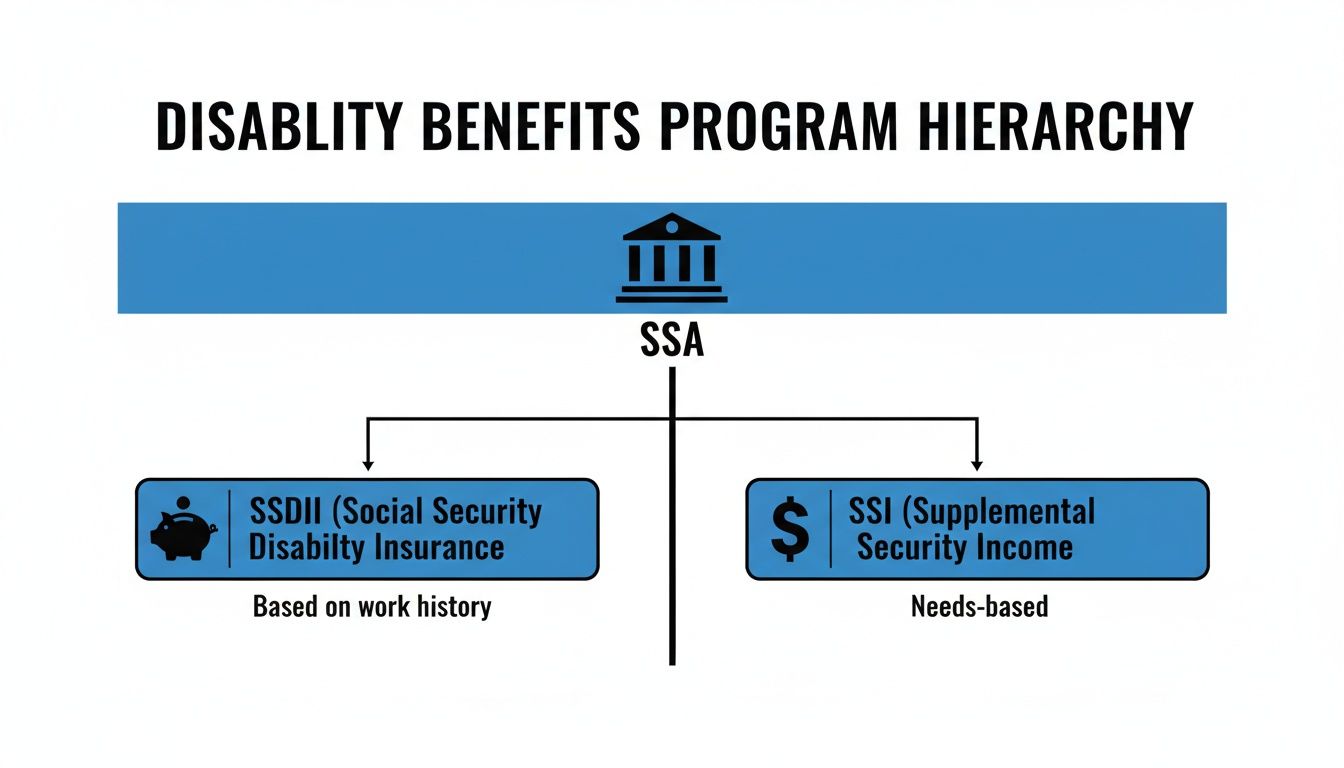
This diagram shows how the SSA is the umbrella agency for both programs. SSDI is based on work history and the payroll taxes paid, while SSI is a needs-based program for those with limited income and resources.
Decoding the Blue Book Listing for Bipolar Disorder
The SSA uses a guide called the "Blue Book" to define what it considers a disabling medical condition. Bipolar disorder falls under Listing 12.04 for Depressive, bipolar and related disorders. To be found disabled by "meeting the listing," an applicant's medical records must satisfy a very specific set of requirements, which are broken down into Parts A, B, and C.
- Part A relates to the diagnosis. The records must show you have bipolar disorder, supported by documentation of at least three classic symptoms. This could include things like pressured speech, flight of ideas, inflated self-esteem, being easily distracted, or engaging in high-risk behaviors.
- Part B addresses functional limitations. This is where the SSA looks at how the disorder affects an individual's ability to function. A person must have an "extreme" limitation in one area of mental functioning, or "marked" limitations in two of them.
- Part C offers another way to qualify. This path is for people who have a long, documented history of a "serious and persistent" bipolar disorder—meaning it has lasted for at least two years and they have difficulty functioning outside of a highly supportive living situation.
The Blue Book isn't just a symptom checklist. It's the framework the SSA uses to measure the severity and persistence of a condition and how it concretely impacts an individual's ability to show up and do a job.
The Four Areas of Mental Functioning
Part B is central to many bipolar disorder claims, and it comes down to those four areas of mental functioning. The SSA uses these to gauge how symptoms interfere with the basic mental abilities needed for most jobs.
The SSA’s "Blue Book" can be dense, so here’s a table that breaks down what those four functional areas mean in day-to-day terms.
| Understand, Remember, or Apply Information | Can you follow instructions, learn new tasks, solve problems, or use good judgment? Cognitive fog from depression or racing thoughts from mania can make this difficult. |
| Interact with Others | How well can you get along with supervisors, coworkers, and the public? Symptoms like paranoia, irritability, or severe social withdrawal can break down workplace relationships. |
| Concentrate, Persist, or Maintain Pace | This is about staying on task and keeping up with the speed of the job. Distractibility and massive swings in energy are hallmark symptoms that can directly harm productivity. |
| Adapt or Manage Oneself | Can you regulate your emotions, control your behavior, and handle workplace stress? This includes basic things like maintaining personal hygiene, being punctual, and coping with pressure. |
Demonstrating "marked" limitations in at least two of these areas is a common path for a claim to be approved under the listing.
What if You Don't Exactly Meet a Listing?
It is common for an application to not neatly fit into the rigid boxes of Listing 12.04. But that doesn’t mean the claim is over.
If an applicant doesn't meet the listing, the SSA moves on to the next step: a "medical-vocational allowance." This is a more personalized look at the situation.
An examiner will determine your Residual Functional Capacity (RFC), which is a detailed assessment of what you can still do despite your condition's limitations. They then combine the RFC with your age, education, and work history to see if there are any other jobs in the national economy you could realistically perform. If they conclude that your limitations prevent you from doing your past work and any other kind of work, your claim may be approved.
Building a Strong Case with Medical Evidence
Think of your disability claim for bipolar disorder as the story you're telling the Social Security Administration (SSA). In this story, your medical records are the most crucial chapters. The strength of an application can hinge on how detailed, consistent, and convincing that evidence is. It's the documentation that shows an examiner the reality of your life with bipolar disorder, far beyond a simple diagnosis on a form.
Consistent treatment is very important. When you regularly see professionals like psychiatrists, therapists, and psychologists, you’re creating a timeline of your condition. This ongoing record can clearly show the cyclical nature of the illness—the manic highs and the debilitating lows—and how it impacts you month after month, year after year.
Key Types of Medical Documentation
To paint the full picture of your limitations for the SSA, certain documents are more powerful than others. The goal is to provide a complete file that leaves very little room for doubt or guesswork.
A medical file could include:
- Detailed Psychiatric Evaluations: These are the formal reports from your psychiatrist or psychologist that officially diagnose your condition and lay out your symptoms in clinical terms.
- Therapy Session Notes: Your therapist's notes can offer a window into your day-to-day struggles. They may capture your emotional state and the functional challenges you face in real-time.
- Medication Records: A complete history of your prescribed medications—including what you've tried, the dosages, whether they worked, and any side effects—demonstrates you're actively following treatment.
- Hospitalization Records: If your condition has ever required psychiatric hospitalization, those records are critical. They can offer undeniable proof of the severity of your episodes.
Pulling all of this together can feel like a mountain of a task. For a deeper dive into this process, check out our guide on how to handle a Social Security medical records request.
The Importance of Detailed and Consistent Records
The SSA isn't just looking for a diagnosis; they are looking for objective medical evidence that supports what you say about your symptoms and limitations. If your records are vague or have big gaps, it could weaken an application.
This is why open communication with your doctors can be so important. It is helpful for them to understand that their notes about your difficulties with concentration, memory, social interaction, and simply managing daily tasks can directly support your claim. Following proper medical record documentation guidelines helps ensure these details are captured correctly.
The SSA also recognizes the seriousness of bipolar disorder. Broader health statistics—like its association with a shortened life expectancy and a significant lifetime suicide risk—add important context that underlines the severity of the condition and can be a factor in their evaluation.
Perspectives from Outside the Doctor's Office
Medical records are the foundation, but they don't always show what your life looks like day-to-day. That's where information from non-medical sources can be useful. These personal accounts can add real-world color and context to a claim.
Statements from people who know you well can help bridge the gap between a clinical diagnosis and your everyday reality. They can describe how your condition affects you in ways a medical chart simply can't.
These third-party statements can be very persuasive and can come from a few different places:
- Family Members: They can talk about your struggles with personal care, keeping up with chores, or social withdrawal.
- Friends: They might be able to describe changes in your personality or your inability to participate in activities you once enjoyed.
- Former Employers or Coworkers: Their firsthand accounts of problems at work—like absenteeism, conflicts with others, or missed deadlines—are powerful evidence.
When you combine these personal stories with solid medical evidence, you create a complete and compelling narrative that shows the SSA exactly how bipolar disorder may prevent you from holding a job.
The Social Security Disability Claims Process Step by Step
Filing for disability can feel like navigating a maze in the dark. The process for getting disability benefits for bipolar disorder is a multi-step journey, and knowing what to expect can make it feel less overwhelming.
From the moment an application is submitted, a specific sequence of events kicks off. It can be a long road, but being prepared for each stage can make a difference.
The Initial Application and Review
This is where it all starts. After you apply, the Social Security Administration (SSA) does a check to see if you meet the basic, non-medical rules for either SSDI or SSI. This means looking at things like your recent work history or your current income and assets. Our detailed guide on how to apply for SSDI benefits breaks down this first step even further.
If you clear that first hurdle, your file gets sent to a state agency. In Oregon, that agency is called Disability Determination Services (DDS). An examiner at DDS is tasked with the medical review. They will review all your evidence—records from your psychiatrist, notes from your therapist, reports from any hospital stays—to decide if your bipolar disorder is severe enough to prevent you from working.
This is the stage where many claims get a decision. A significant number of applications are denied at this stage, sometimes because the medical evidence was not considered strong enough.
A denial at the initial stage is not the end of the road. It is a common part of the process for many applicants, and there is a clear path forward through the appeals system.
The Reconsideration Stage
If your application is denied, the first appeal is called reconsideration. You generally have 60 days from receiving your denial letter to request this, and it is critical not to miss that deadline.
Think of reconsideration as a second look. Your file goes back to DDS, but this time it’s reviewed by a different examiner and medical consultant who had nothing to do with the first decision. This is an opportunity to add any new medical evidence you’ve gathered since you first applied. While it’s a necessary step, many claims that were denied the first time are denied again at reconsideration.
The Hearing Before an Administrative Law Judge
For many people, this is a very important part of the process. If you’re denied after reconsideration, you can ask for a hearing with an Administrative Law Judge (ALJ). Just like before, you have 60 days from the reconsideration denial to make this request.
The hearing is an opportunity to present your case in person to the decision-maker. Here’s what generally happens:
Your Testimony: The judge will ask you direct questions about your bipolar disorder. You'll talk about your symptoms, your good days and bad days, your treatment, and how it all impacts your ability to function and hold a job.
Expert Witnesses: The SSA usually brings in a vocational expert (VE). This person’s job is to listen to the evidence and give an opinion on what jobs, if any, a person with your specific limitations could do.
Making Your Case: You or your representative will have the opportunity to argue why the medical evidence shows you cannot sustain competitive work.
This is a formal hearing. For the first time, a judge gets to see you as a person, not just a file of paperwork. That human element can be powerful, and preparation is very important.
Demonstrating Your Work-Related Limitations
Being approved for disability benefits for bipolar disorder isn't just about having the diagnosis on paper. The Social Security Administration (SSA) is focused on one central question: how, exactly, do your symptoms prevent you from holding down a full-time job?
This is a critical shift in thinking for many applicants. A claim is not built on the name of a condition. It's built on the specific, real-world ways it limits an individual, day in and day out. You have to draw a clear, undeniable line from your medical chart to your inability to be a reliable employee.

From Daily Life Struggles to Work-Related Evidence
Some of the strongest evidence for a case can start at home. The SSA will look closely at what they call your Activities of Daily Living (ADLs) to get a baseline for how you function. These are the basic, everyday tasks many people take for granted.
The logic is that if bipolar symptoms make it a struggle to manage one's own life, it’s likely they'll interfere with the greater demands of a job.
Think about how your condition shows up in these areas:
- Personal Care: During a depressive episode, do you find it difficult to get out of bed, shower, or get dressed?
- Household Tasks: Is keeping up with cooking, cleaning, or even grocery shopping a constant battle?
- Managing Your Life: Do manic episodes lead to impulsive spending? Does depression make it hard to focus long enough to pay bills on time?
- Social Life: Do you find yourself isolating from friends and family? Do your symptoms cause friction in your relationships?
Documenting these struggles helps paint a realistic picture for the SSA. Someone who cannot consistently manage their own home may face significant challenges in a structured work environment.
Connecting Bipolar Symptoms to Specific Job Functions
The next step is to translate those daily struggles into the language the SSA understands—the language of work capacity. Bipolar disorder can be tricky because its symptoms are often polar opposites. It is helpful to show how the high-energy impulsivity of mania and the crushing lethargy of depression can both make sustained employment difficult.
An effective claim demonstrates how both sides of the coin may prevent someone from being a steady employee.
The heart of a disability claim is showing that the unpredictable, cyclical nature of bipolar disorder makes it difficult to be a reliable worker. The SSA needs to understand why you may not be able to work 8 hours a day, 5 days a week, week after week.
Let’s break down how to connect specific symptoms to real-world job limitations.
How Manic or Hypomanic Symptoms Affect Work
During a manic or hypomanic phase, you might feel energetic, but these symptoms can be at odds with a professional setting.
- Inflated Self-Esteem & Poor Judgment: This can lead to conflicts with a boss or coworkers, or making reckless decisions that put a company at risk.
- Racing Thoughts & Distractibility: When your mind is jumping from one thing to the next, it can be hard to focus. This may make it difficult to finish tasks accurately or follow a multi-step set of instructions.
- Irritability & Agitation: These symptoms can make professional interactions with colleagues or customers tense and difficult, potentially leading to disciplinary action.
How Depressive Symptoms Affect Work
The limitations from depressive episodes are often easier for people to understand, but they still need to be documented in detail.
- Fatigue & Low Energy: This deep exhaustion can make even simple tasks feel monumental. It may lead to an inability to maintain a consistent pace, meet deadlines, or even show up for work.
- Difficulty Concentrating & Indecisiveness: The "brain fog" of depression is real. It can make it hard to remember instructions, learn a new process, or make routine judgments required in a job.
- Social Withdrawal & Apathy: A profound loss of interest can make it tough to engage with work or collaborate with a team. Social withdrawal can turn every interaction into a major hurdle.
The Global Impact of Functional Impairment
This focus on how a condition impairs your ability to function isn’t just a U.S. concept; it's a global standard for assessing disability. Bipolar disorder is recognized worldwide for the massive impact it has on a person’s ability to work and live. In fact, by 2030, mental health conditions are projected to cost the global economy around US$6 trillion, mostly from lost productivity and unemployment.
These staggering numbers show why social insurance programs must address the real-world impairments caused by conditions like bipolar disorder. They have to look beyond the diagnosis and focus on how the symptoms restrict a person's capacity to work, concentrate, and adapt. To learn more, read about the global economic impact of bipolar disorder.
Ultimately, a strong application weaves a consistent story. Every piece of evidence—from your doctor’s notes to statements from people who know you—should all point to the same conclusion: your condition, in all its phases, prevents you from being the reliable, productive employee that a job requires.
Your Top Questions About Bipolar Disorder Disability Claims
Trying to get disability benefits for bipolar disorder is a journey, and it's completely normal to have a lot of questions. The whole process can feel like a maze of rules and paperwork. Let's walk through some of the most common things people ask for general informational purposes.
Our goal here is to demystify these topics, helping you feel more prepared as you move forward.
Can I Still Work While I'm Applying for Benefits?
This is a very common question. People need to pay their bills, but they’re worried that working might automatically disqualify them. The Social Security Administration (SSA) has a specific rule for this called "Substantial Gainful Activity" (SGA).
SGA is an income limit. The SSA sets a maximum amount a person can earn each month, and this amount is adjusted periodically. If you're earning more than that threshold, the SSA will likely determine that you are not disabled by their definition, regardless of the severity of your bipolar disorder. The rules around this can be complex and depend on an individual's situation.
It is important to be aware of the current SGA limit. There are also special rules, like trial work periods, for people who are already receiving benefits and want to try returning to the workforce without immediately losing their support.
What's the Real Difference Between SSDI and SSI?
You'll hear the acronyms—SSDI and SSI—all the time, and it's easy to get them confused. They are the two major disability programs run by the SSA, but they’re designed for different groups of people. Knowing which one you might be eligible for is a fundamental first step.
Here’s a simple way to think about it:
- Social Security Disability Insurance (SSDI): This is an insurance program. To be eligible, you need to have worked long enough and recently enough, paying Social Security taxes from your paychecks. The benefit amount is based on your lifetime earnings.
- Supplemental Security Income (SSI): This is a needs-based safety net. It’s for people with very little income and few assets, regardless of their work history. To qualify for SSI, an individual's financial situation has to fall below very strict limits.
While the medical proof needed to show disability is the same for both, the financial rules are worlds apart. It is possible for some people to qualify for both at the same time, which is known as getting "concurrent benefits."
The easiest way to remember it is this: SSDI is tied to your work history and what you've paid into the system. SSI is based entirely on your current financial need.
What Actually Happens at a Disability Hearing?
If an initial application and first appeal (reconsideration) are denied, the next step is often a hearing with an Administrative Law Judge (ALJ). This provides an opportunity to present your case in person, and it’s a much more formal step than the earlier stages.
During the hearing, the judge will ask you direct questions about your life with bipolar disorder. You’ll talk about your medical history, your treatments, and most importantly, how your symptoms impact your day-to-day ability to function and work. The judge is trying to build a complete picture of your limitations.
You might not be the only one talking. A vocational expert (VE) is almost always present. This person is an independent expert who will listen to the evidence and then tell the judge about jobs that exist in the economy and whether someone with your specific challenges could realistically do any of them. Being prepared for this hearing is critical for many people seeking to have their claim approved.
When Should I Think About Getting Legal Help?
The Social Security disability process can be long and confusing, and it's easy to feel overwhelmed doing it all on your own. Many people reach a point where they wonder if it’s time to consult a professional, like an attorney who specializes in this area of law.
This is a personal decision. It depends on how comfortable you are managing deadlines, paperwork, and legal standards. Some people hire an attorney right from the start to help make sure their application is as strong as it can be from day one.
Many others reach out for help only after they've received a denial letter. The appeals process is where things can become more complex, with strict deadlines and formal procedures. A representative can take that burden off your shoulders by helping to gather medical evidence, handling communication with the SSA, and arguing your case before a judge.
The journey to securing disability benefits can feel overwhelming, but you don't have to face it alone. The team at Bell Law is dedicated to guiding Oregon residents through every stage of their Social Security Disability claims. If you have questions or need skilled advocacy, visit us at https://www.belllawoffices.com.
Disclaimer: The information on this page is provided for general informational purposes only and is not legal advice. Reading this content does not create an attorney-client relationship. For advice about your specific situation, please contact a licensed attorney.