
Does Bipolar Qualify for Disability? A Guide to the SSA
"I was satisfied once John Bell took over my case."
"Communication was always timely."
Does Bipolar Qualify for Disability? A Guide to the SSA
Yes, bipolar disorder is absolutely a condition that can qualify you for Social DDisability benefits. The Social Security Administration (SSA) recognizes it as a serious mental illness that can make holding down a job impossible. But it's important to know that just having a diagnosis isn't enough to get approved.
Understanding How Bipolar Qualifies as a Disability

While the SSA has clear guidelines for bipolar disorder, winning a claim really comes down to one thing: proving your symptoms are severe enough to stop you from working consistently. This means showing how the manic highs and depressive lows are so disruptive that you can't perform what the SSA calls substantial gainful activity (SGA).
Think of your diagnosis as just the first step. The real heart of your case lies in demonstrating your functional limitations—the day-to-day struggles that prevent you from working. The SSA needs to see a direct, well-documented line connecting your condition to your inability to hold a job.
The Impact of Bipolar Disorder on Daily Functioning
The central issue is impairment. In fact, data shows that a staggering 82.9% of adults with bipolar disorder experience serious impairment, which is the highest rate among all mood disorders. These limitations ripple through every aspect of life, from social interactions and job duties to basic self-care. You can find more of these eye-opening bipolar disorder statistics from the Depression and Bipolar Support Alliance.
Your application needs to tell a clear and compelling story of how your condition affects you. The SSA will be looking closely at:
- Your documented medical history: This is everything from your official diagnosis and psychiatrist's notes to therapy records and a list of your medications.
- The frequency and duration of your episodes: How often do you cycle between mania and depression? How long do these episodes typically last?
- Your ability to function between episodes: Even when you’re not in a severe episode, do lingering symptoms still get in the way of performing job tasks?
Ultimately, the SSA isn't just asking, "Do you have bipolar disorder?" What they really want to know is, "Does your bipolar disorder prevent you from working a full-time job for at least 12 consecutive months?"
To make this clearer, let’s break down the main things the SSA will be looking for when you apply for disability benefits.
Key Factors for Your Bipolar Disability Claim
This table summarizes the core requirements the Social Security Administration evaluates when determining eligibility for disability benefits based on bipolar disorder.
| Medical Documentation | You need a solid, consistent paper trail from qualified medical professionals (like a psychiatrist) that confirms your diagnosis and details your symptoms and treatment. | This is the objective evidence that proves your condition is real, severe, and persistent over time. It's your proof. |
| Functional Limitations | You must clearly explain how your symptoms—like poor concentration, memory lapses, social anxiety, or irritability—prevent you from doing basic work tasks. | This is the crucial link that connects your diagnosis to your inability to work. Without it, your claim is just a medical file. |
| Treatment History | The SSA needs to see that you've been following your doctor's orders, whether that means taking medications, attending therapy, or trying other treatments. | This shows you are doing everything you can to manage your condition. It strengthens your case by proving that your disability persists despite your best efforts. |
Each of these factors plays a critical role in building a strong case for the SSA. Missing even one piece can unfortunately lead to a denial.
How The SSA Evaluates Bipolar Disorder Claims

When the Social Security Administration (SSA) looks at your disability claim, they aren't just checking to see if you have a bipolar diagnosis. They follow a very specific, step-by-step process to figure out if your condition is truly severe enough to keep you from working. It's less about a single "yes" or "no" and more about building a solid case with the exact evidence they require.
For bipolar disorder, the SSA has two main ways to approve a claim. The first, and most straightforward, is by meeting their strict medical criteria in the "Blue Book." The second, which is actually more common, is by qualifying for a "Medical-Vocational Allowance" that looks at the bigger picture of how your illness affects you.
Path One: Meeting The Blue Book Listing For Bipolar Disorder
The SSA’s Blue Book is essentially a manual of medical conditions they consider severe enough to prevent someone from holding a job. Bipolar disorder is covered under Listing 12.04 Depressive, Bipolar and Related Disorders. To get approved this way, you have to satisfy two different sets of requirements, often called the "A" and "B" criteria.
First, your medical records must show a bipolar disorder diagnosis that includes at least three of these classic symptoms:
- Pressured speech
- Flight of ideas or racing thoughts
- Inflated self-esteem or grandiosity
- Decreased need for sleep
- Distractibility
- Getting involved in risky activities with a high potential for painful consequences
- An increase in goal-directed activity or psychomotor agitation
Second, you have to prove how these symptoms cause extreme or marked limitations in your ability to function. The SSA examines this impact across four specific mental abilities.
Understanding The Four Areas Of Mental Functioning
To determine just how severe your condition is, the SSA evaluates your limitations in four key areas. To meet the Blue Book listing, your evidence needs to show you have an "extreme" limitation in one of these areas or a "marked" limitation in two or more.
The table below breaks down what they're looking for.
SSA Functional Areas for Mental Disorders
| Understand, Remember, or Apply Information | Your ability to learn, recall, and use information to perform job tasks. | During a depressive episode, you might struggle to follow multi-step instructions or remember safety procedures. |
| Interact with Others | Your ability to get along with supervisors, coworkers, and the public. | Manic irritability or depressive withdrawal could lead to conflicts or an inability to cooperate with team members. |
| Concentrate, Persist, or Maintain Pace | Your ability to stay focused on a task and complete it in a timely manner. | Racing thoughts during a manic phase or profound apathy during depression can make it impossible to finish work on schedule. |
| Adapt or Manage Oneself | Your ability to regulate emotions, control behavior, and adapt to changes in a work setting. | Impulsive behavior during mania or an inability to manage personal hygiene during depression demonstrates this limitation. |
This detailed evaluation shows why having the right diagnosis is critical. An accurate assessment is paramount, and understanding the differences between conditions like BPD vs. Bipolar is essential for the SSA's review.
Path Two: The Medical-Vocational Allowance
So, what happens if your symptoms don't perfectly align with the rigid Blue Book criteria? Don't worry—most people's don't. This is where the second path comes in, known as a Medical-Vocational Allowance.
This approach takes a more holistic view of your situation. The SSA will determine your Residual Functional Capacity (RFC), which is a detailed assessment of what you can still do in a work environment despite your limitations. For a mental health claim, the RFC will focus on your ability to concentrate, get along with others, and handle workplace stress.
The SSA then takes your RFC and considers it alongside your age, education, and past work experience. They use this combination of factors to see if there are any jobs that exist in the national economy that you could realistically perform. If they conclude that your limitations from bipolar disorder, combined with these other factors, rule out all types of work, your claim can be approved.
You can learn more about how this works by reading our guide on the general Social Security Disability requirements. This path acknowledges the real-world impact of the condition. After all, bipolar disorder is a leading cause of disability worldwide. A 2019 study found that approximately 39.5 million people live with the disorder globally, leading to 8.5 million years lived with disability.
Ultimately, whether you qualify through the Blue Book or a Medical-Vocational Allowance, the goal is the same: to provide a complete and consistent picture of how your bipolar disorder symptoms prevent you from maintaining full-time employment.
Building a Case with Strong Medical Evidence
Think of your disability application less like a form and more like a story—the story of how bipolar disorder impacts your daily life. A doctor’s note simply stating your diagnosis is just the title of that story. To get approved for benefits, you need to provide the Social Security Administration (SSA) with all the chapters, showing them exactly how your symptoms make it impossible to hold down a job.
You have to paint a vivid, long-term picture for the claims examiner. They need to see not just the what (your diagnosis) but the how—how mania, depression, and everything in between concretely prevent you from working full-time.
The Foundation of Your Claim: Essential Documents
The heart of your disability claim is your medical history. Each document you submit acts as a piece of objective, third-party proof that backs up your personal experience. This paper trail is what transforms your claim from a simple request into a compelling case.
Your file should be a complete collection of records that shows a consistent history of treatment. Be sure to gather:
- Psychiatric Evaluations: These are the cornerstone of your case, providing the official diagnosis and a clinical overview of your condition.
- Therapy Notes: Regular notes from a therapist or counselor show you're actively engaged in treatment and document the day-to-day struggles you discuss.
- Medication History: This should be a detailed log of every prescription, including dosages, when you started them, and any changes made over time.
- Records of Medication Side Effects: Don't forget this part. Side effects like severe fatigue, brain fog, or tremors can be just as disabling as the bipolar symptoms themselves.
- Hospitalization Records: If you've had any inpatient or outpatient hospital stays for a mental health crisis, these records provide powerful evidence of the severity of your condition.
Key Takeaway: Consistency is everything. The SSA wants to see a documented history of a "serious and persistent" mental illness, which usually means at least two years of continuous medical records. Gaps in your treatment history can really weaken your claim.
Getting all these documents together can feel like a huge task, but it’s absolutely critical. You can find some helpful guidance on how to manage a Social Security medical records request to make sure you don't miss anything important.
Beyond Clinical Records: Proving Functional Limitations
While clinical notes are crucial, the SSA also needs to understand how your symptoms play out in the real world. Your medical records need to connect the dots, explaining how your bipolar disorder affects your ability to concentrate, get along with others, and manage basic daily tasks—all skills you need to keep a job.
For many people, especially when cognitive issues like memory problems or an inability to focus are major factors, a neuropsychological assessment can be incredibly valuable. This kind of testing provides objective data on your functional limitations, measuring deficits that might not show up clearly in standard psychiatric notes.
The disabling nature of bipolar disorder is widely recognized, often impacting individuals early in their working years. In fact, in 2019, mental disorders were the top cause of nonfatal disability for people aged 5 to 24, with bipolar disorder being a major driver. Globally, mental health conditions were responsible for about one-fifth of all disease-related disability in this age group, showing just how profoundly these conditions can derail a person's ability to build a career.
The Power of Human Perspective: Third-Party Statements
Finally, never underestimate the impact of statements from people who see your struggles up close. These personal accounts aren't "medical evidence" in a technical sense, but they add a layer of human reality to your clinical records that can be incredibly persuasive.
Consider asking for short, written statements from:
- Family members: They can describe how you change during depressive or manic episodes, from struggles with self-care to impulsive behavior.
- Friends: They can talk about your social withdrawal or the difficulty you have maintaining relationships.
- Former employers or coworkers: These are often the most powerful. A statement from a past supervisor detailing your attendance problems, missed deadlines, or conflicts with the team provides a direct link between your symptoms and your inability to work.
These letters help the SSA examiner see you as a real person, not just a case file. They turn the clinical jargon in your records into a relatable story of daily struggle, making your claim for disability benefits that much stronger.
Navigating the Application and Appeals Process
Let's be realistic: applying for disability benefits is a marathon, not a sprint. This is especially true when your claim is built around a mental health condition like bipolar disorder. To have any chance of success, you need to understand the entire journey—from that first application to the potential for multiple appeals. Knowing the road ahead is the best way to manage your own expectations and build a case that can go the distance.
You can get the ball rolling by applying online, over the phone, or by visiting a local SSA office. A huge part of this initial step is filling out the Adult Disability Report. Think of this as your first real chance to paint a clear picture of how bipolar disorder impacts your day-to-day ability to work. Be honest, be detailed, and don't hold back.
The Four Levels of Appeal
Here’s a hard truth: a huge number of initial disability claims for mental health conditions get denied. The Social Security Administration has a very high bar, and first-time applications often just don't have the specific, detailed evidence the examiners are looking for. But an initial denial is not a final "no." It’s just the start of a much longer process.
If your claim is denied, you have the right to fight that decision. The appeals process has four distinct levels, and you have to go through them one by one.
Reconsideration: This is your first shot at an appeal. You have to request it within 60 days of getting your denial notice. Your entire file goes to a brand-new examiner who had nothing to do with the first decision. This is also a great opportunity to add any new medical evidence you've gathered since you first applied.
Hearing by an Administrative Law Judge (ALJ): If the reconsideration is also a no, you can request a hearing with an ALJ. For many people, this is the most important part of the entire process. It’s your chance to actually appear (in person or by video) and talk to a judge, who can ask you direct questions about your life and your limitations.
Review by the Appeals Council: If the judge denies your claim, you can ask the Appeals Council to take a look. The Council isn't re-hearing your case; they're looking for mistakes the judge might have made in applying the law. They can either refuse to hear it, make a new decision, or send your case back to an ALJ for a do-over.
Federal Court Review: The last resort is to file a lawsuit in federal district court. This is a serious legal step where you are formally challenging the SSA's final decision.
Preparing for a Long Process
One of the toughest parts of this whole ordeal is simply the waiting. An initial decision can easily take three to six months. If you have to appeal, the wait for an ALJ hearing can stretch the entire process out to well over a year, sometimes even two.
The diagram below shows how the key pieces of your evidence come together at every stage, from the initial application right through the appeals.
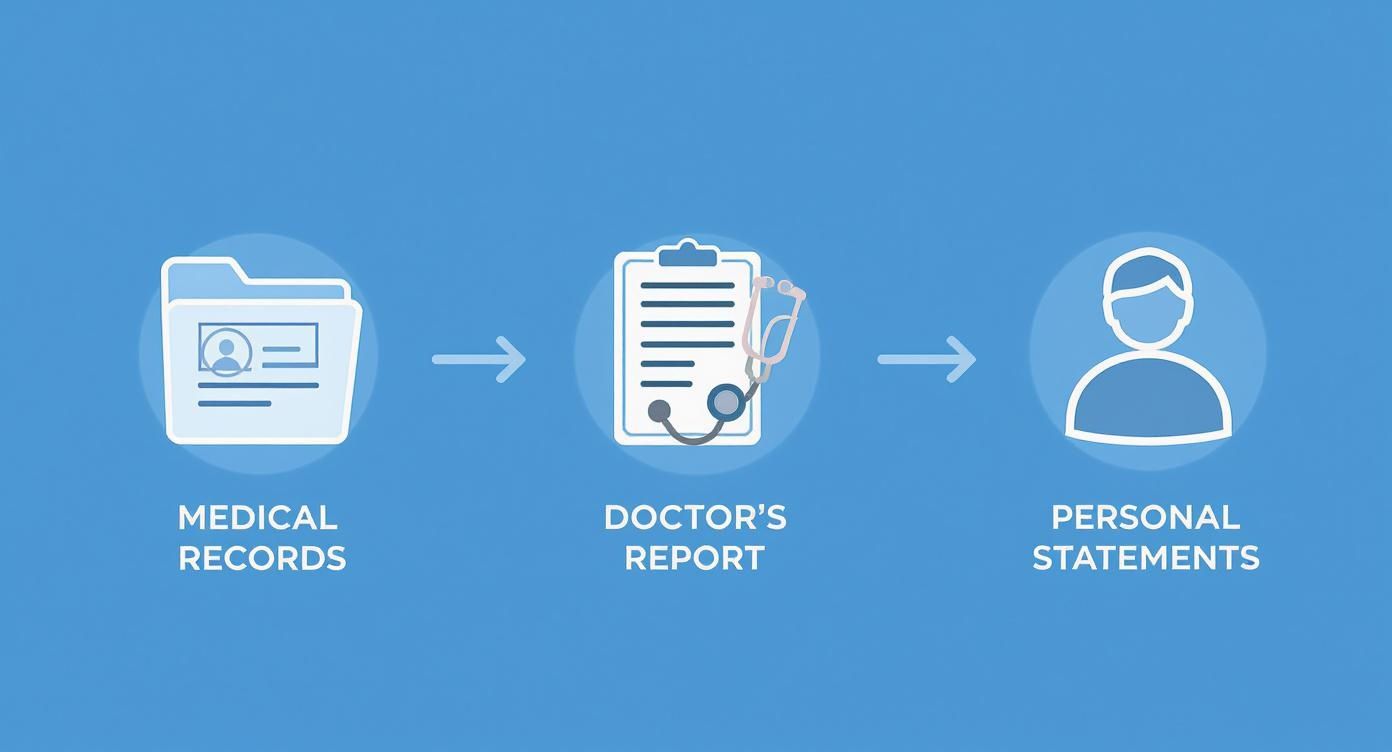
As you can see, it’s the combination of your complete medical records, supportive reports from your doctors, and powerful statements from people who know you that creates a strong foundation for your claim.
Key Insight: Statistically, the ALJ hearing offers the best chance for getting approved after you've been denied. Why? It's the first time a real person gets to hear your story directly from you, putting a human face to the name on the file.
Persistence is everything. Through this long, often frustrating process, you have to keep up with your medical treatment. If the SSA sees big gaps in your treatment history, they might assume your condition isn't as serious as you say it is. Keep going to your appointments, stay on your medications, and be open with your doctors about what you're going through. Every single visit adds another piece of evidence to your file, making your case stronger for the next step in the journey.
Common Reasons Bipolar Disability Claims Are Denied
It’s frustrating, but a huge number of initial disability claims for bipolar disorder get denied. Knowing why they get denied is one of the best ways to build a stronger application right from the start. Think of it as learning from other people’s mistakes so you don’t have to make them yourself.
Often, a denial isn't a judgment on how severe your condition truly is. It's usually about a failure to communicate that severity in the specific way the Social Security Administration (SSA) needs to see it. By getting ahead of these common problems, you can make sure your application paints a clear, undeniable picture of how bipolar disorder keeps you from working.
The Paper Trail is Too Weak
By far, the most common reason for denial is simply not having enough medical evidence. An SSA examiner can’t take your word for it—they need to see a long, consistent history on paper that shows the real-world impact of your condition.
Your claim is on shaky ground if your medical records show:
- Big Gaps in Treatment: If you go months or years without seeing a doctor or therapist, the SSA might assume your condition isn't severe enough to need ongoing care.
- Vague Doctor's Notes: Notes that just say "patient stable" or "refilled meds" are practically useless. Your records need to detail your specific symptoms, your daily struggles, and the functional limitations you talk about during your appointments.
- Not Enough Objective Proof: Your own description of your symptoms is important, but it’s not enough. The SSA is looking for a psychiatrist's observations, clinical signs, and results from psychological tests to back up what you're saying.
Not Following Doctor's Orders
This is a huge red flag for the SSA. They call it non-compliance, and it can sink a claim fast. If your doctor prescribes a medication, therapy, or another treatment and your file shows you aren't doing it, the SSA's logic is pretty simple: if you aren't trying the recommended treatments, your condition must not be that bad.
There might be a perfectly good reason you couldn't follow a treatment plan—maybe the medication side effects were unbearable, or you simply couldn't afford it. If so, it is absolutely critical that your doctor documents these reasons in your medical records. Without that note from your doctor, the SSA will likely just assume you chose not to comply.
Make a point to talk to your doctor about this. If you’re struggling with a treatment, make sure they write down exactly why.
Substance Use Complicates Things
Drug or alcohol use can throw a major wrench into a bipolar disability claim. If the SSA sees evidence of substance abuse, they have to perform what's called a Drug and Alcohol Abuse (DAA) determination.
Basically, they try to figure out if your bipolar symptoms would still be disabling if you stopped using drugs or alcohol. If they decide that your substance use is the main reason for your limitations, and that you'd be able to work if you were sober, they will deny your claim. It’s a tricky area that requires careful handling with your doctors.
You’re Earning Too Much Money
Sometimes, a denial has nothing to do with your medical condition at all—it's just a technicality. The SSA has a hard income limit, known as Substantial Gainful Activity (SGA). If you earn more than that amount in a month, you are automatically disqualified.
It's a black-and-white rule. Even working a simple part-time job could push you over the SGA limit. If that happens, your application gets denied before an examiner ever even looks at your medical file.
Getting a denial letter is disheartening, but it's not the end of the road. For many, it's just the first step in a longer process. You can learn more about what comes next and how to appeal a disability denial to keep fighting for the benefits you need.
How a Disability Attorney Can Strengthen Your Claim
Trying to prove your bipolar disorder is severe enough to qualify for disability can feel like an impossible fight against a huge, faceless system. Facing the Social Security Administration’s bureaucracy alone is daunting, and frankly, you don’t have to. An experienced disability attorney can be your guide and champion, dramatically improving your odds of a successful claim.
I know what you might be thinking: "I can't afford a lawyer." That's a common and completely valid concern. But here’s the good news: most disability attorneys work on a contingency fee basis. This means you pay nothing—zero—out of your own pocket. Their fee is simply a small, legally capped percentage of the back pay you receive if you win. If you don't win, you don't owe them a fee.
Transforming Your Claim from Good to Great
A great attorney does so much more than fill out forms. They bring an insider's understanding of what the SSA is actually looking for, which is especially critical in mental health cases like bipolar disorder.
Here’s what they really do:
- Hunt Down the Right Evidence: They know which medical records carry the most weight and will work with your doctors to get detailed opinions that speak directly to your functional limitations—the kind of evidence that gets claims approved.
- Manage Every Deadline: The SSA runs on a very strict clock. One missed deadline for an appeal can mean starting all over again. A lawyer takes that burden off your shoulders.
- Translate Your Reality: They are experts at taking your day-to-day struggles and framing them in the specific legal and medical language the SSA requires, drawing a clear line from your symptoms to your inability to hold a job.
Think of a disability attorney as a storyteller who speaks the SSA's language. They build a compelling narrative that connects your personal experience with the precise legal criteria the SSA uses to make decisions.
The Advantage at a Disability Hearing
If your claim is denied at first—and many are—your best shot at winning is often at a hearing before an Administrative Law Judge (ALJ). This is where having an attorney on your side can make all the difference. They will prep you for the judge's questions, so you can clearly and confidently explain how your bipolar disorder truly impacts your life.
During the hearing itself, your lawyer will argue your case, challenge the opinions of any so-called "experts" the SSA brings in, and build a powerful argument for why you can't work. They know how to dismantle an expert's testimony to prove that your limitations are real and prevent you from performing any job.
Hiring an attorney isn't a cost; it's an investment in your future and the strength of your claim.
Your Questions Answered: Bipolar Disorder and Disability Claims
When you're trying to navigate the disability process for bipolar disorder, it’s natural to have a lot of questions. Let’s walk through some of the most common ones I hear from clients to give you a clearer picture of what to expect.
Can I Still Work Part-Time and Qualify for Disability?
This is a common point of confusion, and the answer is maybe, but you have to be careful. The Social Security Administration (SSA) has a very strict income limit they call Substantial Gainful Activity (SGA). If you earn more than that amount in a month, they won't even look at your medical files—they'll just issue a technical denial.
However, if your part-time earnings stay below the SGA threshold, you can still have a viable claim. The challenge then becomes proving that your bipolar disorder is the very reason you can't work more. You need to show that your symptoms and limitations prevent you from handling a full-time schedule.
What's the Difference Between SSDI and SSI?
Think of it this way: SSDI is like an insurance plan you've paid into, while SSI is a safety net based on financial need.
- SSDI (Social Security Disability Insurance) is based on your work history. You qualify by having worked and paid enough Social Security taxes over the years to earn "work credits."
- SSI (Supplemental Security Income) is a needs-based program. It’s for people who have very limited income and resources, regardless of whether they have a long work history.
Some people can apply for one or the other, and in certain situations, you might even qualify for both at the same time. It all depends on your work and financial background.
How Long Will This Whole Process Take?
I wish I had a simple answer, but the timeline can really vary. You can typically expect an initial decision in about three to six months. The hard truth, though, is that most mental health claims get denied at this first step, which is where things can really slow down.
If your claim is denied and you have to appeal, be prepared for a long haul. The journey from first applying to finally getting a decision after a hearing in front of a judge can easily take over a year, and sometimes closer to two. Patience isn't just a virtue here; it's a necessity.
Does It Matter if I Have Bipolar I vs. Bipolar II?
While your specific diagnosis—Bipolar I, Bipolar II, or another type—is an important piece of the puzzle, the SSA is far more interested in how the condition actually affects you day-to-day. They focus on the severity of your symptoms and the functional limitations they create.
A well-documented claim for Bipolar II that clearly shows how the disorder prevents you from working can be just as strong, if not stronger, than a claim for Bipolar I with weaker evidence. In the end, it’s not the label that wins a case; it’s the consistent, detailed medical evidence that proves your inability to work.
Successfully navigating a Social Security Disability claim for bipolar disorder in Oregon hinges on building a case that leaves no room for doubt. The experienced attorneys at Bell Law know what it takes to win. We can guide you through every stage, from putting together a compelling initial application to fighting for you at a hearing. To make sure your case is presented in the strongest possible light, contact Bell Law for a consultation.
Disclaimer: The information on this page is provided for general informational purposes only and is not legal advice. Reading this content does not create an attorney-client relationship. For advice about your specific situation, please contact a licensed attorney.