
Does Insurance Cover DUI Wrecks? A Complete Guide
"I was satisfied once John Bell took over my case."
"Communication was always timely."
Does Insurance Cover DUI Wrecks? A Complete Guide
The question on many people's minds after a drunk driving wreck is whether insurance will pay for the damage. Generally, an at-fault driver's liability insurance may cover damages, even with a DUI involved. But that simple answer is where the simplicity ends.
The reality is far more tangled, with financial and legal consequences splitting into two very different paths. Understanding how these paths run parallel can be key to navigating the aftermath of such a serious crash.
Navigating Insurance Claims After a DUI Wreck
When a driver under the influence causes an accident, it can trigger two separate processes: one in the criminal justice system and one in the civil insurance system. Think of it like two trains leaving the same station on parallel tracks, heading to completely different destinations.
The criminal case is about the driver's violation of the law. This track involves the police, prosecutors, and the courts. The goal is to hold the driver accountable for the crime of driving intoxicated, and the consequences can include:
- Fines and court fees
- License suspension or revocation
- Mandatory alcohol education or treatment programs
- Probation or jail time
The civil matter, on the other hand, is about who pays for the harm done. This is where the insurance question comes into play. The focus here is on compensating victims for their losses, whether it's a totaled car or mounting medical bills. This compensation comes from insurance claims or, if necessary, a personal injury lawsuit.
The Role of Auto Insurance in a DUI Accident
At its core, an auto insurance policy is a contract to cover financial risk from accidents. From an insurance company's perspective, even though getting behind the wheel drunk is a reckless choice, the crash itself may still be considered an "accident" under the terms of the policy.
For this reason, a standard auto policy could cover the damages caused by an impaired driver, up to the policy limits. The scale of this problem is significant. Across the U.S., alcohol-related crashes kill 32 people every single day and contribute to more than $44 billion in annual losses. You can learn more about how auto insurance generally addresses drunk driving accidents from industry experts.
It’s useful to separate the act of driving drunk from the crash itself. The insurance policy is there to cover the financial fallout of the wreck, not to protect a driver from the criminal penalties of a DUI conviction.
This distinction is fundamental. An insurance company's duty is to its contract—the policy—which may require them to pay for liability damages up to the stated limits. This obligation exists separately from what happens in criminal court. In fact, the civil claim for damages can move forward long before a driver is ever convicted of a DUI.
Grasping this separation is the first step for everyone involved in understanding how insurance works after a wreck caused by an impaired driver.
Now, let's break down which specific insurance coverages might come into play and who they are designed to protect. The following table provides a general overview.
Insurance Coverage Overview in a DUI Wreck
| Liability (Bodily Injury & Property Damage) | The victim(s) of the crash. | Medical bills, lost wages, pain and suffering, and vehicle repair or replacement for the people the at-fault driver injured. |
| Personal Injury Protection (PIP) | The policyholder and their passengers. | Immediate medical expenses for you and your passengers, regardless of who was at fault for the accident. |
| Uninsured/Underinsured Motorist (UM/UIM) | The victim(s) who have this coverage. | Your own medical bills and other damages if the drunk driver has no insurance or not enough to cover all your losses. |
| Collision Coverage | The at-fault driver who has this coverage. | Repairs to the at-fault driver's own vehicle, though filing this claim after a DUI could impact their policy. |
As you can see, different parts of an auto insurance policy serve very different functions. While the drunk driver's liability coverage may be the primary source for a victim's compensation, other policies like your own PIP or UM/UIM can become essential safety nets.
What Are My Insurance Options After a DUI Wreck?
When you’re hit by an impaired driver, the aftermath can be a confusing mix of police reports, medical bills, and insurance questions. It’s helpful to understand how auto insurance works in this specific situation. Think of your policy not as a single thing, but as a toolbox with different tools for different jobs. Knowing which tool to use, and when, can make a difference.
An auto policy is really a package of separate coverages. Let's walk through the ones that come into play after a DUI crash and see what each is designed to do.
Liability Coverage: The At-Fault Driver's Responsibility
Liability coverage is a foundational component of auto insurance. It’s the part of the at-fault driver's policy that pays for the harm they cause to other people. It’s not for them; it’s for their victims.
This coverage is often split into two distinct parts:
- Bodily Injury (BI) Liability: This is for people. It covers medical bills for those injured in the crash—from the ambulance ride and ER visit to surgery and long-term physical therapy.
- Property Damage (PD) Liability: This is for property. It pays to repair or replace whatever the at-fault driver damaged, which is most often the victim's car but can also include a fence, a mailbox, or even a storefront.
In a DUI wreck, the drunk driver's BI and PD liability coverage may be the primary source of compensation for the people they hurt.
Why Your Own PIP Coverage Matters in Oregon
Oregon is a Personal Injury Protection (PIP) state, which means every auto policy sold here must include this coverage. PIP is "no-fault," a critical detail that means it pays for your medical bills and lost wages right away, no matter who caused the crash.
Think of PIP as your policy's first-aid kit. It's designed to provide immediate financial help for medical care without having to wait for insurance companies to officially assign blame.
A DUI crash kicks off two parallel processes: a criminal case against the driver and a civil claim for your damages. They are completely separate.
This flowchart highlights why PIP can be so essential. It can handle immediate needs while the much longer civil claim against the other driver's liability insurance unfolds.
What About the Drunk Driver's Car? Collision Coverage
While liability coverage is for the victims, Collision Coverage is the optional part of a policy that pays to fix the policyholder's own car.
Even if the drunk driver has collision coverage, using it is another story. Filing a claim after being arrested for DUI can be a significant event for their insurer, potentially leading to a non-renewal or cancellation of their policy down the road.
Insurers might also look for ways to deny a claim. Some policies include clauses that may allow them to deny claims resulting from a criminal act, like driving intoxicated. This can turn what seems like a straightforward claim into a complex situation. It's also worth remembering that the trauma of a wreck goes beyond physical injuries; resources like ICBC counselling benefits after an accident can be vital for emotional recovery.
The Ultimate Safety Net: Uninsured and Underinsured Motorist Coverage
What if the impaired driver who hit you has no insurance? Or what if they have the state minimum, but your medical bills are ten times that amount? This is where Uninsured/Underinsured Motorist (UM/UIM) coverage on your own policy can be important.
- Uninsured Motorist (UM) coverage may kick in when the at-fault driver has zero insurance.
- Underinsured Motorist (UIM) coverage can help fill the gap when the at-fault driver has insurance, but their policy limits aren't high enough to cover all of your damages.
This coverage can serve as a shield against irresponsible drivers. Taking a moment to understand the details of your own UM/UIM coverage is one way to protect yourself and your family before you ever need it.
The Financial Aftermath for a Driver with a DUI
While an insurance policy might cover the immediate damage from the accident, that's just the first domino to fall. A DUI conviction can trigger a long and difficult financial road, with consequences that ripple out for years. For an insurance company, a DUI isn't just a mistake; it's a major event that can completely change how they view a driver as a risk.
This new risk profile can lead to one thing: a spike in insurance premiums. What was once a manageable bill can quickly become a serious financial weight. In the eyes of an insurer, a driver may have gone from a standard driver to a high-risk client, and their rates may reflect that.
Facing Steep Premium Hikes
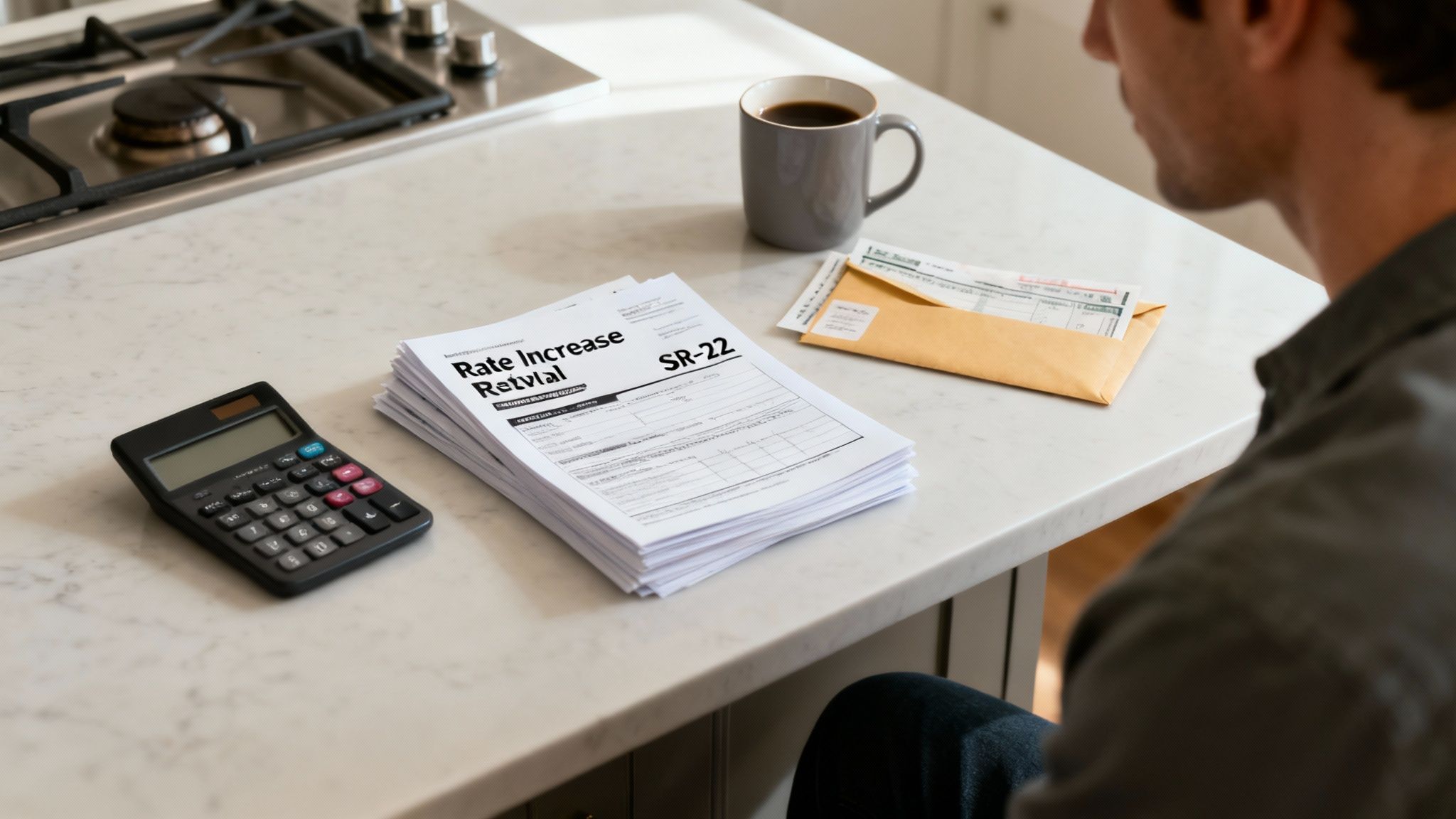
After a DUI, an insurer might move a driver into a high-risk category, and their premiums could surge. This may not be a small bump. Studies show premiums can jump by an average of 70% after a conviction. Some insurers might hike rates up to 80% or even double them. This isn't just about money; it can impact one's ability to keep a job that requires driving. These are just some of the tangible consequences of drunk driving, which can also include things like installing an ignition interlock device in a car.
On top of the higher rates, a current insurer might decide a driver is too much of a liability and choose not to renew their policy. This can force them into the world of "high-risk" insurance carriers, where the premiums are even more punishing. This financial strain isn't a short-term problem; it can stick with a person for years, long after they've paid court fines.
The SR-22 Requirement in Oregon
Another major financial hurdle is something called an SR-22 certificate. In Oregon, if a person is convicted of a DUI, the DMV may require them to file an SR-22 to get their license back. It's a common point of confusion, but an SR-22 is not an insurance policy.
An SR-22 is simply a form an insurance company files with the state to prove a driver has the minimum required liability coverage. It’s official proof of financial responsibility that also tags them as a high-risk driver.
Think of it as a bright red flag on a driving record that both the DMV and insurance companies can see. This flag means a driver has to keep continuous insurance coverage for a set period, often three to five years. If their coverage lapses for even one day, the DMV is notified, and their license could be suspended all over again.
Long-Term Financial Impact
When you add it all up, the financial squeeze from a DUI can be significant and last for a long time. Here’s a quick rundown of what a driver might expect from their insurance company:
- Dramatically Higher Premiums: This is one of the most immediate and painful hits to a wallet.
- Policy Non-Renewal or Cancellation: A current insurer may cut ties, forcing a driver to shop for more expensive coverage elsewhere.
- Mandatory SR-22 Filing: This comes with its own fees and can lock a driver into high rates for years.
- Difficulty Finding Coverage: Many standard insurance companies may not offer a policy, severely limiting options.
So while people initially ask, "does insurance cover dui wreck," the real, lasting question for the driver can be how they'll manage the financial fallout and stay insured for years down the road.
Potential Hurdles in the Insurance Claim Process
Even when the at-fault driver has insurance, getting a fair settlement after a DUI wreck is not always a straight line. Just because a policy exists doesn't mean the insurance company will make it easy. Insurers may scrutinize any claim involving a DUI, searching for loopholes or policy clauses that could limit their liability.
To protect yourself, it can be helpful to understand a couple of key concepts that can pop up in these situations. They might sound like legal jargon, but they’re part of the framework that determines who pays for what. Knowing what to watch for can be your best defense.
Intentional Acts Exclusions
One of the first arguments an insurer might try to use is something called an "intentional acts" exclusion. At its core, this clause states that insurance is for accidents, not for damage someone causes on purpose. It's a standard part of many policies.
Here's the twist: the insurance company might claim that because the driver chose to drink and drive, their actions were intentional, and therefore the crash isn't covered. This argument's success can vary. Courts in some jurisdictions may see the crash itself as an unintended, tragic consequence of a reckless decision, not a deliberate act of destruction.
The real issue here is over a subtle but crucial distinction: Is the act of driving drunk the same as the intent to cause a specific crash? The answer can vary, creating a potential point of conflict between the policyholder and the insurer.
This is a perfect example of how a claim that seems straightforward on the surface can quickly become a complicated legal battle.
The Concept of Subrogation Explained
Another term you might hear is subrogation. It's the process an insurance company uses to get its money back after paying a claim that was someone else's fault.
Here’s a simple breakdown of how it works:
A drunk driver hits you. You use your own insurance—like PIP for medical bills and collision coverage for your car—to handle the immediate costs.
Your insurance company pays out on your claim so you can get medical care and your car fixed without waiting.
Your insurer then essentially "steps into your shoes" and goes after the at-fault driver's insurance company to demand reimbursement for every penny they paid you.
This is a standard industry practice. It’s designed to make sure the financial burden ends up with the insurer for the person who caused the wreck. For you, it mostly happens behind the scenes, but it's a critical part of how insurance companies sort out financial responsibility.
A big part of this process involves back-and-forth with claims adjusters. For a deeper dive into their tactics, check out our guide on how to deal with insurance adjusters. Understanding these potential hurdles is key; knowing how insurance covers a DUI crash is about much more than just reading the policy—it's about navigating the entire claims battlefield.
What To Do Right After a DUI Wreck: A Victim's Checklist
The moments after being hit by a drunk driver can be a blur of shock, confusion, and fear. While you're trying to process what just happened, it’s hard to think clearly. But the steps you take in the immediate aftermath can make a huge difference in protecting your rights and getting your life back on track.
First things first: your health is the absolute priority. Get medical help right away for yourself and anyone else involved, even if you feel fine. Some serious injuries don't show symptoms until hours or even days later.
Start Documenting Everything You Can
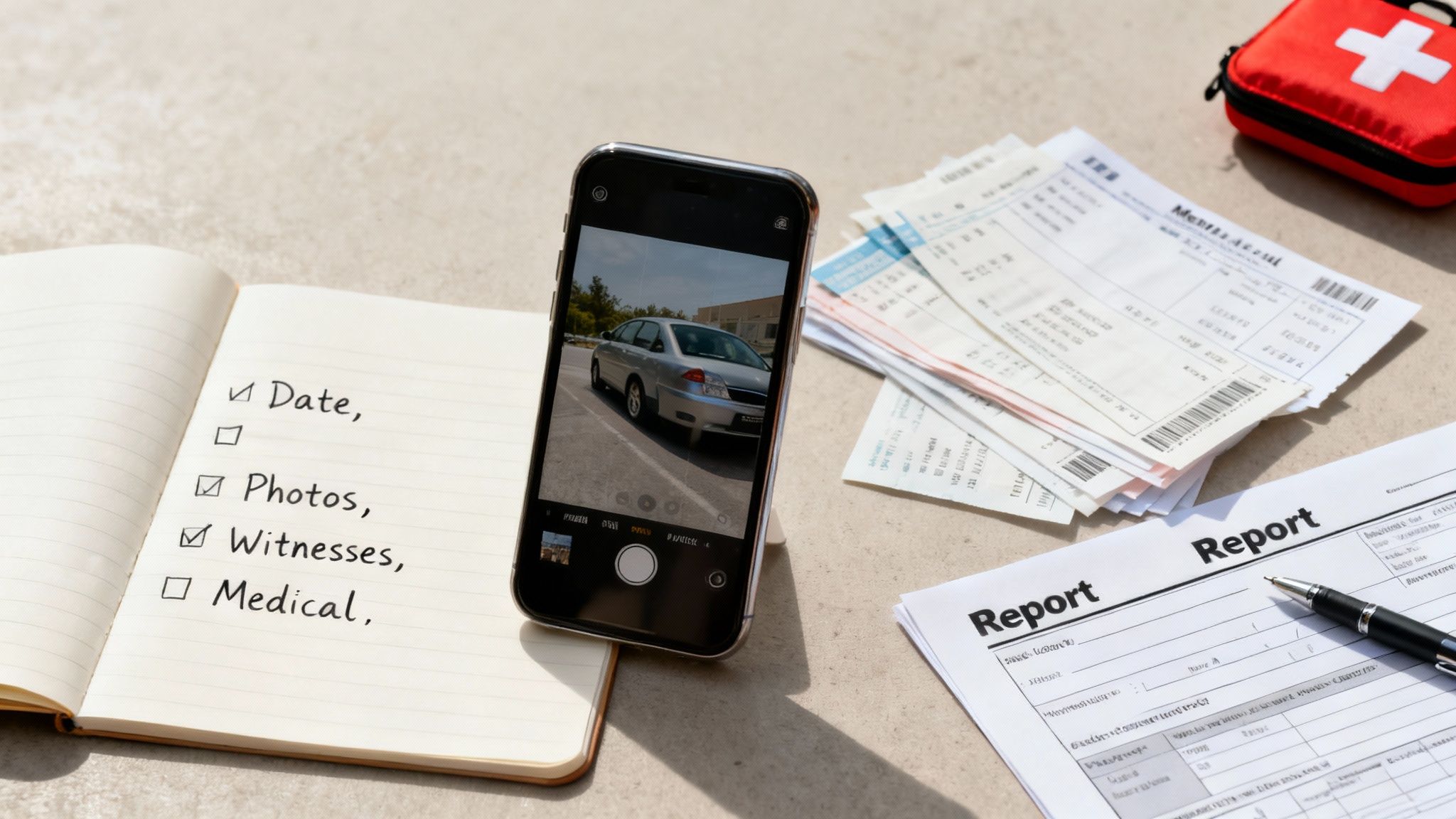
Once you're safe, it's time to become a meticulous record-keeper. Building a detailed file from the very beginning provides the factual backbone for your insurance claim and any potential legal action. If you are physically able, try to capture these key details right at the scene.
- Driver & Insurance Info: Get the other driver's name, phone number, and insurance policy details.
- Witness Contacts: If anyone saw what happened, ask for their name and number. An independent account can be very powerful.
- Photos and Videos: Use your smartphone to document everything. Take pictures of the damage to both cars, the license plates, the wider accident scene from different angles, and any relevant details like skid marks or traffic signals.
- Police Details: Make a note of the responding officers' names and badge numbers. Be sure to ask for the police report number before you leave.
The official police report is a cornerstone of any accident claim. To learn more about what it contains and how to get a copy, check out our guide on how to get a car accident police report.
Why You Should Call Your Own Insurer
It might seem counterintuitive, but you should report the accident to your own insurance company as soon as possible, even though the other driver was at fault. Many policies require you to report any incident in a timely manner.
More importantly, this is how you activate your own coverages. Your Personal Injury Protection (PIP) coverage, for example, can start paying your medical bills right away without waiting for the other driver's insurance to act. When you call, just stick to the facts of what happened.
A Grim Reminder of Why This Matters
The need for this diligence is driven home by some truly sobering statistics. According to the National Highway Traffic Safety Administration (NHTSA), one person in the U.S. dies in a drunk-driving crash every 42 minutes.
In 2023 alone, these preventable wrecks took 12,429 lives. In fact, 30% of all fatal crashes involved a driver with a blood alcohol concentration at or above the legal limit. These aren't just numbers; they represent families torn apart. For victims, they underscore just how critical it can be to have solid Uninsured/Underinsured Motorist (UM/UIM) coverage in place, as it may be your only safety net.
Action Checklist for Victims of a DUI Wreck
Navigating the aftermath of a wreck with an impaired driver can feel overwhelming. This checklist breaks down the immediate steps to consider to help you stay organized and protect your interests.
| 1. Prioritize Safety | Move to a safe location away from traffic and call 911 immediately. | Ensures you and others receive prompt medical and police assistance. |
| 2. Seek Medical Care | Get evaluated by a medical professional, even for minor discomfort. | Establishes a medical record linking injuries to the accident and addresses hidden issues. |
| 3. Document the Scene | Take photos and videos of vehicle damage, injuries, and the surrounding area. | Creates a visual record of the facts before the scene is cleared. |
| 4. Gather Information | Collect the other driver's contact/insurance details, witness contacts, and officer info. | Provides the necessary information for filing insurance claims and legal follow-up. |
| 5. Do Not Discuss Fault | Avoid apologizing or admitting any fault at the scene. Stick to factual statements. | Protects you from having your words used against you later by an insurance company. |
| 6. Report to Your Insurer | Notify your own insurance company about the accident promptly. | Fulfills your policy obligations and allows you to access your own benefits like PIP. |
| 7. Organize Everything | Keep a dedicated file for the police report, medical bills, receipts, and all communications. | Prevents critical documents from being lost and reduces stress during a chaotic time. |
| 8. Consider Legal Advice | Speak with an experienced attorney to understand your rights and options. | An expert can help navigate the complex claims process and ensure you are treated fairly. |
By taking these methodical steps, you can bring a sense of order to a chaotic situation. Keeping a well-organized file with all your documentation is one of the best things you can do for your peace of mind and the strength of your claim.
Frequently Asked Questions About DUI Wreck Claims
The moments after a crash with a drunk driver can be a whirlwind of confusion and stress. It’s completely normal to have questions about how insurance will work, who pays for medical bills, and how your car gets fixed. Let's walk through some of the most common questions people have, clearing up the roles insurance plays and how it all fits with the criminal and civil sides of the accident.
I Used My Own Insurance to Fix My Car. Can I Still Go After the Drunk Driver for My Injuries?
Yes, these are two completely separate things. When you use your own collision coverage to get your car repaired, you are often getting things moving quickly. Behind the scenes, your insurance company doesn't just foot the bill and walk away.
They may kick off a process called subrogation. Your insurer steps into your shoes and goes after the at-fault driver's insurance company to get back the money they paid to fix your car. This is an insurer-to-insurer process that doesn't stop you from pursuing your own claim for your personal losses.
Your personal injury claim is a different matter. It's focused entirely on making you whole after what you've been through and covers things like:
- Medical Bills: The ambulance ride, ER visit, doctor's appointments, physical therapy—all of it.
- Lost Wages: If you couldn't work while you were healing, this covers the income you lost.
- Pain and Suffering: This is compensation for the physical pain and emotional trauma the crash inflicted on you.
This compensation comes from the at-fault driver’s bodily injury liability coverage, which has nothing to do with the property damage coverage that fixed your car.
Will My Insurance Rates Go Up If I Was Hit by a Drunk Driver?
This is a common worry for people who did nothing wrong. In Oregon and many other places, insurance laws may be on your side. Insurers are often prevented from penalizing you for an accident you didn't cause.
You were the victim. Filing a claim under your own policy for benefits you've paid for, like Personal Injury Protection (PIP) or Uninsured/Underinsured Motorist (UM/UIM), should not count against you as an at-fault accident in many jurisdictions.
That said, every insurance company has its own internal playbook. If you're concerned, one option is to review your policy or call your agent. They can provide information on how they handle not-at-fault claims.
What's the Difference Between the Civil Claim and the Criminal Case?
It’s helpful to see a DUI wreck as two completely separate legal tracks running at the same time. Keeping them straight in your head can make the whole process less confusing.
The criminal case is the State of Oregon vs. the drunk driver for breaking the law. The civil claim is you vs. the driver's insurance for financial compensation. The outcome of one does not necessarily dictate the outcome of the other.
The criminal case is handled by a prosecutor. The goal is to hold the driver accountable for the crime of driving under the influence. This can lead to serious consequences for them, such as:
- Fines and court-ordered payments
- Jail time
- A suspended driver's license
- Mandatory DUII treatment programs
The civil claim is your private action. Its purpose is to obtain money to cover the harm their negligence caused. This is where you recover funds for your medical bills, lost income, and car repairs. While a DUI conviction can be powerful evidence for your civil claim, you don't have to wait for the criminal case to be over to start your own process.
The Other Driver's Insurance Offered Me a Quick Settlement. What Should I Do?
Be very careful. An adjuster from the other driver's insurance company may call you quickly, sounding sympathetic and offering a check. It can be tempting, especially when you have bills piling up, but this is a critical moment.
Remember, insurance companies are businesses looking to close claims for the least amount of money possible. An early offer could be a bet they're making—a bet that your injuries aren't as bad as they might be. They might hope you'll take the money before you realize the full extent of your medical needs. Some injuries, especially whiplash or concussions, don't show their true colors for days or even weeks.
If you accept that offer, you'll have to sign a release form. That document can end your claim forever. Even if you need surgery a year later because of the accident, you may not be able to go back and ask for another dime.
Before you consider settling, you may want to have a complete picture of your medical situation and all your financial losses. This isn't just about the ER bill—it's about future physical therapy, lost earning potential, and the long-term impact on your life. Taking the time to understand the true cost of the accident is a very important step.
At Bell Law, we focus on helping Oregonians navigate the tough road after a serious injury. If you’ve been hurt in an accident, our team is here to give you clear guidance and fight for your rights. Contact us to find out how we can help at https://www.belllawoffices.com.
Disclaimer: The information on this page is provided for general informational purposes only and is not legal advice. Reading this content does not create an attorney-client relationship. For advice about your specific situation, please contact a licensed attorney.