
What To Do After Getting Sued for a Car Accident
"I was satisfied once John Bell took over my case."
"Communication was always timely."
What To Do After Getting Sued for a Car Accident
Being served with a lawsuit after a car accident can be a stressful, jarring experience. That moment when a process server hands you a Summons and Complaint can make your world stand still. It’s natural to feel overwhelmed, but what you do in the next 24 to 48 hours can be very important and may set the tone for the entire legal process ahead.
Your First Moves After Receiving a Lawsuit
The documents you just received aren't just notifications; they are legal demands with strict deadlines. A measured, timely response is an important early step. The key is to get organized and make the right calls right away.

Immediately Notify Your Insurance Company
This is a high priority. Your auto insurance policy isn't just there to cover damages—it may include a "duty to defend." This is a contractual term that can mean your insurer is obligated to provide and pay for a lawyer to represent you in a lawsuit related to a covered accident.
Don't wait. Call your agent or the claims department as soon as you have the papers in hand. A delay in this call could potentially jeopardize your coverage.
To make the call go smoothly, have this information ready:
- Your auto policy number.
- The date, time, and location of the accident.
- The names of everyone involved (the plaintiff).
- The specific legal documents you were served—the Complaint and Summons.
Your insurer will assign a claims adjuster or legal team to your case. This is an official step in building a defense under the protection of your policy.
Review and Organize All Accident-Related Documents
While the shock is still fresh, start pulling together every single document related to the accident. You may be glad you did later. Create one central file, whether it's a physical folder or a digital one, for everything. This can be an invaluable resource for the attorney your insurance company assigns to you.
Your file could include:
- The official police or crash report.
- Any photos or videos you took at the scene—vehicle damage, the surrounding area, even your own injuries.
- The names and contact information for any witnesses you spoke with.
- Every email, letter, or note from conversations with any insurance company.
- Your own medical records or bills if you were treated after the accident.
A well-organized file allows a defense team to get up to speed quickly. It gives them the raw materials to see the facts from your point of view and start building a strategy.
Identify and Respect Every Deadline
The paperwork you received is time-sensitive. The Summons will state how long you have to file a formal response—often called an "Answer"—with the court.
Do not ignore this deadline. Missing it can lead to a default judgment. This is where the court could rule against you simply because you didn't respond, potentially making you liable for the full amount the plaintiff is demanding without you getting a chance to tell your side of the story.
Find that deadline and put it on every calendar you have. It's one of the most important dates in this early stage.
For a quick reference, here are some of the most important things to consider doing right away.
Immediate Action Checklist When Sued
This checklist summarizes critical first steps to consider after receiving a car accident complaint and summons. Staying organized and acting promptly can make a significant difference.
| Call Your Insurer | Activates your policy's potential "duty to defend," getting you a lawyer. | Policy number, accident details, the lawsuit papers. |
| Read the Complaint | Understand who is suing you and what they are alleging. | The Complaint and Summons documents. |
| Calendar the Deadline | Missing the response deadline can lead to a default judgment. | A calendar, a pen, and the Summons. |
| Gather All Documents | Provides a defense team with the evidence they need. | Police report, photos, witness info, medical records. |
| Don't Talk to the Plaintiff | Avoid saying anything that could be used against you. | The phone number/contact info for your insurance adjuster. |
Following these initial steps can help ensure you are protecting your rights and giving your defense team a good start.
Finally, some situations are more complex. If the accident involved a hit and run, you might want to understand the process of hiring a hit and run defense attorney to know all your options. It's also worth thinking about when to hire a personal injury attorney yourself, especially if the lawsuit asks for damages that could go above your insurance policy limits.
What Are These Legal Papers? Making Sense of the Summons and Complaint
Getting served with a thick stack of legal documents can be intimidating. This paperwork officially kicks off the lawsuit, and it’s usually made up of two main parts: a Summons and a Complaint. Figuring out what each one does is the first step toward getting your bearings.
The Summons is essentially a formal notice from the court. Think of it as an official command to appear and respond. It’s the court’s way of saying, "A lawsuit has been filed against you, and you are now required to participate."
The Complaint, on the other hand, is the plaintiff’s side of the story. It’s where the person suing you lays out their claims, often in a numbered list of allegations. It will explain what they say happened, what injuries they claim to have, and how much money (or "damages") they’re asking for.
The "Service of Process" and Why It Matters
That moment when a sheriff's deputy or a private process server hands you the documents is a formal legal step called "service of process." This isn't just a mail delivery; it's a constitutionally required action to ensure you've been officially notified.
The date you were served is incredibly important. It starts a legal countdown timer for your response, so make a note of it immediately.
How to Read the Complaint
At first glance, the Complaint might look like it's full of dense legalese. But if you know what to look for, the structure can be quite logical. Reading it carefully helps you understand exactly what you’re up against.
Keep an eye out for these key sections:
- The Parties: This is straightforward. It identifies the "plaintiff" (the person suing) and you, the "defendant."
- Jurisdiction and Venue: These paragraphs simply explain why the case is being filed in a particular court—often because that’s where the accident happened or where you live.
- Factual Allegations: This is the narrative part. The plaintiff will lay out their version of how the crash occurred and why they believe you were at fault.
- Causes of Action: This is where the legal theories are listed. For a car accident, this is frequently negligence.
- Damages Sought: Often called the "Prayer for Relief," this is the section that details what the plaintiff wants. It will list things like medical bills, lost income, and a dollar amount for their pain and suffering.
Remember, reading the Complaint isn't about agreeing with it. It's about understanding the claims so that the legal team your insurance company provides can build a defense. This document is the roadmap for the entire case.
You might have received a letter from the other party's lawyer before the lawsuit was actually filed. It’s useful to know the difference between pre-litigation documents and an official lawsuit. To learn more, see our guide explaining what is a demand letter and how it differs from a formal Complaint.
Finding the Most Important Information Fast
Buried in all that text are a few critical details you need to pull out right away. These are the facts your insurance company and your future lawyer will need immediately.
Comb through the first few pages and find this information:
The Court: Which court is the lawsuit in? (e.g., Washington County Circuit Court).
The Case Number: Every case gets a unique tracking number. You'll use it on all future documents.
The Deadline to Respond: The Summons will tell you exactly how many days you have to file your formal "Answer." This can be a hard deadline that is very important not to miss.
Once you’ve identified these key pieces of information, you have a solid starting point. You know the who, what, where, and when, which is everything you need to take the next step and start building your response.
Navigating Oregon's Legal Process and Timelines
Once the initial shock of being sued wears off, you're left facing the legal system. It can feel intimidating, but it follows a structured path. Knowing the roadmap—what happens when, and why—can take a lot of the mystery out of the process and help you know what to expect in the months ahead.
The first major step is filing what's called an Answer to the Complaint. This is your formal, written response to every single allegation the other side has made. It's a critical document; this is how you officially join the legal fight and preserve your right to defend yourself.
This is a simplified look at how the clock starts ticking once you receive those initial documents.
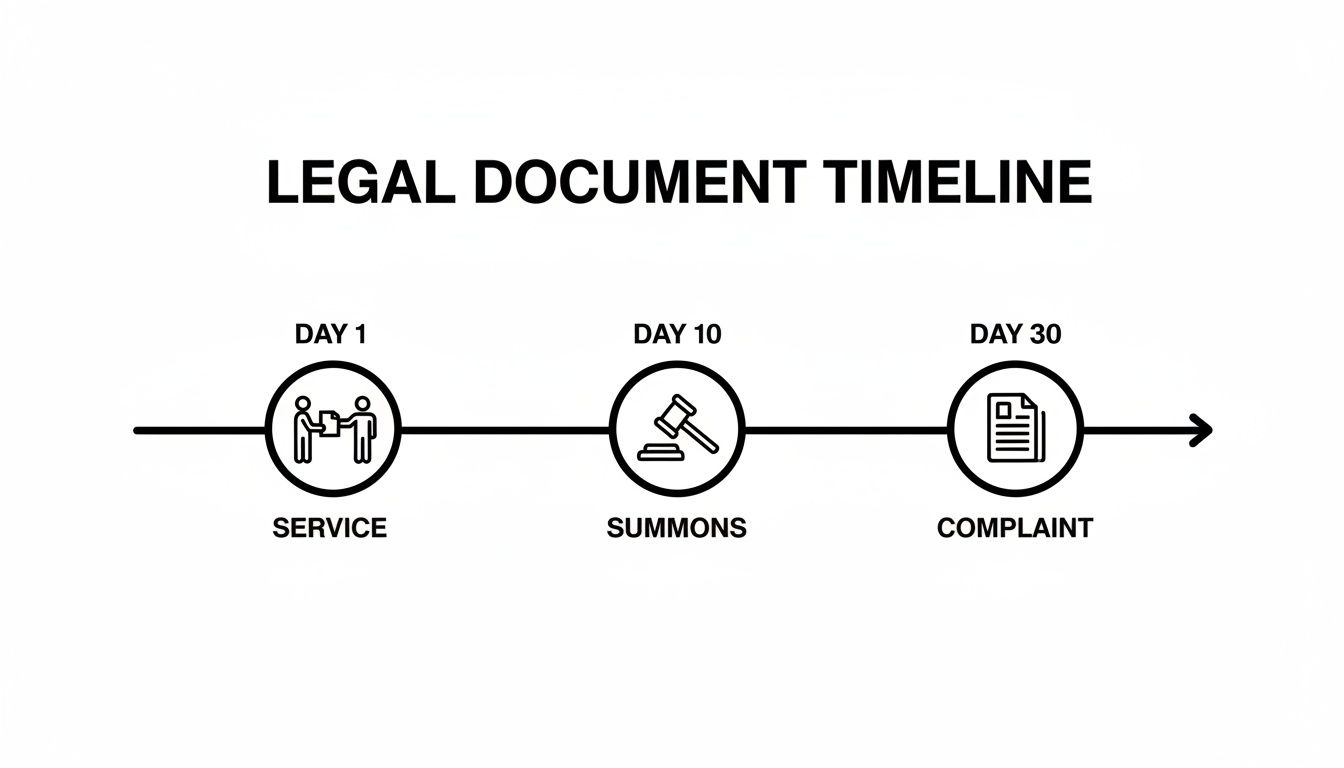
As you can see, a lawsuit doesn't just appear out of thin air. It's kicked off by a formal series of steps—Service, Summons, and Complaint—that are legally required to get things started.
Understanding Oregon's Statute of Limitations
You might be wondering, "Why now?" especially if the accident happened a long time ago. The timing is often dictated by a law called the statute of limitations. For many personal injury claims from a car accident in Oregon, the other party has two years from the date of the crash to file a lawsuit.
This deadline can be incredibly strict. If they miss that two-year window, they may lose their right to sue you forever. This is why it’s common to get served with a lawsuit just before that deadline, even if it feels like it came out of the blue.
The Discovery Phase: Where the Real Work Happens
After the initial back-and-forth of the Complaint and Answer, the case moves into what is frequently the longest phase: discovery. This is the formal process where both sides are required to share information and evidence. The point is to avoid surprises at trial and make sure everyone knows the strengths and weaknesses of the other's case.
Discovery relies on a few key tools:
- Interrogatories: These are written questions that the other side sends you, which you have to answer in writing and under oath. They'll ask for specifics about the accident, your version of events, your injuries, and any witnesses.
- Requests for Production of Documents: This is a formal demand for documents—think medical records, photos from the scene, car repair bills, or even relevant emails and text messages.
- Depositions: This is live, out-of-court testimony given under oath. Attorneys from both sides are there asking questions, and a court reporter is typing down every single word.
Discovery is a meticulous, fact-finding mission. It can feel slow and tedious, but it’s the workhorse of any lawsuit. This is where the foundation for a settlement or a trial is built.
Exploring Alternatives to Trial: Mediation and Arbitration
The good news is that very few car accident lawsuits actually end up in a full-blown courtroom trial. In the U.S., car crashes make up a huge portion of personal injury cases, and the system is designed to encourage settling. In fact, about 95% settle pre‑trial, with only a tiny fraction ever seeing a judge or jury. You can find more personal injury statistics on Clio.com.
Two of the most common ways to reach a resolution are mediation and arbitration.
Mediation is a guided negotiation. A neutral third party, the mediator, comes in to help both sides talk through the issues and find a middle ground they can both agree on. The mediator can’t force anyone to do anything; their job is just to facilitate a voluntary settlement.
Arbitration, however, is a bit different. It’s more like a private, less formal trial. A neutral arbitrator (or a small panel) hears the evidence from both sides and then makes a decision that can be binding—similar to a judge's verdict.
These "alternative dispute resolution" methods are used all the time in Oregon to resolve car accident cases more quickly and cheaply than going to trial. They offer a way to get the case closed without the time, expense, and stress of a courtroom battle.
Your Insurance Company Is Your First Line of Defense
When you get served with a lawsuit, your first thought might be about the staggering cost of hiring a lawyer. But here’s the good news: your car insurance policy is much more than just a checkbook for damages. It may include a "duty to defend."
This is a powerful contractual obligation. It can mean your insurance company is required to hire and pay for a lawyer to defend you against any lawsuit related to a covered accident. This is one of the most valuable, and often overlooked, parts of your liability coverage.
Once you notify your insurer about the lawsuit, they’ll get the ball rolling. They'll assign a claims professional to your case and, most importantly, retain a defense attorney to represent you. This takes a massive financial and logistical weight off your shoulders right from the start.

You Have a "Duty to Cooperate"
Your insurance policy is a two-way agreement. While your insurer may have a duty to defend you, you have a duty to cooperate with them and the legal team they bring on board. This isn't just a suggestion; it can be a condition of your coverage, and failing to hold up your end of the bargain could put your defense in jeopardy.
So, what does cooperation look like in practice? It’s all about being engaged and honest.
- Be Responsive: Don't ignore calls or emails from your adjuster or the attorney. Prompt communication is crucial.
- Share Everything: Hand over every document, photo, and detail about the accident. Don't hold anything back, even if you think it might be unfavorable. The legal team needs the full story to build the strongest defense.
- Show Up: You'll need to be available for meetings, depositions, and any court hearings. Your presence is essential.
Your lawyer can only be as effective as the information you provide. Think of it as a partnership—your active participation is the foundation of a strong defense. You'll be interacting with claims professionals a lot, and it helps to understand their role. You can get more insights on how to deal with insurance adjusters in our comprehensive guide.
It is important to view the insurer's legal team as your own. Be an open book. Transparency and active involvement are what empower them to protect your interests effectively.
Common Legal Defenses Your Attorney Might Use
The lawyer your insurance company hires will dig into the specifics of your case to find the best way to defend you. While every accident is different, a few common legal arguments often come up in these lawsuits. Knowing these concepts will help you understand the strategy your attorney is building.
These aren't about denying everything happened. Instead, they are legal arguments designed to ensure the court gets a full and accurate picture of who was responsible and to what degree.
It's Rarely 100% One Person's Fault: Comparative Negligence
One of the most common defenses is comparative negligence. This legal concept acknowledges that accidents are often complex, and more than one person might share some of the blame. Oregon operates under a "modified comparative negligence" rule.
Here’s how it works: If the person suing you (the plaintiff) is found to be partially at fault, any money they are awarded gets reduced by their percentage of fault. For instance, if a jury decides the other driver was 20% responsible for the crash, their total damage award could be cut by 20%. This is a critical tool for fairly allocating responsibility.
Other Angles of Defense
Beyond arguing shared fault, a defense attorney will question the core claims made by the plaintiff. They'll scrutinize the connection between the accident and the injuries, as well as the actual amount of damages being claimed.
Two key areas they may investigate are:
- Causation: Was the car accident the cause of the plaintiff's injuries? The defense might investigate whether a pre-existing medical condition or another event is the source of their pain.
- Severity of Damages: Is the amount of money the plaintiff is asking for fair and backed by evidence? The legal team will carefully review all medical bills, lost wage claims, and demands for "pain and suffering" to make sure they aren't inflated.
By challenging these points, your attorney works to make sure you are only held responsible for what is fair, reasonable, and proven by the facts of the case.
Deciding to Settle or Go to Trial
So, you've been sued. Now what? Your case will likely head down one of two paths: a negotiated settlement or a courtroom trial.
While movies and TV love a dramatic trial scene, the reality is that the vast majority of personal injury cases, well over 90%, are resolved out of court. Understanding the pros and cons of settling versus fighting it out in front of a jury is one of the most critical parts of the process.

Why is settling so common? It comes down to control. A trial can be unpredictable—you're handing the final say over to a group of strangers. A settlement, on the other hand, gives both you and the other party a predictable, final resolution, avoiding the immense costs and stress of a trial.
The Give-and-Take of Settlement Negotiations
Settlement talks aren't a single phone call; they're more of a strategic process. It's a structured negotiation that can stretch over months as both sides gather evidence and get a clearer picture of the case's strengths and weaknesses.
These conversations are handled by the lawyers and insurance adjusters. They’re weighing everything—from police reports and medical records to deposition testimony—to calculate the risks of what a jury might decide. The number they land on is a reflection of that risk.
The negotiation process generally unfolds like this:
- The Opening Demand: The plaintiff’s lawyer will kick things off with a formal demand letter, asking for a specific dollar amount to resolve the case.
- The Counteroffer: Your lawyer, working with your insurance company, will analyze their demand and come back with a counteroffer. This back-and-forth can happen several times.
- Bringing in a Mediator: If the two sides are too far apart, a neutral third-party mediator is often brought in. This person doesn't make decisions but helps facilitate a productive conversation to find common ground.
If everyone agrees, the terms are locked into a legally binding settlement agreement. Your insurance company pays the agreed-upon amount, and in return, the plaintiff drops the lawsuit for good, releasing you from all future claims related to that accident.
What to Expect if Your Case Goes to Trial
When negotiations stall and an agreement isn't possible, the next stop may be the courthouse. Going to trial is a far more rigid and formal process, bound by complex rules of evidence and procedure. It's where each side gets to tell their story and present their proof to a decision-maker.
Think of a trial as a storytelling competition. Each side presents their version of the facts, backed by witnesses and evidence, trying to convince a judge or jury that their story is the more believable—and legally correct—one.
While every trial is unique, they follow a predictable rhythm. Knowing the stages can take some of the mystery out of what lies ahead.
The Key Phases of a Civil Trial
Picking the Jury: This is where the lawyers question a pool of potential jurors to find an impartial group. The process is called voir dire (French for "to speak the truth").
Opening Statements: This is the roadmap. Each lawyer gives the jury a preview of what they plan to prove and the evidence they'll use to do it.
The Plaintiff's Case: The person suing goes first. Their attorney will call witnesses (like the plaintiff, doctors, or accident reconstruction experts) and introduce evidence. Your attorney gets to cross-examine every single witness.
The Defense's Case: Once the plaintiff "rests," it's your turn. Your lawyer will present your evidence and witnesses, and the plaintiff's attorney gets their chance to cross-examine.
Closing Arguments: Here, the lawyers sum everything up. They connect the dots for the jury, highlight the most important evidence, and make one final plea for why they should win.
Deliberation and Verdict: The judge gives the jury a set of legal instructions, and the jurors go into a private room to discuss the case and reach a final verdict.
The choice between settling and heading to trial isn't made lightly. It's a strategic decision that depends on a deep analysis of the evidence, the costs, and the potential risks versus rewards of a specific case.
Common Questions After Being Sued for a Car Accident
It's completely normal to have a million questions running through your head when you get served with a lawsuit. The whole process can feel overwhelming and confusing. Let's break down some of the most common concerns people have when they find themselves in this situation.
What Happens If I Just Ignore the Lawsuit?
Tempting as it might be to just ignore the paperwork and hope it goes away, this may be the worst thing you can do. It likely won't disappear.
If you don't file a formal response (called an "Answer") with the court in time, the person suing you can ask the judge for a default judgment. If the court grants it, you may lose the case automatically. You could be ordered to pay the plaintiff, all without ever getting to tell your side of the story. Taking these documents seriously from day one is absolutely critical.
Do I Have to Pay for the Lawyer My Insurance Company Hires?
This is a common worry, but in many cases, the answer is no. Standard auto insurance policies often include what's called a "duty to defend."
This is a core part of your liability coverage. It means your insurance company may be contractually obligated to hire and pay for a defense attorney to represent you. It's one of the main reasons you have insurance in the first place. Of course, it's always smart to double-check your specific policy, but typically, the legal bills for the lawyer they appoint are their responsibility, not yours.
Can I Be Sued for More Than My Insurance Policy Limits?
Yes, and this is a major reason why these lawsuits must be taken so seriously. A plaintiff can sue you for an amount that exceeds your insurance coverage.
If the case goes to trial and a jury awards the plaintiff more than your policy limit, you could be on the hook for the difference out of your own pocket. This is known as an "excess judgment," and it can put your personal assets—like your savings, investments, or even your home—at risk.
The possibility of a judgment exceeding your policy limits is a game-changer. It shapes every strategic decision, from early settlement talks to preparing for trial, because the goal is not just to resolve the claim, but to protect your personal financial future.
How Long Is This Lawsuit Going to Take?
There’s no simple answer here—the timeline for a car accident lawsuit can vary dramatically. Some resolve relatively quickly, while others can drag on for years.
Several key factors will influence the timeline:
- Case Complexity: A simple two-car accident is very different from a multi-vehicle pile-up with conflicting stories.
- Severity of Injuries: The more serious the alleged injuries, the longer the case tends to take, especially if future medical needs are part of the claim.
- Court Calendars: The local court's schedule is a huge factor. It can take months just to get a hearing date on the docket.
- Willingness to Settle: If both sides are motivated to find a middle ground, things move much faster. If one party is dug in, you could be in for a long haul.
A straightforward case might settle in under a year. A highly contentious one that goes all the way to a jury trial could take two, three, or even more years to finally conclude.
Don't forget the emotional toll a lawsuit can take. It’s a stressful, draining process. It’s important to look after your own well-being, and remember that there are support services after a car accident that can help you manage the strain.
Navigating the legal system after getting sued for a car accident is not something you should do alone. At Bell Law, our attorneys have the experience to guide you through every step and advocate for your best interests. If you're facing a lawsuit in Oregon, contact us for the support you need.
Disclaimer: The information on this page is provided for general informational purposes only and is not legal advice. Reading this content does not create an attorney-client relationship. For advice about your specific situation, please contact a licensed attorney.