
How Long Does Disability Application Take? A Realistic Timeline
"I was satisfied once John Bell took over my case."
"Communication was always timely."
How Long Does Disability Application Take? A Realistic Timeline
When you can't work and need to apply for disability benefits, one of the first questions on your mind is often, how long is this going to take? The answer isn't a quick one. The national average for just an initial decision is now over seven months, and that's just the start for many people.
Your Guide To The Social Security Disability Timeline
Getting a handle on the Social Security Disability timeline can be helpful for managing your expectations. This isn't a one-and-done application; it's a process with multiple stages, and each one comes with its own waiting period.
The journey starts with your initial application. If that gets denied, which is a common outcome, you can move through several levels of appeals. For a lot of folks, getting that final yes or no can take a very long time.
Current National Wait Times
Wait times have gotten longer. Recent data from the Social Security Administration (SSA) shows the average wait for an initial decision has grown to around 230 days. To put that in perspective, it was around 130 days back in July 2020.
Why the long wait? It's a mix of factors. The SSA has been dealing with chronic underfunding for years, and a flood of new applications has created a large backlog. You can read more about the SSA's current processing challenges and what that means for applicants.
This reality makes it critical to get your application right the first time.
Navigating the disability claims process requires a ton of patience. The timelines can feel intimidating, but understanding each phase gives you a roadmap and helps you prepare for the long haul.
A High-Level View Of The Process
To help you see the full picture, let's break down the journey stage by stage. The table below gives you a general idea of the average wait times for each step, though remember, your own experience could be different.
This isn't always a straight line from start to finish. If an application is approved at any point, the journey ends there. But a denial pushes you to the next level of appeal, giving you another chance to have your case reviewed.
Average Disability Application And Appeal Timelines
This table provides an at-a-glance summary of the average wait times for each major stage in the Social Security Disability process.
| Initial Application | ~7 months (about 230 days) |
| Reconsideration | ~6 months (about 180 days) |
| Hearing Level | ~12-18 months (varies significantly by office) |
| Appeals Council | ~6-12 months |
| Federal Court | ~12+ months |
Keep in mind, these numbers are national averages. The actual time you'll wait can depend heavily on where you live and the specifics of your case. It can be a lengthy process.
The 4 Stages of a Social Security Disability Claim
Applying for Social Security Disability isn't a one-and-done deal. It’s a process with four distinct stages, and understanding this journey is crucial for setting realistic expectations about how long it might take.
Think of it as building a case. Your initial application is the foundation. If it's denied, each appeal adds a new layer of evidence for a fresh set of eyes to review. The system is designed to give applicants multiple chances to present their case.
This infographic shows just how much wait times have ballooned in recent years.
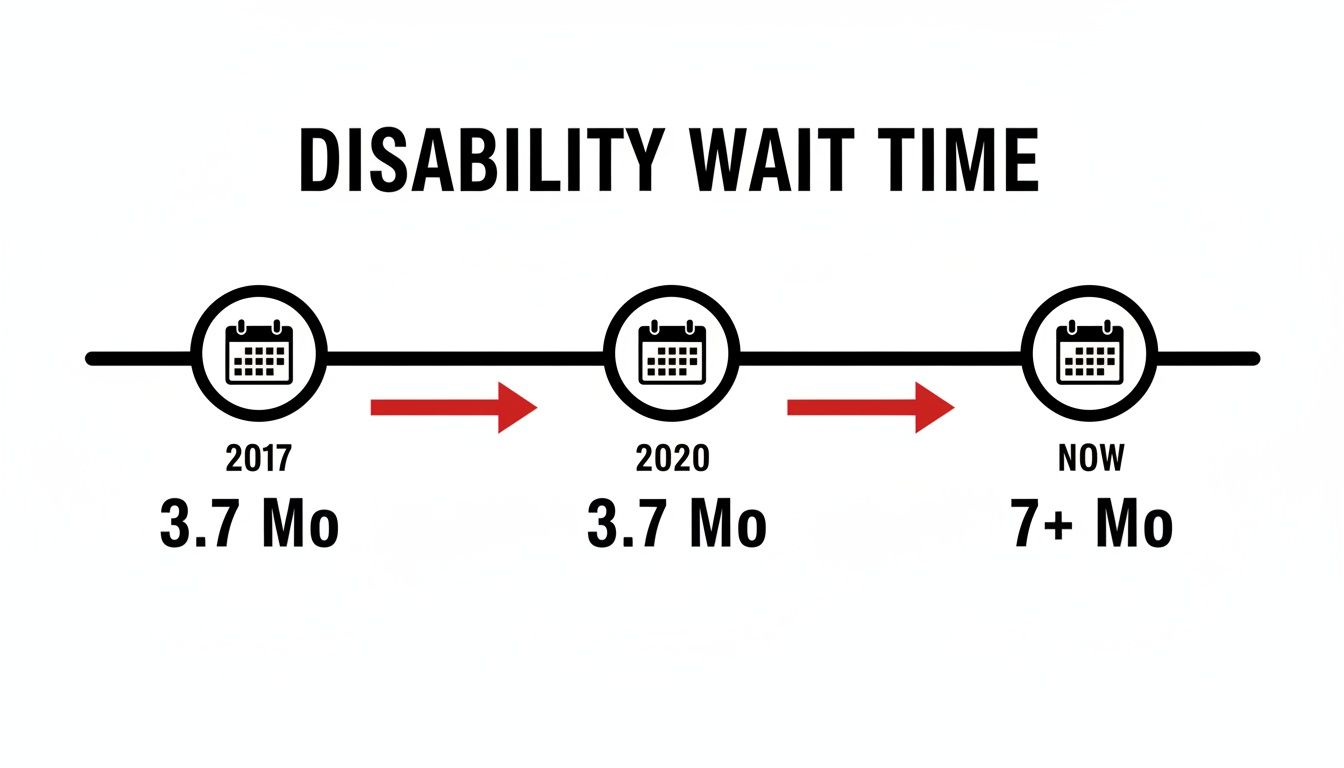
As you can see, the average wait for an initial decision has more than doubled since 2017, which highlights the growing backlogs in the system.
Stage 1: The Initial Application
This is square one for every disability claim. Once you submit your paperwork, your file goes to a state-level agency known as Disability Determination Services (DDS). There, a claims examiner and a medical consultant team up to review your medical records and determine if you meet the Social Security Administration's (SSA) definition of disability.
Their main job is to gather all the facts—your work history, treatment records, and doctor's notes. A DDS examiner may call you or your doctor's office for more information; it's a routine part of their investigation. For a deep dive into this first step, check out our guide on how to apply for SSDI benefits.
Stage 2: Reconsideration
If an initial application is denied—and many are—your first appeal is called a Reconsideration. Your file is handed over to a different DDS examiner who had nothing to do with the first decision. They will review all the original evidence along with any new medical information you've provided since the denial.
This is your second shot at the state level. It’s a critical opportunity to strengthen your claim with updated medical records or new reports from specialists that fill in any gaps from the first review.
Stage 3: The Administrative Law Judge Hearing
If the Reconsideration is also a denial, you can request a hearing with an Administrative Law Judge (ALJ). This is a big step. For the first time, you may be able to present your case in person (or by video) to the person who has the authority to approve your benefits.
An ALJ hearing is more like a formal legal proceeding. The judge will have your entire file and will ask you direct questions about your medical condition, your past work, and how your disability impacts your daily life. Often, a vocational expert and a medical expert may also be there to provide testimony. This stage can be the longest wait in the entire process.
Stage 4: The Appeals Council and Federal Court
If the ALJ denies your claim, you have two final, and less common, options for appeal.
- Appeals Council: You can ask the Appeals Council to review the judge's decision. They aren't re-evaluating your disability; they're looking for legal or procedural mistakes the ALJ might have made. The Council can deny your request, approve your claim outright, or—as is often the case—send your case back to an ALJ for a new hearing.
- Federal Court: Your last resort is to file a lawsuit in a U.S. District Court. This is a complex legal battle where a federal judge examines the entire administrative record to decide if the SSA’s final decision was legally sound and backed by substantial evidence.
Key Factors That Shape Your Application Timeline
No two disability applications move at the same speed. While national averages give you a ballpark idea, several key factors can speed up or slow down a specific claim. It may be helpful to think of it as telling a story to the Social Security Administration (SSA)—the clearer, more detailed, and better supported that story is, the more efficiently an examiner may be able to understand it and make a decision.

Getting a handle on these variables gives you a behind-the-scenes look at the evaluation process. It also explains why some people hear back in months while others are left waiting for years. Every applicant's journey is unique because it's shaped by the specific details of their life and health.
The Quality and Completeness of Your Medical Records
The strength of your medical evidence can be a key factor in your application's timeline. The Disability Determination Services (DDS) examiner making the decision relies heavily on the records from your doctors, specialists, and hospitals.
If your file has big gaps in treatment, is missing objective evidence like MRIs or lab tests, or is just plain thin, the examiner may have to pause the review. They will have to spend extra time hunting down that missing information, a process that can add weeks or even months to your wait. Starting with a complete, well-documented medical history can contribute to a smoother review.
For mental health conditions, a thorough psychiatric evaluation can provide the detailed clinical findings that examiners need, often becoming a critical piece of evidence.
A well-organized application with comprehensive medical evidence allows an examiner to see the full picture of your condition and its limitations without needing to stop and gather more information, which is a common source of delay.
Your Age, Education, and Past Work Experience
The SSA doesn't just look at your medical condition. They also have to consider what they call "vocational factors" to decide if you could perform other types of work despite your limitations.
These non-medical details are a huge part of the puzzle.
- Age: The SSA has specific age categories (like "younger individual" or "person closely approaching advanced age"). Being over 50, for instance, can change how a case is viewed.
- Education: Your educational background and any special training you've had are used to assess your ability to learn new skills and adapt to different jobs.
- Past Work: The type of work you used to do—whether it was unskilled, semi-skilled, or skilled—and its physical demands are put under a microscope.
An examiner weighs all these factors against your medical limitations. If a case involves a complex mix of these elements, it will require a more in-depth analysis, and that just takes more time.
The Specifics of Your Medical Condition
The nature of your impairment itself plays a big role in the timeline. Some conditions are simply easier to document with objective medical tests than others. For example, a spine injury confirmed by an MRI might be evaluated more quickly than a condition like fibromyalgia, which can rely more on subjective reports of pain and fatigue.
On the other hand, some extremely severe conditions can actually get a faster decision. The SSA’s Compassionate Allowances (CAL) program flags applications for certain diagnoses—like aggressive cancers or late-stage neurological diseases—for expedited processing because they are presumed to meet disability standards.
How To Proactively Manage Your Disability Claim
While you have no control over the internal workings and timelines at the Social Security Administration (SSA), you can influence how smoothly your own claim moves through the system. Thinking ahead from day one is a good way to sidestep common administrative hiccups that tack on extra weeks or even months to your wait.
Taking an active role is about more than just filling out forms. It’s about being the project manager of your own claim, ensuring the right information gets from you and your doctors to the SSA examiner in a clear, organized fashion. A clean, well-supported file makes it easier for an examiner to process a claim.

Maintain Consistent Medical Treatment
One general principle in a disability claim is this: keep going to the doctor. The SSA needs to see a consistent, ongoing story of your condition, your symptoms, and the treatments you've tried.
Big gaps in your treatment history can be red flags for an examiner. They can create questions about how severe or persistent a condition really is. By continuing to see your doctors and following their prescribed treatment, you’re building the crucial documented history your file needs.
Keep Meticulous and Organized Records
You may be dealing with a mountain of paperwork—medical records, test results, letters from the SSA, you name it. Keeping it all organized isn't just a good idea; it's a vital strategy. Grab a folder, a binder, or a box and make it the dedicated home for every single document related to your claim.
This simple habit can be very helpful. When the SSA requests a specific form or record, you'll know exactly where to find it, allowing you to respond immediately and avoid delays. Beyond your disability claim, knowing how to get help with expediting other essential benefit applications can be a huge part of managing your overall financial and medical stability.
Answering SSA requests for information quickly and completely is one of the few areas where you have direct influence over the speed of your claim's review. Delays in your response can cause your file to be set aside, adding weeks or months to the process.
Provide Complete and Accurate Information
The forms you fill out are the very foundation of your entire case. Taking the time to provide thorough, accurate information right from the start can prevent the back-and-forth of follow-up questions from the SSA.
Pay special attention to your list of medical providers and your work history. A wrong phone number for a clinic or a misspelled name of a former boss can bring the review of your file to a halt while the examiner tries to track down the correct details. The checklist below can help you gather everything you might need.
Checklist For A Well-Prepared Disability Application
Gathering these key documents and pieces of information before you even start can help you build a stronger case and avoid some of the most common delays.
| Contact Information for All Medical Providers | Ensures the SSA can quickly request and receive your complete medical records without delay. |
| Detailed Work History (Last 15 Years) | Provides the examiner with the necessary details to evaluate your past job duties and skills. |
| List of Current Medications and Dosages | Offers insight into your treatment plan and the severity of your medical conditions. |
| Copies of Key Medical Evidence | Having your own copies of MRIs, lab results, and specialist reports can help ensure nothing is missed. |
| A Log of All Communications with SSA | Helps you keep track of deadlines, requests, and the names of representatives you speak with. |
Ultimately, a proactive approach is about making the examiner's job as easy as possible. When you provide a clear, complete, and well-documented file, you’re giving them everything they need to make a fair decision based on the facts—and to do it in a timely manner.
When Should You Call a Lawyer?
Trying to get Social Security Disability benefits can feel like trying to navigate a maze. The rules are confusing, the paperwork is endless, and the waiting can feel like an eternity. At some point, many people wonder if it's time to ask for help. While bringing in a lawyer is a personal decision, it’s worth understanding what a representative does.
Think of a disability attorney as your project manager and advocate. Their job is to build the strongest case possible and present it clearly to the Social Security Administration (SSA). They know the system, the deadlines, and the kind of evidence that matters most, which can be a relief when you're already dealing with a serious health condition.
What a Disability Lawyer Really Does
When people ask, "how long does a disability application take?", the honest answer is "it depends." One of those dependencies is how well the case is put together from the start. This is where a lawyer can make a difference.
A large part of their job is gathering and organizing your medical records. They know how to identify specific evidence that documents your limitations and will work to get those records submitted to the SSA correctly and on time. This is about building a complete, compelling story of your medical situation.
Your representative also becomes the main point of contact with the SSA. They can handle the communication, respond to requests, and make sure every form is filled out before a deadline hits. Simple administrative mistakes are a common reason for denials, and a lawyer helps you sidestep those pitfalls. Of course, the financial part is a major concern for most people, and you can learn more about how Social Security attorney fees are structured to see how that works.
Getting Ready for a Hearing
If a claim is denied at the initial and reconsideration levels—which happens to a majority of applicants—the next shot is a hearing in front of an Administrative Law Judge (ALJ). This is a critical stage of the process, and it's where having an experienced professional in your corner can be invaluable.
Going into a hearing is not something you want to do unprepared. A representative helps you get ready by:
- Digging into your file: They'll go through every piece of evidence to find the strengths and weaknesses of the case long before you see the judge.
- Prepping your testimony: They will walk you through the kinds of questions the judge will likely ask, helping you explain—in your own words—how your condition truly affects your ability to work and live your life.
- Questioning expert witnesses: The SSA often has vocational or medical experts testify at hearings. Your lawyer knows how to cross-examine them to protect your interests.
At a hearing, the goal isn't just to tell your story, but to present it in a way that is organized, persuasive, and legally sound. A lawyer makes sure the judge has all the facts needed to make a sound decision.
For people here in Oregon, our team at Bell Law Offices, PC, has guided clients through this system for years. Whether you're in Eugene, Portland, Salem, or the surrounding areas, we focus on giving you the information and support you need to feel confident at every step. Our job is to take the mystery out of the process and help you build the strongest claim possible for your unique situation.
Common Questions About Disability Application Timelines
It's completely normal to have a lot of questions about how long the Social Security Disability process takes. While every single case is different, getting a handle on the general timeline can help you know what to expect.
Here, we'll tackle some of the most frequent questions we hear from people navigating the disability system. Think of this as a quick-reference guide to help you make sense of the road ahead.
Can My Disability Application Be Expedited?
The short answer is: sometimes, but it's rare. The Social Security Administration (SSA) does have a few programs designed to fast-track applications for the most severe cases. These include claims involving a terminal illness (called TERI cases) or situations of dire need, like being unable to afford food or facing homelessness.
However, the bar for these programs is quite high, and most applications won't qualify for expedited processing. For nearly everyone, the best strategy to keep your claim moving smoothly is to submit a rock-solid, complete application right from the start.
You can't directly control the SSA's internal processing speed, but you absolutely have control over the quality of your application. A clean, well-organized file with all the necessary documentation is almost always a faster file because it prevents the simple administrative hiccups that cause so many delays.
Why Is My Friend's Case Moving Faster Than Mine?
This is a classic and totally understandable question. You and a friend might apply on the same day, yet your timelines look completely different. It's frustrating, but it happens all the time because no two disability claims are ever identical.
Several key things can make one case move faster than another:
- The Medical Condition Itself: Some conditions are simply easier to prove with objective evidence like MRIs or blood tests, while others rely more on subjective reports.
- The Strength of Your Medical Records: A person with years of consistent treatment from specialists often has a more straightforward file to review than someone with significant gaps in their medical history.
- Local Office Caseloads: Wait times can vary dramatically just based on the workload at your specific SSA field office and the Oregon Disability Determination Services (DDS) agency.
- The Path of the Claim: If one person gets approved at the initial application stage while another has to appeal and wait for a hearing, their timelines will naturally be separated by many months, if not more than a year.
What Happens If My Disability Application Is Denied?
First, don't panic. Getting an initial denial is very common—in fact, it's a standard part of the process for the majority of applicants. A denial is not the end of the road; it's simply the first step in a much longer journey.
After a denial, your first move is often to file a Request for Reconsideration. This asks a new claims examiner at the SSA to take a fresh look at your file. If your claim is denied again, you can then request a hearing with an Administrative Law Judge (ALJ). The hearing is where many people have success with their claim. Seeing a denial as just one stage in a multi-step process can help you stay focused and prepared for what's next.
The Social Security Disability process is a marathon, not a sprint, and the long waits can take a toll. Having an experienced guide in your corner can make all the difference.
At Bell Law Offices, PC, our team is focused on helping Oregonians build the strongest claim possible and navigate every step of this complex system. If you're feeling lost or have questions about your disability application, we're here to help. Find out more about how we can support you by visiting Bell Law Offices.
Disclaimer: The information on this page is provided for general informational purposes only and is not legal advice. Reading this content does not create an attorney-client relationship. For advice about your specific situation, please contact a licensed attorney.