Lane Splitting in Oregon: A Guide to the Laws
"I was satisfied once John Bell took over my case."
"Communication was always timely."
Lane Splitting in Oregon: A Guide to the Laws
If you ride a motorcycle in Oregon, you may have found yourself stuck in traffic wondering about the cars on either side of you. Can you just ride between them? The short, simple answer is no. Lane splitting is not permitted under current Oregon law.
That means riding your bike between two lanes of traffic—whether the cars are stopped or just crawling along—is against the law. Let's break down exactly what that means for riders on Oregon's roads.
Understanding Oregon's Stance on Lane Splitting

The state’s prohibition isn't based on a law that explicitly says "no lane splitting." Instead, it's rooted in existing traffic statutes that dictate how all vehicles are supposed to behave on the road.
The key piece of legislation here is Oregon Revised Statute (ORS) § 814.240, which covers "unlawful passing in a lane." While the statute doesn't use the term "lane splitting," its language effectively outlaws the practice. It lays out the rules for overtaking another vehicle, and riding between marked lanes simply doesn’t fit within those legal maneuvers.
What This Law Means for Riders
From the bumper-to-bumper traffic in downtown Portland to the wide-open roads of Eastern Oregon, the rule is the same. Motorcyclists are required to operate their bike within a single, defined lane, just like a car or truck.
Essentially, the law treats your motorcycle as a full-sized vehicle. It should occupy the lane, and if you want to pass someone, you have to do it by legally and safely changing lanes. Squeezing between cars, even when they’re at a standstill, is considered an improper pass and can result in a traffic ticket. This is a crucial distinction that sets Oregon apart from states like California, where lane splitting is allowed under specific circumstances.
The thinking behind Oregon’s law is to keep traffic patterns predictable. By requiring every vehicle, motorcycles included, to stay within a single marked lane unless actively passing or turning, the rules aim to reduce confusion and surprises for all drivers.
To help clarify, here’s a quick summary of how Oregon law treats common motorcycle maneuvers.
Oregon Motorcycle Traffic Maneuvers at a Glance
| Lane Splitting | Illegal | Implied prohibition under ORS § 814.240 (Unlawful passing in a lane) |
| Lane Sharing | Legal | ORS § 814.250 allows two motorcycles to ride side-by-side in a single lane |
| Lane Filtering | Illegal | Considered a form of lane splitting; not permitted |
As the table shows, while you can't ride between lanes, you can ride side-by-side with another motorcycle in the same lane. It's a key difference many riders should know.
The Ongoing Legislative Conversation
The topic of legalizing lane splitting is far from settled in Oregon. Given the state's motorcycle crash statistics, it’s a subject that comes up frequently in legislative sessions, with safety as the core argument for both sides.
A recent proposal, House Bill 2314, aimed to change the law. It would have allowed a limited form of lane splitting on roads with speed limits over 50 mph when traffic slowed to 10 mph or less. Under the bill, riders could have moved no more than 10 mph faster than the surrounding traffic. However, despite passionate debate, this bill did not pass into law.
You can find more details about Oregon's lane splitting bill and see how these discussions continue to shape the state's motorcycle regulations. For now, the ban remains firmly in place.
The Push to Legalize Lane Splitting in Oregon
If you ride in Oregon, you may have heard the chatter: "Is lane splitting ever going to be legal here?" The short answer is no, not yet. But the conversation is very much alive and has been for years.
Lawmakers in Salem have seen several proposals come and go, each one sparking an intense debate. Supporters aren't just pushing for convenience; their arguments are almost always centered on rider safety and cutting down on traffic jams.
To really get what's being debated, it is helpful to understand the difference between lane splitting and lane filtering. People often use the terms interchangeably, but they describe two very different actions, and it's a critical distinction in the eyes of the law.
Think of it this way: lane splitting is moving between lanes of moving traffic, like a kayaker navigating between boats on a flowing river. Lane filtering, on the other hand, is when a rider moves between lanes of stopped or very slow-moving traffic, like at a red light. This is like that same kayaker carefully weaving through anchored boats to get to the front of the pack.
Most of the legislative efforts we've seen in Oregon have focused on legalizing the second version—lane filtering—and only under very strict conditions.
What Recent Bills Have Proposed
One of the most serious attempts was a bill that laid out a very specific, limited form of lane filtering. It wasn't a free-for-all.
The proposal aimed to keep things safe by setting clear ground rules. A rider would only be allowed to filter between cars when:
- Traffic on a highway with multiple lanes had slowed to a crawl—10 mph or less.
- The posted speed limit on that road was 50 mph or higher.
- The motorcyclist's speed was no more than 10 mph faster than the surrounding traffic.
The idea was to create a low-speed, predictable situation. Proponents argued this would let riders get out of the dangerous position of being sandwiched between cars at a standstill, without encouraging them to weave through fast-moving traffic. But, like the bills before it, this one failed to pass and is not the law today.
The core safety argument from supporters is always about reducing rear-end collisions. A motorcycle stopped in traffic is a sitting duck for a distracted driver. The consequences of that kind of impact are often catastrophic for a rider.
The Arguments for Making a Change
So, why do people keep fighting for this? The arguments from advocates are pretty consistent. First and foremost, they believe allowing riders to filter forward moves them out of the "crush zone" between bumpers, which could potentially cut down on injuries and deaths.
Then there's the traffic flow argument. When motorcycles filter to the front, they're no longer taking up a full car's length of space in a long line of traffic. It might only be a small improvement, but supporters argue it helps ease congestion for everyone on the road.
Finally, advocates often point to other states like California, Utah, and Arizona, where versions of these laws are already on the books. They use them as examples to show that, with clear rules and some public education, Oregon could safely adopt the practice. For now, the debate continues, reflecting a constant push to balance overall road safety with the realities of riding a motorcycle.
What the Research Says About Motorcycle Safety
When Oregon lawmakers and riders talk about lane splitting, the conversation always comes back to one crucial question: is it actually safe? There is no simple yes or no answer. Digging into the research reveals a complex picture, with different studies pointing in different directions. The debate isn't about finding a single truth, but about carefully weighing the risks against the potential benefits.
At its heart, the argument pits two dangerous scenarios against each other. On one side, you have the very real danger of a car driver making a sudden lane change right into a motorcyclist's path. On the other, you have the equally serious risk of a rider being rear-ended while stuck in stopped or slow-moving traffic—a collision that can be devastating for a motorcyclist.
Major Studies and Their Findings
To get a handle on the safety debate, it is useful to look at the research that has shaped it. The best data comes from places where lane splitting or filtering is already legal, giving us a real-world glimpse into how it plays out on the road.
California, where lane splitting has been a common sight for decades, provides some of the most-cited research. A landmark 2015 report from UC Berkeley looked at three years of statewide crash data and found some compelling results. The researchers discovered that lane-splitting motorcyclists were 28 percent less likely to be involved in rear-end collisions. They also found that injury risks dropped dramatically when riders kept their speed under 40 mph and stayed within 15 mph of the surrounding traffic's speed.
But that's just one piece of the puzzle. Other studies paint a different picture. A French study, for instance, showed a 12 percent increase in motorcycle crashes in areas that allowed lane splitting over a five-year period, while areas without it saw a 10 percent decrease. Another study from 2017 suggested that the risk of an injury accident could be nearly four times higher for riders who were filtering through traffic. You can see more details on these findings in a document submitted to the Oregon legislature.
The data on lane splitting can feel contradictory, as different studies focus on unique conditions, traffic patterns, and rider behaviors. This complexity is central to the debate, as seen in the contrasting findings below.
Contrasting Data on Lane Splitting Safety
| Reduced Rear-End Collisions | The 2015 UC Berkeley study found lane-splitting motorcyclists were 28% less likely to be hit from behind. | Opposing views argue that this benefit may not outweigh the increased risk of side-swipe or lane-change collisions. |
| Speed Differential is Key | The same Berkeley study noted a significant drop in injuries when riders kept their speed differential below 15 mph. | Critics point out that maintaining such a low speed differential can be difficult in real-world, unpredictable traffic. |
| Overall Accident Rates | A French study showed a 12% increase in motorcycle crashes in areas where lane splitting was permitted for a trial period. | Proponents argue that such increases may be temporary, linked to a lack of driver and rider education during the transition. |
Ultimately, these studies show that the conditions under which lane splitting occurs are what truly determine its safety, which is why the debate over its legalization in places like Oregon is so nuanced.
Interpreting the Conflicting Data
How can smart people looking at the same topic come to such different conclusions? It all comes down to the specific conditions they're studying.
- Speed Differential: There's a world of difference between slowly filtering through a traffic jam and speeding between lanes on the freeway. The speed of the motorcycle relative to the cars around it is the single most critical factor.
- Traffic Conditions: The practice is much different in dense, stop-and-go city traffic versus freely moving highway conditions. What's relatively safe in one environment could be incredibly risky in another.
- Driver Awareness: This is a huge one. In places like California, drivers are more conditioned to look for motorcycles between lanes. Here in Oregon, where the practice is illegal and unexpected, a driver may be less likely to check their blind spot for a filtering rider.
These variables make it tough to just lift the findings from one state or country and apply them directly to Oregon. What works in California's driving culture wouldn’t necessarily translate here without a massive public education campaign for every driver on the road.
The chart below gives a good idea of the kinds of strict rules that are often proposed in legislation to try and manage these exact risks.
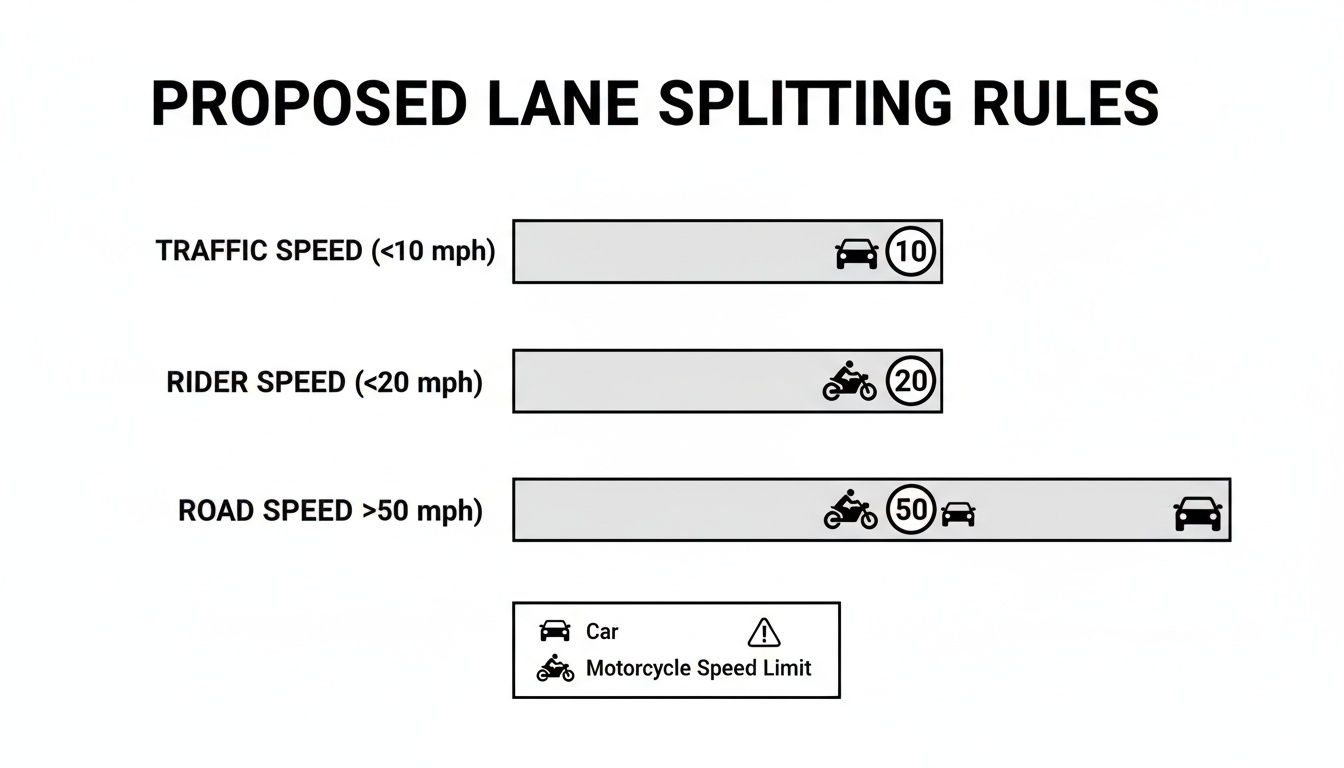
As you can see, the focus is almost always on creating a controlled, low-speed environment to make the maneuver as safe as possible.
What This Means for Oregon Riders
In the end, the research doesn't give us a clean, simple verdict. Lane splitting isn't universally "safe" or "unsafe." Instead, its safety appears to be dependent on the context—the specific circumstances in which it's done.
For Oregon lawmakers and residents, the key takeaway is that the details matter immensely. Any potential legalization would likely hinge on defining very specific, controlled conditions that aim to maximize the potential safety benefits while minimizing the inherent risks.
This complexity is why the discussion keeps going. Supporters will point to the data showing a reduction in dangerous rear-end crashes. Opponents, just as rightly, will highlight the risk of side-swipes from drivers who simply aren't expecting a motorcycle to be there. Until a consensus is reached on how to balance these risks, the practice will remain illegal in Oregon, and the debate over the data will continue.
How Liability Works in a Motorcycle Accident
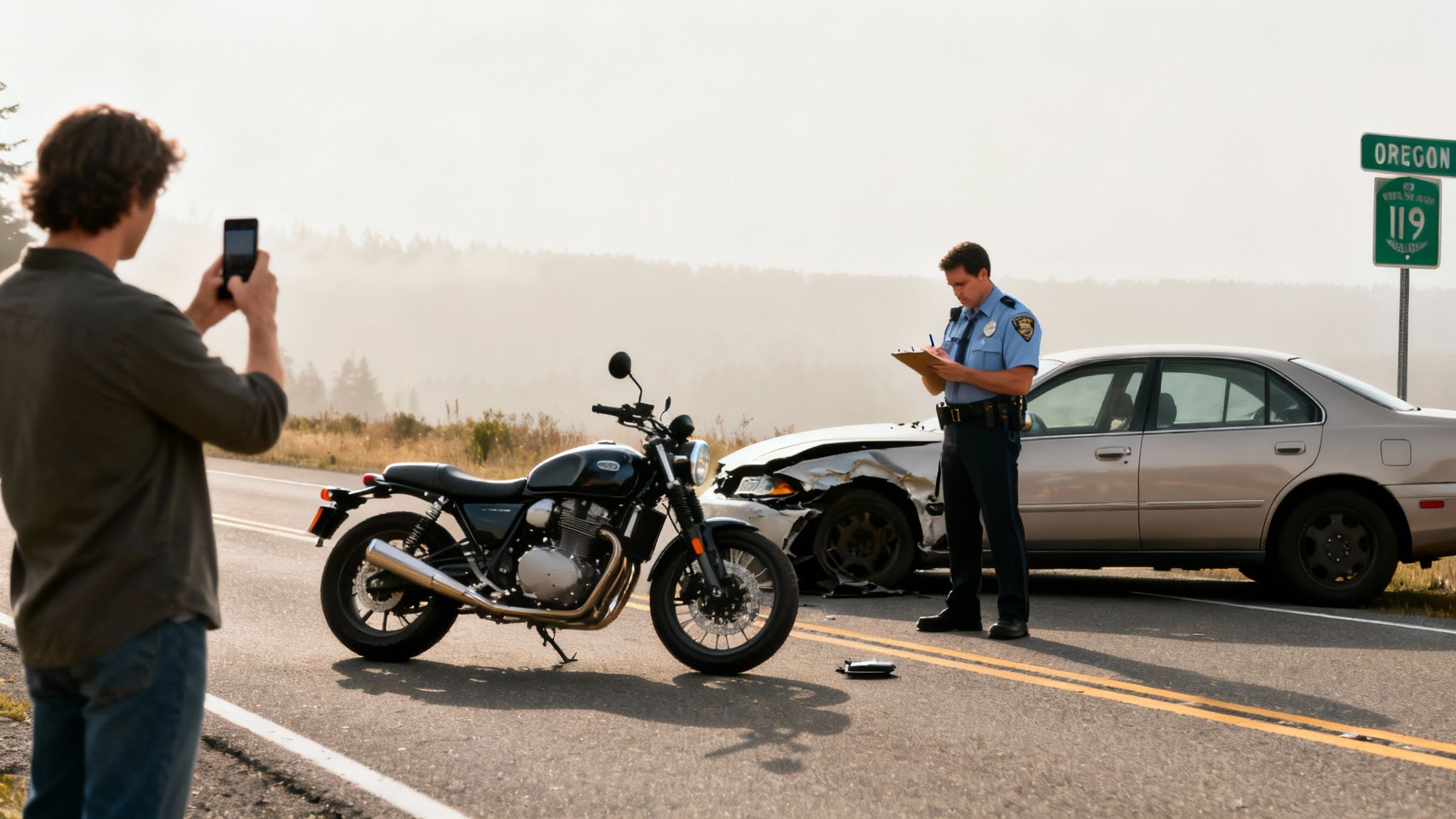
After a motorcycle crash, things can get confusing fast. Once you know everyone is safe and medical care is on the way, the big questions start to pop up: Who’s at fault? Who pays for this? Getting a handle on how Oregon determines liability is the first step toward finding answers.
At the heart of any personal injury case is a legal concept called negligence. It’s really just a formal way of saying someone failed to be reasonably careful, and that failure caused harm to someone else. Everyone on the road has a basic duty to operate their vehicle safely, whether they’re in a car or on a bike.
When a driver breaches that duty—maybe by texting, speeding, or changing lanes without looking—and an accident happens as a result, they may be considered negligent. Figuring out liability means looking at what everyone involved did (or didn't do) to see who may have failed in their duty of care.
The Role of an Illegal Maneuver
Of course, a motorcyclist's actions are also under the microscope. Since lane splitting in Oregon is illegal, a rider who is doing it is, by definition, breaking a traffic law. This can become a huge factor when an accident claim is being evaluated.
If a crash occurs while a rider is lane splitting, that maneuver will be a central part of the investigation. It doesn't automatically put 100% of the blame on the rider, but it can complicate things. The key question becomes: how much did that illegal act contribute to the accident?
It's crucial to remember that fault isn't always a simple, all-or-nothing blame game. The actions of everyone involved are weighed to build a complete picture of why the crash happened.
This is where Oregon's specific rules on shared fault come into play. The system is designed to acknowledge that sometimes, more than one person is responsible for a collision.
Understanding Comparative Negligence
Oregon uses a legal framework known as modified comparative negligence. This is just a system for assigning a percentage of fault to each person involved in an accident. It’s a way of recognizing that real-world accidents are often messy, with both parties potentially contributing to the outcome.
Think of it like a pie chart of blame. After looking at all the evidence, each person may be assigned a percentage that reflects their share of the responsibility. For instance, a car driver might be found 70% at fault, while the motorcyclist is found 30% at fault.
This percentage split has very real financial consequences. Under Oregon law, you can recover damages from the other party as long as your share of the fault is not greater than theirs. In practical terms, this means if you are found to be 50% or less at fault, you can still file a claim. If your fault is pegged at 51% or more, you may be barred from recovering anything.
How Different Actions are Weighed
Let’s walk through a general scenario. Say a car driver suddenly swerves into another lane without signaling, hitting a motorcycle. The driver’s failure to signal and check their blind spot may be an act of negligence.
Now, let's add a twist: what if the motorcyclist was illegally lane splitting when they were hit? In this case, an insurance adjuster or court would have to weigh both actions—the car's unsafe lane change and the bike's illegal pass.
The final percentages of fault would depend on the specific details. An investigator would look at factors like:
- The speed of both the car and the motorcycle
- Visibility, weather, and general road conditions
- Whether the driver could have reasonably seen the motorcyclist
- How aggressive the car driver's lane change was
This detailed analysis is what determines how responsibility gets divided. For anyone dealing with an insurance company after a wreck, it's also helpful to understand the basics of third-party liability. We break down how claims against another person's insurance work in our guide on what is third-party liability. Reading it can give you a much clearer picture of the entire process.
What to Do After a Motorcycle Collision in Oregon

The moments after a motorcycle crash can be a blur of adrenaline and confusion. It’s tough to think clearly. But what you do right then and there can have a huge impact on your health and any future claim.
Your absolute first priority is safety. If you can, get yourself and your bike out of the flow of traffic. Check on everyone else involved and call 911 immediately for police and medical help.
Even if you think you’re okay, you need an official police report. This document is a critical, objective record of what happened, and it can be needed later.
Gathering Information at the Scene
Once you've called for help and are in a safe spot, it's time to become a detective—if you're physically able. The evidence you gather now can paint a powerful picture of the crash.
Grab your phone and start taking pictures and videos. Go for more than you think you need. Get shots of everything from different angles:
- Vehicle Positions: Where did the bikes and cars end up?
- Property Damage: Get close-ups of the damage to your bike, the other vehicle(s), and anything else that was hit.
- Road Conditions: Capture skid marks, debris on the road, traffic signs, and signals.
- Visible Injuries: Take photos of any cuts, bruises, or scrapes you have.
Next, you'll need to exchange information with the other driver. Get their name, contact info, driver's license number, and insurance details. If anyone saw what happened, ask for their name and number, too. A witness's account can be invaluable.
Stick to the facts when you talk to the other driver. Explaining what you saw happen is very different from saying "it was my fault" or guessing about the cause. Keep it simple and direct.
Later, when you have a quiet moment, write down everything you remember. The time, the weather, the location, a step-by-step account of the crash—these details fade fast, so get them on paper while they're fresh.
Essential Steps After the Accident
What you do in the days and weeks after the crash is just as important as what you did at the scene. This is the time to focus on your recovery and get your paperwork in order.
Get checked out by a doctor right away, even if you feel fine. The adrenaline from a crash can easily mask serious problems like concussions or internal injuries. A medical evaluation creates a professional record that ties your injuries directly to the accident.
From here on out, organization is your best friend. Start a file and keep everything related to the crash in one place:
- The police report number
- All medical bills and treatment notes
- Receipts for prescriptions, co-pays, or other costs
- Proof of any time you missed from work
- Every email and letter from the insurance companies
You’ll have to report the accident to your own insurance company. Just give them the facts you collected. It's also helpful to know how official accident classifications work; for those interested in the specifics, understanding DOT recordable accidents provides a deeper look. While every crash is unique, our general guide on what to do after a car accident has some extra tips that you might find useful.
Whether your accident involved an illegal move like lane splitting in Oregon or was a more common type of collision, being prepared can make all the difference. Speaking with a legal professional can help you understand your rights and figure out the best path forward.
Your Questions About Oregon Motorcycle Laws, Answered
When you're out on the road, knowing the rules is everything. This is especially true for motorcyclists, who often have questions about specific practices like lane splitting. Let's clear up some of the most common questions we hear from riders in Oregon.
What Happens If I Get a Ticket for Lane Splitting in Oregon?
Getting caught lane splitting in Oregon means you'll be cited for an unlawful passing maneuver. The state classifies this as a Class B traffic violation.
This is treated like many other moving violations. It can result in fines and potential points on your record. The exact penalty often depends on the specifics of the situation and your driving history. If you're handed a ticket for this, it's important to understand exactly what you're being cited for and what your options are.
Could My Insurance Claim Be Denied If I Was Lane Splitting?
This is a big question. If you're in an accident while lane splitting, it can definitely complicate your insurance claim. Insurance companies look at the actions of everyone involved to figure out who's at fault.
Oregon operates under a "comparative fault" system. This means an insurer will likely argue that because you were performing an illegal maneuver, you share some—or even all—of the blame for the crash. This could seriously reduce the amount of compensation you can recover for your injuries and bike damage. It’s always a good idea to pull out your policy and get familiar with its terms before you ever have to make a claim.
When a collision occurs, investigators look at the whole picture. Even if another driver clearly made a mistake, your own actions will be scrutinized and weighed in the final determination of fault.
Figuring out the next steps after an accident can be overwhelming. To get a better sense of the landscape, take a look at our guide on when to hire a personal injury attorney, which walks you through the process.
Are There Neighboring States Where Lane Splitting Is Legal?
Yes, and this is where it gets tricky for riders who travel. The moment you cross state lines, the rulebook can change completely. While Oregon holds a firm line against the practice, several other states have given it the green light in one form or another.
It's on you as the rider to know the local laws wherever you go. For example:
- California has allowed lane splitting for years, though with certain common-sense conditions.
- Utah permits a version called "lane filtering," where riders can move between stopped traffic.
- Montana and Arizona have also passed laws allowing specific types of lane filtering.
The rules are anything but uniform, so doing a quick search before a road trip is one of the smartest things you can do to stay on the right side of the law.
What Is the Difference Between Lane Splitting and Lane Filtering?
People often use these terms as if they mean the same thing, but in the eyes of the law, they are quite different. The key distinction boils down to one simple factor: whether the traffic around you is moving or at a standstill.
Let's break it down:
| Lane Splitting | Riding your motorcycle between two lanes of moving traffic. | Cruising between cars on the freeway that are flowing, even if they're moving slowly. |
| Lane Filtering | Moving your motorcycle between lanes of stopped or barely crawling traffic. | Weaving between stationary cars to get to the front of the pack at a red light. |
Most of the recent legislative efforts in Oregon and other states have focused on legalizing the much more limited act of lane filtering, not full-on lane splitting. Filtering is often seen as a safer, more practical maneuver. But for now, it's crucial to remember that in Oregon, both are illegal.
If you've been hurt in a motorcycle accident, understanding your rights is the first step toward getting back on your feet. The team at Bell Law is here to offer clear, straightforward advice and powerful legal support for injured riders across Oregon. Contact us today for a consultation to talk about your case.
Disclaimer: The information on this page is provided for general informational purposes only and is not legal advice. Reading this content does not create an attorney-client relationship. For advice about your specific situation, please contact a licensed attorney.