
A Guide to Mild Traumatic Brain Injury Settlement Claims
"I was satisfied once John Bell took over my case."
"Communication was always timely."
A Guide to Mild Traumatic Brain Injury Settlement Claims
A mild traumatic brain injury settlement is about seeking compensation for an injury that's often misunderstood. The word "mild" can be incredibly misleading. While the initial event might not seem catastrophic, the ripple effects can change someone's life. A settlement is meant to account for every single one of those ripples.
What Exactly Is a Mild Traumatic Brain Injury?

A mild traumatic brain injury (mTBI), often called a concussion, can happen when a sudden jolt or blow to the head shakes the brain and temporarily affects its normal function. Unlike severe brain injuries, an mTBI may not cause a long loss of consciousness, but the fallout can be serious and last for months or even years.
The "mild" label generally describes the injury at the moment it happens. It may have very little to do with the severity of a person's symptoms or how much the injury disrupts their life down the road. That's a critical distinction to make.
The True Impact of a "Mild" Injury
Think of the brain as a sophisticated computer running everything in a person's life. A concussion can be like a sudden power surge. It might not break any physical parts, but it can scramble the operating system.
That’s a potential reason why standard MRIs and CT scans often come back "normal." The injury may not be a crack in the hardware; it can be a glitch in the software that may show up in all sorts of frustrating ways.
Common symptoms of an mTBI can include:
- Cognitive Fog: Trouble remembering things, focusing on tasks, or just thinking clearly.
- Emotional Volatility: Suddenly feeling irritable, anxious, or experiencing unpredictable mood swings.
- Physical Pain: Chronic headaches, dizziness, constant fatigue, and a new sensitivity to light and noise.
- Functional Problems: Finding it difficult to keep up at work or even manage simple household chores.
When these symptoms stick around, medical professionals may call it post-concussion syndrome. It can impact a person's ability to work, connect with their family, and enjoy the life they once had. For a deeper look at how different types of harm are valued, you can read our guide on a bodily injury claim.
The Challenge with mTBI Settlements
This is where things can get tricky. Pursuing a mild traumatic brain injury settlement may not be straightforward because the injury can be "invisible." You can't show an insurance adjuster an x-ray of a headache or a photo of your memory loss.
Demonstrating the full extent of damages often involves building a case with clear, consistent evidence. It's about much more than just tallying up the first few doctor's visits; it's about painting a complete picture of how this injury has fundamentally changed a person's life.
A settlement for a mild TBI isn't just for the accident itself. It’s for the aftermath—the sleepless nights, the lost wages, the cognitive struggles, and the emotional distress that follows.
These injuries are incredibly common. Global data reveals that mild TBIs account for the vast majority of all head injury cases, especially in places like North America. Because they make up such a large number of personal injury claims, it’s more important than ever to document their impact meticulously. The outcome of a claim can depend on the ability to translate a personal, subjective experience into a powerful, evidence-backed story.
How Insurers Calculate Mild TBI Claim Value
When an insurance company looks at a mild TBI claim, it follows a specific process. Adjusters systematically break down every loss into distinct categories, often called “damages.” The goal is to build a complete financial picture of how this injury has impacted a person's life.
This process boils down to two main types of damages: economic and non-economic. Think of it like a house fire. The cost to rebuild the structure and replace furniture is straightforward—you can get quotes and receipts. But how do you put a price on losing irreplaceable family photos or the feeling of safety in your own home? One is easy to tally, the other is deeply personal, but both are very real losses.
Tangible Costs Known as Economic Damages
Economic damages are the calculable losses that can come with receipts. These are the concrete, out-of-pocket costs and financial hits taken because of the injury.
These documented expenses form the bedrock of a claim's valuation. The more thorough the records, the stronger the foundation for a potential settlement.
Common examples of economic damages include:
- Medical Bills: This includes everything from the ambulance ride and ER visit to follow-ups with specialists like neurologists, neuropsychologists, and physical or occupational therapists.
- Future Medical Care: A mild TBI can have lingering effects. If ongoing therapy, medication, or other treatments are needed down the road, the estimated cost of that future care is part of the calculation.
- Lost Wages: This is the pay missed out on because a person was physically unable to work while recovering. Pay stubs and a letter from an employer can be key here.
- Diminished Earning Capacity: This is a big one. It addresses the long-term hit to a career. If the TBI prevents a return to an old job, or if a person can no longer work toward a promotion, this damage category accounts for that potential lost future income.
Because medical care is often the biggest part of a TBI claim, understanding insurance coverage for medical treatments for therapies like hyperbaric oxygen can be crucial when planning for long-term recovery.
Intangible Impacts Known as Non-Economic Damages
While economic damages cover what came out of a wallet, non-economic damages are about what the injury took from a person's quality of life. These are the invisible wounds of a mild TBI—the frustration, the pain, the loss—and they are much harder to put a price tag on.
There is no invoice for suffering. Instead, the value of these damages can be demonstrated by painting a clear picture of how the injury has impacted day-to-day existence, relationships, and happiness.
Non-economic damages are an attempt to place a monetary value on the human cost of an injury. They address the pain, emotional turmoil, and loss of joy that never show up on a bill but are often the most devastating consequences of the harm done.
Here's what can fall under this category:
- Pain and Suffering: This compensates for the physical pain, headaches, dizziness, and general discomfort endured.
- Emotional Distress: This covers the psychological toll—the anxiety, depression, irritability, and fear that so often follow a brain injury.
- Loss of Enjoyment of Life: This is about an inability to do the things that once brought joy. It could be anything from playing with children to hiking, reading, or just enjoying a quiet evening without a headache.
For example, imagine a dedicated musician who, after a concussion, can no longer tolerate loud sounds or focus long enough to compose music. The cost of their doctor visits is an economic damage. The theft of their passion and creative outlet? That could be considered a non-economic damage, and it's a critical piece of their story and their claim.
To put it all together, here is a breakdown of how these damages are categorized in a mild TBI claim.
Categories of Damages in a Mild TBI Claim
This table outlines the two primary types of compensation sought in a mild traumatic brain injury settlement, with examples for each category.
| Economic Damages | Verifiable monetary losses with a clear paper trail. These are the tangible, out-of-pocket costs. | Medical bills (past and future), Lost wages, Lost earning capacity, Rehabilitation costs, Prescription medications |
| Non-Economic Damages | Subjective, non-monetary losses that affect quality of life. These are the human costs of the injury. | Pain and suffering, Emotional distress, Anxiety and depression, Loss of enjoyment of life, Loss of consortium |
Ultimately, a strong claim effectively documents both the tangible financial costs and the profound, intangible human losses to help ensure the final settlement reflects the true and total impact of the injury.
Building a Strong Foundation with Key Evidence

A fair settlement for a mild traumatic brain injury is built, piece by piece, on a foundation of clear and compelling evidence. Because these injuries are so often "invisible" to the outside world, a strong claim depends on meticulous documentation that tells the whole story.
The goal is to connect the dots for the insurance company—linking the accident directly to the changes in health, ability to work, and daily life. This isn't about a single doctor's note. It's about weaving together a tapestry of medical and personal information that paints a complete picture of a person's reality after the injury.
The Central Role of Medical Documentation
Medical records are the absolute cornerstone of an mTBI claim. They can serve as the official, chronological narrative of a diagnosis, treatment, and recovery. Seeking consistent medical care is, of course, critical for health, but it also creates the paper trail needed to document what a person has been through.
Crucial medical evidence includes:
- Initial Treatment Records: The notes from the ER or urgent care right after the incident are vital. They establish the starting point of the injury.
- Specialist Reports: Evaluations from experts like neurologists or physiatrists can provide a deeper diagnosis and professional opinion on a long-term outlook.
- Therapy Notes: Records from physical, occupational, or cognitive therapy show the real-world functional problems being faced and the hard work being put in to overcome them.
Gathering all these files is a critical first step. For a closer look at the process, our guide on how to get medical records breaks down what's involved.
Objective Data from Diagnostic and Cognitive Testing
Even though many standard imaging tests come back "normal" after a concussion, they still play a key part in a claim. These diagnostic tools are essential for ruling out more severe structural damage, which helps complete the medical picture.
It’s incredibly common for an MRI or CT scan of the brain to show nothing wrong after a concussion. That's because an mTBI is a functional injury—it affects how the brain works, not necessarily how it looks. These scans simply can't capture that kind of damage.
This is where neuropsychological testing can become so valuable. These sophisticated tests may provide objective data by measuring cognitive functions like memory, attention, and processing speed. A neuropsychologist’s report can turn subjective symptoms like "brain fog" into hard numbers, giving tangible proof of cognitive struggles. To ensure records are as strong as possible, one can even explore ways to improve the quality of your clinical documentation.
Painting a Full Picture with Non-Medical Evidence
The true impact of an mTBI spills far beyond the walls of a doctor's office. Non-medical evidence is what can bring the story to life, showing how the injury has disrupted an everyday world in ways a medical chart never could. This kind of proof can be incredibly powerful.
Here are some of the most effective examples:
- Personal Symptom Journal: A simple daily or weekly log tracking headaches, fatigue, dizziness, and cognitive issues. This creates a consistent, first-hand account of the day-to-day battle.
- Statements from Others: Written observations from family, friends, or even coworkers can be persuasive. They can confirm the changes they've seen in personality, mood, or abilities since the accident.
- Work and Financial Records: Pay stubs showing missed days, performance reviews that highlight a drop in productivity, or a letter from a boss can draw a straight line from the injury to financial losses.
Every single piece of evidence, from a neurologist’s formal report to a heartfelt statement from a spouse, is a building block. Together, they can create a solid, undeniable claim that accurately reflects the full and true impact of a mild traumatic brain injury.
What's a Typical Settlement for a Mild TBI?
This is the first question on many people's minds, and unfortunately, it's the hardest one to answer with a simple number. There is no chart or formula that can predict an exact outcome. The truth is, every single case is built on its own unique set of facts, and the settlement value can swing widely from one person to the next.
The main reason for this huge range is that the term “mild TBI” itself covers a massive spectrum of injuries. One person’s concussion might clear up after a few weeks of rest and taking it easy. But for another person, that same "mild" diagnosis can lead to persistent post-concussion syndrome, creating life-altering cognitive and emotional struggles that last for years.
Ultimately, a settlement's value is directly tied to the proven, long-term impact that injury has on a person's life.
Why Is There Such a Big Difference in Settlement Amounts?
Think of it like car damage. A minor fender-bender with a few paint scratches is a quick, low-cost fix. But an accident that looks similar on the surface could have caused hidden frame damage and serious engine problems, making the repair bill ten times higher. The real cost is determined by the damage you can't see at first glance.
The same general principle applies to valuing a mild traumatic brain injury claim. One has to look far beyond the initial ER visit to measure the full extent of the "damage" to a person's life—their health, their career, and their daily well-being.
Several key factors can create dramatic differences in settlement values:
- How Long Do Symptoms Last? A person who is back to normal in two months has a very different claim from someone still battling headaches, memory loss, and brain fog two years later.
- What’s the Impact on Your Job? There's a world of difference between missing a couple of weeks of work and being forced to take a lower-paying job—or stop working altogether—because of lasting cognitive issues.
- Is There Objective Medical Proof? A claim supported by hard data from a neuropsychological evaluation or advanced brain imaging may carry more weight than one based only on symptoms reported to a doctor.
- Will You Need Future Care? A settlement has to cover what's coming. The projected costs of future therapy, medication, or other long-term medical needs can significantly increase the final value.
Hypothetical Scenarios to Illustrate the Point
To see how these moving parts can fit together, let's look at a couple of purely hypothetical scenarios. These are not based on real cases or guarantees of any outcome, but they help show how different facts can lead to vastly different results.
Scenario A: The Quick Recovery
An individual gets into a minor rear-end collision and is diagnosed with a concussion. They deal with headaches and some dizziness for about six weeks. After that, they’re cleared to return to their office job with no restrictions. Their medical bills are fairly low, and their only lost income is from the time they missed work. In this case, the documented long-term impact is minimal.
Scenario B: The Lingering Injury
Another individual sustains a similar concussion after a slip and fall. A year later, they are still struggling with debilitating migraines, frustrating memory problems, and severe anxiety. A neuropsychological exam confirms cognitive deficits, and their doctor says they can no longer handle the high-pressure, detail-oriented work of their accounting career. This situation involves significant medical bills, a potential loss of future earning capacity, and immense pain and suffering.
The key takeaway is this: the settlement value isn't based on the "mild" label. It's based on the demonstrable and lasting consequences the injury has on a person's health, career, and quality of life.
Data from the legal industry shows that concussion claims where symptoms resolve quickly may result in settlements in the low tens of thousands to the mid-five figures. In stark contrast, cases involving proven, long-term cognitive problems or career-ending impacts can be valued well into the six or even seven figures. You can dig deeper into the factors that drive these outcomes in this detailed report on U.S. personal injury practice data.
Navigating The mTBI Settlement Process and Timeline
Figuring out the path to a mild traumatic brain injury settlement isn't a single event—it's a journey. Knowing the typical stages can give you a roadmap for what's ahead and show you why being patient and thorough is so critical. The process starts the moment the injury happens and moves through several key phases before a resolution is reached.
Each step builds on the one before it. It starts with the immediate aftermath, then moves to getting the medical situation stable, gathering all the necessary proof, and finally, entering into negotiations. Following this order is crucial because it can be important to understand the full picture of an injury before making any final decisions.
The First Steps After an Injury
Right after the incident, two things are absolutely essential: reporting what happened and getting immediate, consistent medical care.
Reporting the accident right away—whether it's to the police after a car crash or a supervisor at work—creates an official record. This is a first step in formally linking the event to the injuries sustained.
Just as important is getting a complete medical check-up, even if you feel okay. The symptoms of a mild TBI can appear hours or even days later. An early medical record is the foundation of a claim. From there, consistent follow-up appointments with doctors and specialists aren't just for recovery; they build the detailed medical story needed to present a case.
This timeline illustrates how the length and seriousness of your symptoms can shape how long a settlement takes.
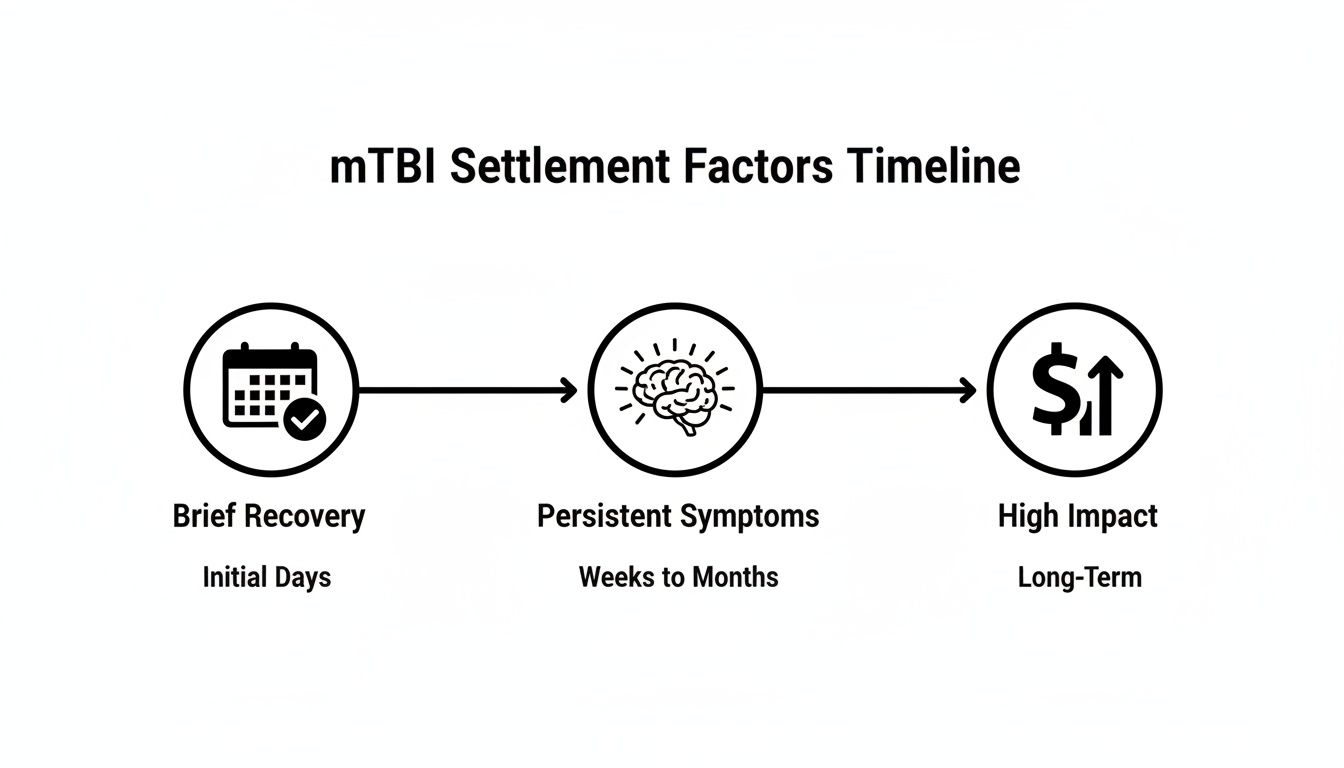
As you can see, when symptoms stick around and the financial toll adds up, the timeline for settling a claim tends to get longer.
Reaching Maximum Medical Improvement
A huge milestone in this process is reaching what’s called maximum medical improvement (MMI). This is simply the point where doctors agree that a condition has stabilized as much as it's going to. In other words, more treatment isn't expected to result in further improvement.
Hitting MMI is a game-changer because it’s only then that one can get a truly accurate picture of the long-term impact of the injury.
Trying to settle a claim before reaching MMI can be a risk. One may not know the full extent of future medical needs, how the injury might limit the ability to work, or if there will be any permanent impairments. The timeline is dictated by the personal recovery journey; the true value of a claim may not be known until the final chapter of the medical story is written.
The Evidence and Negotiation Phase
Once doctors confirm MMI has been reached, the focus shifts. Now, it's all about gathering every piece of evidence and formally presenting the claim. This means pulling together all medical records, bills, proof of lost wages, and any other documentation that shows the damages suffered.
This package of information can then be sent to the at-fault party's insurance company. This kicks off the negotiation phase. An insurance adjuster will comb through everything and may come back with an initial settlement offer, which is often a starting point for a back-and-forth discussion. Handling these conversations can be tricky, which is why our guide on how to deal with insurance adjusters can be a big help here.
How long does negotiation take? It really varies. When mTBI symptoms linger, insurance companies may take more time, waiting until the prognosis is crystal clear. This can push the timeline out anywhere from 6 to 24 months after the injury. On top of that, every state has strict legal deadlines, like the statute of limitations, that must be met.
Common Questions About mTBI Settlements
When you're dealing with the aftermath of a brain injury, the last thing you want is a confusing legal process. It’s completely normal to have a lot of questions about what comes next. How does this work? What should I expect?
Let's cut through the noise and answer some of the most common questions about mild traumatic brain injury claims. The goal is to give you clear, straightforward information so you can feel more in control.
Do I Have To Go To Court To Get A Settlement?
This is a number one concern for many people. The idea of a long, drawn-out court battle can be stressful. But the good news is that many personal injury claims, including those for mTBI, never see the inside of a courtroom.
The vast majority of these cases are settled through direct negotiations. An attorney will put together a detailed demand package—think of it as the complete story of the injury and its impact—and present it to the insurance company. This kicks off a back-and-forth process of offers and counter-offers, with the goal of reaching a fair agreement.
Filing a lawsuit and going to trial is always a possibility, but it's typically a last resort. It generally happens only if the insurance company refuses to make a reasonable offer. For the most part, the aim is to get a fair resolution as efficiently as possible, making a trial the exception, not the rule.
How Long Does An mTBI Settlement Take?
There's no magic number here. Every injury is different, and every case has its own unique timeline. It can be tempting to rush things, but that can sometimes lead to a settlement that doesn't cover long-term needs.
A few key things can dictate the timeline:
- Maximum Medical Improvement (MMI): This is a huge factor. MMI is the point where doctors say a person has recovered as much as they're going to. It's often crucial to wait until reaching MMI to understand the full, long-term picture of the injury.
- The Complexity of Your Case: A claim with extensive medical records, multiple expert opinions, and projections for future care will naturally take more time to build than a simpler case.
- The Negotiation Dance: Some insurance companies negotiate in good faith. Others may drag their feet. The time it takes to go back and forth can range from quick and professional to long and frustrating.
Because of all these moving parts, a settlement can take anywhere from several months to a couple of years. Patience is important here; it ensures the final number can truly reflect everything that has happened.
What If My MRI or CT Scan Is Normal?
This is a huge one, and it causes a lot of anxiety. It's incredibly common for someone with a concussion to have an MRI or CT scan come back "normal." It can make you feel like you're imagining things, but it does not mean the injury isn't real.
Here’s a simple way to think about it:
Standard scans like MRIs are great at finding structural problems—things like a bleed, a tumor, or a fracture. But a mild TBI is often a functional injury. It’s about how the brain’s wiring is firing, not whether there’s a visible hole. These scans just aren't designed to see that kind of disruption.
A "normal" scan doesn't close the book on a claim; it just means the story may need to be told with different evidence. This is where other tools become essential:
- Neuropsychological Testing: These tests may provide hard data on how the injury has affected memory, attention, and processing speed.
- Specialist Reports: A detailed report from a neurologist or physiatrist can explain the functional nature of the injury in a way an insurance adjuster can understand.
- Your Personal Story: Keeping a symptom journal and getting statements from family, friends, and coworkers can paint a powerful picture of how the injury impacts daily life.
So, don't panic over a normal scan. It just shifts the focus to other, equally powerful forms of proof.
Can I Handle An mTBI Claim Without A Lawyer?
Technically, a person can represent themselves. But trying to manage a complex mTBI claim while also trying to recover is a monumental task. It can be an uphill battle.
These cases are far more complicated than they seem. It's not just about filling out forms; it involves interpreting dense medical records, navigating tricky legal deadlines, and going head-to-head with professional insurance adjusters whose job is to pay out as little as possible. Valuing things like pain and suffering or projecting the cost of future medical needs requires experience.
Even a brief consultation with a personal injury attorney can give you clarity on your rights and what the process looks like. An attorney can handle everything—gathering the evidence, dealing with the insurance company, and fighting for a fair number—so you can put all your energy into what truly matters: getting better.
If you are coping with the effects of a mild TBI in Oregon and have questions about your situation, the team at Bell Law is here to help. We are dedicated to guiding our clients through every step of the process with compassion and skill. For a deeper understanding of your options, we invite you to connect with us at https://www.belllawoffices.com.
Disclaimer: The information on this page is provided for general informational purposes only and is not legal advice. Reading this content does not create an attorney-client relationship. For advice about your specific situation, please contact a licensed attorney.