
negotiating medical liens after settlement: Essential tips
"I was satisfied once John Bell took over my case."
"Communication was always timely."
negotiating medical liens after settlement: Essential tips
Reaching a personal injury settlement is a huge relief, but it's not the final step. Before you receive your money, you must address any medical liens, which are legal claims from providers and insurers seeking reimbursement from your settlement funds. The key to maximizing your take-home amount lies in successfully negotiating medical liens after settlement, as the initial amounts demanded are almost never the final word.
Your Settlement Is Finalized—Now What About Medical Liens?
That moment your personal injury case settles feels like the end of a long road. But before you can close this chapter for good, there’s one more critical phase to navigate: resolving the debts tied to your medical care. This is where you protect the money you fought for.
When a hospital or insurance company covered the cost of your treatment, they didn't just do it out of goodwill. They almost certainly placed a legal claim on your future settlement funds to ensure they get paid back.
Provider Liens vs. Insurer Subrogation
It’s crucial to know who you’re dealing with, as claims generally fall into two camps.
First, you have direct provider liens. Think about the hospital that treated you right after the accident. If you couldn’t pay those bills out of pocket, they likely had you sign a lien agreement. This gives them a legal right to a slice of your settlement to cover their costs. You’ll see this often with ER visits, surgeries, and ongoing physical therapy.
Second, there are subrogation claims from insurers. This happens when your own health insurance—whether it's a private plan, Medicare, or Oregon's Medicaid (known as the Oregon Health Plan)—pays your medical bills along the way. Once you secure a settlement from the at-fault party, your insurer essentially has the right to "step into your shoes" and claim back what it spent on your behalf.
The most important thing to remember is that neither a provider's lien nor an insurer's subrogation claim is a final bill. Think of them as the starting point for a negotiation. You have more power here than you think.
Why Negotiation Is Non-Negotiable
You can't just ignore these claims. They are legally binding, and failing to resolve them can lead to lawsuits or a major hit to your credit score.
But that doesn’t mean you should just pay the full amount they ask for. Doing so is one of the biggest mistakes you can make, potentially costing you tens of thousands of dollars. Lienholders, from massive hospital networks to government agencies, are surprisingly open to reducing their claims for a few practical reasons:
- They want quick payment. A guaranteed, immediate check for a reduced amount is often much more attractive to them than a long, drawn-out fight to collect the full balance.
- They have to be realistic. They know you hired an attorney and paid legal fees to get this settlement. Oregon law often requires them to factor in their fair share of your "costs of recovery."
- The settlement isn't just for them. The money you received is also meant to compensate you for your pain, suffering, and lost income—not just to be a pass-through for medical bills.
This post-settlement period is your moment to be strategic. By understanding who has a claim and why their opening demand is flexible, you're in a strong position to start negotiating those medical liens and keep more of the compensation you rightfully deserve.
Key Players in Medical Lien Negotiations
Before you pick up the phone, it helps to know who you'll be talking to. Each party has a different role and goal in this process.
| You (The Plaintiff) | Your goal is to maximize your net recovery by legally and ethically reducing all outstanding claims against your settlement. |
| Your Attorney | Your advocate and negotiator. Their job is to identify all liens, verify their validity, and negotiate reductions on your behalf. |
| Healthcare Providers | Hospitals, clinics, surgeons, or therapists who treated you. They want to recover the full "billed" amount for their services. |
| Private Health Insurers | Companies like Regence, Providence, or Kaiser. They seek to recover the amount they actually paid for your care, not the billed amount. |
| Medicare / Medicaid | Government payers. They have a strong, statutory right to reimbursement but will negotiate based on specific formulas and circumstances. |
| Lien Resolution Services | Third-party companies hired by insurers (especially Medicare) to handle the recovery process. They are professional negotiators. |
Understanding these players and their motivations is the first step in developing a successful negotiation strategy.
How to Identify and Verify Every Claim Against Your Settlement
Before you can even think about negotiating liens, you have to play detective. The first and most critical job is to hunt down every single entity that has a legal claim to a piece of your settlement. This groundwork isn't just important; it's non-negotiable. You can't win a battle if you don't even know who's on the other side.
This goes way beyond just collecting a stack of bills. It means methodically tracking down every doctor, hospital, insurer, and government program that paid for anything related to your accident. Smart negotiation begins with obsessive preparation, making sure no claim is missed and no charge goes unchecked.
Think of the process like this: you get the settlement, then you identify the liens, and only then can you start negotiating.
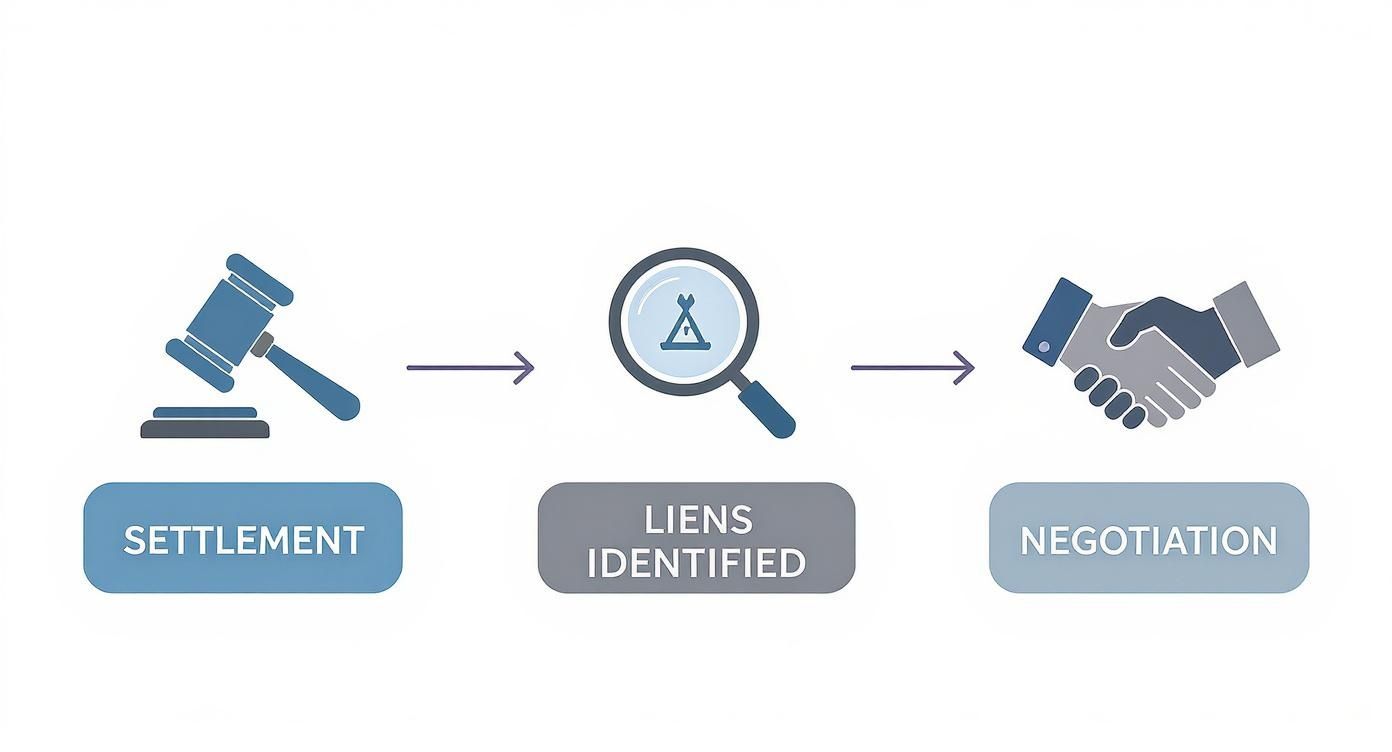
This identification phase is the essential bridge between getting your settlement agreement and actually starting the reduction process.
Building Your Lien Dossier
Your first move is to create a master list of every single medical professional and facility you visited after the accident. Don't try to do this from memory—you'll forget someone. The goal is to get two things from each one: a final, itemized statement of account and a copy of any lien agreement you might have signed.
Start calling the billing departments for:
- The emergency room and hospital where you were first treated.
- Any surgeons, anesthesiologists, and other specialists involved in your care.
- Imaging centers that did your X-rays, MRIs, or CT scans.
- Physical therapy and rehab clinics.
- Your own primary care doctor, if they provided any follow-up care.
For a more detailed guide on gathering these records, you can see our breakdown of https://www.belllawoffices.com/how-to-get-medical-records/. Once those statements start rolling in, get them organized. This is your raw intel.
Contacting Government and Private Insurers
Beyond the direct providers, you absolutely must reach out to any third-party payers. These organizations have powerful subrogation rights, and trust me, they won't be overlooked.
For government programs here in Oregon, you or your lawyer must send a formal written notice of your settlement. For Medicare, that means reporting the case to the Benefits Coordination & Recovery Center (BCRC). For the Oregon Health Plan (Medicaid), you'll need to contact the Oregon Health Authority (OHA) to handle their DMAP claim.
If you have private health insurance like Regence or Kaiser that paid for some of your bills, find their subrogation department. Call them up, give them your policy number and the date of the accident, and ask for a final list of payments they made for your treatment.
Key Takeaway: Never, ever assume a provider or insurer will just send you a final bill. You have to be the one to initiate contact and formally request a final lien amount in writing. A phone call isn't enough—get everything on paper.
Auditing Every Charge for Accuracy
Getting the bills is just step one. Now, you have to put on your auditor hat and comb through every single line item. Billing mistakes are incredibly common, and finding them is often the quickest way to get an initial reduction.
Keep an eye out for these common red flags:
- Duplicate Charges: Are you being billed twice for the same service or medication?
- Unrelated Treatment: Do you see charges for services that have nothing to do with your accident injuries?
- Upcoding: Was a simple procedure coded as a more complex—and more expensive—one?
- Phantom Services: Are there charges listed for tests or consultations you know you never received?
When you're dealing with a mountain of paperwork from numerous claims, you might even consider ways to leverage intelligent document processing to help automate sorting through medical bills and lien notices. This detailed audit is your first real line of defense.
A final word of advice: be patient. A few years ago, you could resolve liens in a few weeks or months. Now, the process for complex claims has slowed to a crawl, sometimes taking a year or more because of agency backlogs. The timeline has changed, so you have to adjust your expectations.
Strategic Negotiation Tactics for Different Lien Types

Successfully negotiating medical liens isn't a one-size-fits-all game. The strategy that works with a private insurer will fall flat with Medicare, and how you approach a local hospital is different still. Each lienholder operates under its own set of rules, motivations, and legal constraints.
To walk away with the most money in your pocket, you have to tailor your approach. Knowing who you're dealing with—and what arguments will actually resonate with them—is the key to turning an intimidating demand into a reasonable resolution. This isn't about just asking for a discount; it's about building a strategic case for a significant reduction.
Negotiating with Private Health Insurers
Private health insurance companies like Blue Cross or Providence have what’s called a contractual right to subrogation. This is their legal avenue to get reimbursed for the medical bills they covered for you. But their claim isn't absolute, and that’s where you find your leverage.
Your negotiation should be built on a foundation of Oregon-specific legal principles. Two of the most powerful are:
- The Common Fund Doctrine: This doctrine basically says that since you had to hire an attorney to create the "common fund" (your settlement), the insurer needs to chip in for the legal work. You can argue they must reduce their lien by a pro-rata share of your attorney's fees and costs.
- The Made Whole Doctrine: This is an equitable defense arguing that an insurer isn’t entitled to a dime until you have been fully compensated for all your damages. This includes pain and suffering, lost wages, and future medical care. If your settlement was a compromise, you can powerfully argue that the insurer's right to recovery is limited or even eliminated entirely.
Kick things off with a detailed letter that outlines your settlement amount, breaks down your attorney's fees and litigation costs, and presents a clear argument based on these doctrines.
Pro Tip: Never, ever accept the insurer's first offer. Their initial response is almost always a lowball reduction. Politely but firmly restate your arguments, emphasizing that your settlement was a compromise that did not fully make you whole.
Handling Liens from Hospitals and Providers
When you're dealing directly with a hospital or other healthcare provider, your tactics need to shift. Forget the complex legal arguments and focus on practical, financial ones. At the end of the day, they're a business, and their main goal is often just to close out an account and get paid promptly.
Your negotiation can center on a few key points:
Offer a Lump-Sum Payment: Providers are often incredibly willing to accept a much lower amount if they can get it all at once, right now. Cash in hand is almost always more valuable to them than a larger, uncertain future payment.
Discuss Financial Hardship: Be ready to show, not just tell. Explain how paying the full lien amount would create a significant hardship, preventing you from covering other essential costs related to your recovery.
Question the “Billed” vs. “Paid” Rate: Hospitals often bill at an inflated "chargemaster" rate that they never actually expect to collect from insurance companies. You can argue that they should accept a reduction closer to what a private insurer or Medicare would have actually paid for the same services.
And remember, Oregon law (ORS 87.555) provides a crucial backstop: a hospital lien is capped at one-third of your total settlement. This ensures the hospital can't eat up your entire recovery. Your negotiation should always start by aiming for a figure well below this statutory cap. To get more comfortable with these kinds of talks, our guide on how to negotiate an insurance settlement offers valuable insights you can apply here.
Tackling Government Liens: Medicare and Medicaid
Negotiating with government giants like Medicare and Oregon Medicaid (DMAP) is more about following a formula, but reductions are still possible. These agencies have powerful statutory rights to recovery, but they also have established procedures you can use to your advantage.
With Medicare, the key is to understand their process. They will automatically reduce their final lien demand to account for their share of your procurement costs (attorney fees and expenses). You don't have to fight for this; it's built into their calculation. If that standard reduction isn't enough, you can request a further compromise or waiver based on financial hardship or if the recovery isn't in the program's best interest.
For Oregon Medicaid (DMAP), the Oregon Health Authority (OHA) uses a specific statutory formula to calculate its recovery. The formula looks at the total settlement, attorney fees, and the total amount of medical bills paid. While there's less wiggle room than with a private insurer, you can still meticulously check their math and ensure they are only claiming costs for treatment directly related to the accident.
Every lienholder presents a different puzzle, and knowing the right strategy is crucial. Here's a quick-reference table breaking down the most effective approaches.
Negotiation Approach by Lienholder Type
| Private Insurer | Legal-based arguments focusing on equity and cost-sharing. | Made Whole Doctrine and Common Fund Doctrine. |
| Hospital/Provider | Practical, finance-based offers focusing on immediate payment. | Capped at 1/3 of the settlement under ORS 87.555. |
| Medicare | Follow established administrative procedures for reductions. | Automatic reduction for procurement costs; hardship waivers available. |
| Oregon Medicaid | Verify their calculations against the state's statutory formula. | Ensure only accident-related costs are included in their demand. |
As you can see, there's no single magic bullet. The right approach depends entirely on who is on the other side of the table.
The impact of skilled negotiation, especially in cases with high medical costs, can be staggering. Medical liens can slash a client's final recovery by huge amounts. One documented case saw a Medi-Cal lien for over $81,620 on a client's personal injury settlement. After an initial statutory reduction, the lien was still over $62,000. An attorney’s aggressive negotiation ultimately reduced it to just $11,430, saving the client over $70,000. This shows that fighting to reduce liens is often just as critical as securing a large settlement in the first place.
Using Legal Frameworks to Your Advantage
When you're trying to lower a lien, you have more than just good-faith negotiation on your side. There are powerful legal principles that can force lienholders to reduce their claims—sometimes substantially. These aren't just polite suggestions; they're established doctrines that level the playing field.
The law recognizes that you're the one who did all the work to get the settlement money. You hired a lawyer, you went through the stress of a claim, and you paid the costs. It’s only fair that the lienholders who want a piece of that money also share in the cost of creating it.
The Common Fund Doctrine: Making Them Chip In
This is basically the "fair share" rule. The settlement money you secured is a "common fund." You paid to create it, and the lienholders stand to benefit from it. The common fund doctrine says that because they're benefiting from your lawyer's work, they need to help pay for it.
In real-world terms, you can demand that the lienholder reduce their claim by a percentage equal to your attorney's fees and litigation costs. If your attorney’s fee is one-third of the settlement, you have a solid argument to reduce the lien by one-third right off the bat. This is a standard, widely accepted starting point, especially with private health insurance companies.
Here’s how it works: Say you have a $15,000 lien from your health insurer and your attorney's contingency fee is 33.3%. You can immediately argue for a $5,000 reduction. That brings the lien down to $10,000 before you even get into any other negotiations.
The Made Whole Doctrine: Are You Truly Compensated?
This is a powerful argument, especially when your settlement doesn't fully cover the true extent of your losses. The made whole doctrine is an equitable principle that says an insurer can’t ask for reimbursement until you have been fully compensated—or "made whole"—for all of your damages. That includes not just your medical bills, but also your pain and suffering, lost wages, and future needs.
Was your settlement a compromise because of a low insurance policy limit? Was liability disputed? If so, you have a strong case that the money isn't enough to make you whole. You can argue that the lienholder's right to get paid should be reduced or even wiped out completely. The key is to show that after paying attorney's fees and the lien, what's left for you doesn't come close to covering everything you've been through.
This doctrine is about fundamental fairness. It prevents the absurd outcome where your insurance company gets all its money back while you're left undercompensated for a life-changing injury.
Strategic Settlement Allocation: The Power of Wording
How your settlement agreement is worded can make a huge difference. Strategic settlement allocation means working with your attorney to specifically earmark parts of the settlement for different types of damages. For example, you can allocate the majority of the funds to non-medical damages like pain and suffering, emotional distress, or lost income.
This isn't some legal loophole; it's backed by the highest court in the land. The U.S. Supreme Court’s unanimous decision in Arkansas Dept. of Health and Human Servs. v. Ahlborn was a game-changer for Medicaid liens. The court ruled that Medicaid can only seek repayment from the portion of a settlement that's specifically for medical expenses. They can't touch funds meant to compensate you for pain and suffering.
This precedent is a massive piece of leverage. Many states have their own protective laws, too. In Missouri, for instance, provider liens are often capped at 50% of the net settlement you receive after attorney fees. These laws reinforce a critical point: your settlement is for more than just paying bills. With the right legal arguments, you can protect the money meant to compensate you for everything else you lost. You can dig deeper into these specifics by reviewing detailed analyses of medical lien reimbursement laws.
Bringing It All Home: Finalizing Reductions and Getting Your Settlement Money

After all the back-and-forth of negotiating your medical liens, getting a "yes" on the phone feels like a huge win. And it is. But a verbal agreement isn't worth the paper it's not written on.
Now comes the final, meticulous phase: getting everything in writing and carefully handling the settlement funds. This last stage is what officially closes the book on your medical debts and protects you from any future collection surprises.
Get the Deal in Writing—No Exceptions
Before a single penny is paid out, your attorney must get the negotiated reduction confirmed in a formal, written document. This is often called a Lien Satisfaction Agreement or a Settlement and Release. This isn't just a formality; it's a non-negotiable shield.
This letter is a binding contract. It needs to clearly state the final, reduced amount the lienholder will accept as full and complete satisfaction of their claim. Never, ever send payment based on just a phone call or an informal email. You need that signed document in hand.
For healthcare agreements, efficiency and security are key. Using HIPAA compliant electronic signatures can be a great way to execute these documents quickly while maintaining the necessary legal and privacy standards.
The Role of the Attorney's Trust Account
While you've been negotiating, your settlement money hasn't been sitting in a regular checking account. It's held in a special, highly regulated IOLTA (Interest on Lawyers' Trust Accounts). This account is specifically designed to keep client funds completely separate from the law firm’s own money.
This separation is a critical ethical safeguard. It guarantees your money is protected and can only be touched for its intended purpose—paying off liens, covering legal fees, and finally, paying you. The funds are essentially locked down until every single lienholder has provided a signed satisfaction agreement.
Why This Matters: The IOLTA account acts as a secure escrow. It protects everyone involved. Lienholders are guaranteed payment per the agreement, and you're shielded from any money going out before the deals are officially locked in.
The Final Payout: Distributing the Funds
Once all the signed satisfaction letters are collected, your attorney can finally prepare the final accounting and distribute the settlement funds. This happens in a very specific order to make sure every legal and financial obligation is met first. The whole procedure is a microcosm of the larger car accident settlement process.
Here’s how the funds typically flow:
Pay the Lienholders: The very first checks cut are to the hospitals, doctors, and insurance companies. Your lawyer sends out the agreed-upon payment along with a copy of the signed satisfaction letter for their records.
Cover Attorney Fees and Costs: Next, the attorney's contingency fee (the percentage agreed upon in your contract) is deducted. Any case-related costs the firm fronted—like expert witness fees or court filing charges—are also reimbursed from the settlement.
Your Net Settlement Check: Everything left over is your net recovery. This is the money that goes directly to you, tax-free, as compensation for your injuries, lost income, and suffering.
This methodical final step turns a settlement number into actual financial relief. It officially wipes out your accident-related medical debt, giving you the clean slate and financial security you deserve.
Common Questions About Medical Lien Negotiations
Once you've finally agreed on a settlement number, it feels like the hard part should be over. But then comes a new wave of questions about liens, and it can feel just as confusing as the initial claim. Let's tackle some of the most common questions that pop up at this stage.
When Should I Get an Attorney Involved to Negotiate My Medical Liens in Oregon?
You can certainly try to handle small, straightforward liens yourself. But when the numbers get big or the lienholders are complex, bringing in a professional is a smart move.
This is especially true if you're dealing with government programs like Medicare or Oregon's own Medicaid (DMAP). The same goes for any large subrogation claim from a private health insurer that's eating up a huge chunk of your settlement. An experienced Oregon personal injury lawyer isn't just a negotiator; they're an advocate armed with specific legal tools. They know how to use Oregon's "made whole" and "common fund" doctrines to argue for significant reductions—turning abstract legal theories into real money back in your pocket.
Honestly, the fee they charge is often a drop in the bucket compared to the thousands they can save you.
What Happens if I Just Ignore a Medical Lien After I Get My Settlement?
Ignoring a lien is one of the worst things you can do. It doesn't just go away. It’s a legal claim on your settlement, and the lienholder will come after you for the money.
The consequences can be pretty severe:
- A hospital or insurer can sue you directly to collect what they're owed.
- Government agencies like Medicare don't mess around. They can garnish your Social Security benefits or send the U.S. Treasury to collect the debt.
- Private lienholders will almost certainly send the unpaid bill to collections, which will tank your credit score for years.
Your attorney also has a professional duty here. They can be held personally responsible if they release settlement funds to you without first satisfying a known lien. That’s why every single claim has to be dealt with head-on.
The Bottom Line: A medical lien is a legal debt tied directly to your settlement funds. Ignoring it will only create bigger financial headaches down the road. You have to face every claim.
Can a Hospital Lien Take My Entire Settlement in Oregon?
No, absolutely not. Oregon law has a built-in protection for this exact situation.
Under ORS 87.555, a hospital lien is legally capped at one-third of your total settlement. This means that no matter how large the hospital bill is, they can never demand more than 33.3% of your gross settlement. This law is a powerful backstop in negotiations and ensures that the bulk of your settlement remains yours to cover pain, suffering, and lost wages. Your entire recovery will never be wiped out by a hospital bill.
How Long Does It Take to Get Medical Liens Sorted Out After a Settlement?
This is the million-dollar question, and the answer is: it depends. The timeline for resolving liens can vary dramatically, so you'll need some patience.
Negotiating with a local clinic might be quick, maybe just a few weeks, especially if you have the funds ready for a lump-sum payment.
But government liens? That’s a whole different story. Dealing with Medicare is a masterclass in bureaucratic delay. It can easily take six months to a year just to get through their process—from waiting on the conditional payment summary to receiving the final demand letter. If you have a mix of liens from private insurers and government programs, you should prepare for the whole process to take several months, at a minimum.
Navigating your personal injury case doesn't stop when you agree on a settlement number. The team at Bell Law is here to guide you through these critical final steps of lien negotiation to make sure you keep as much of your hard-earned compensation as possible. Contact us today for a free consultation.
Disclaimer: The information on this page is provided for general informational purposes only and is not legal advice. Reading this content does not create an attorney-client relationship. For advice about your specific situation, please contact a licensed attorney.