
How to Prepare for a Deposition in Oregon
"I was satisfied once John Bell took over my case."
"Communication was always timely."
How to Prepare for a Deposition in Oregon
Getting a notice for a deposition can be nerve-wracking, but a lot of that anxiety comes from the unknown. Let's pull back the curtain. A deposition isn't a surprise courtroom ambush you see on TV; it's a planned, out-of-court meeting where you answer questions under oath.
The other side's attorney simply wants to hear your side of the story—what you know about your accident, your injuries, and how it's all affected your life.
What a Deposition Really Is
Think of it as a fact-finding mission for the opposing lawyer. It’s a formal Q&A session that usually takes place in a conference room, not a courtroom. There’s no judge and no jury. The other attorney's main goal is to understand the facts from your perspective, see how you come across as a witness, and get your story on the record before a potential trial.
For you, this is a chance to clearly and consistently state the facts of your case. It might feel like a test, but with the right preparation, it’s just another step forward. The testimony given here is a huge deal. In fact, depositions are a core part of evidence-gathering in over 80% of civil cases, and what you say can shape everything from settlement negotiations to trial strategy. You can read more about key deposition trends to get a sense of how central they are to the legal process.
Who You'll See in the Room
Knowing who will be there makes the whole thing feel less mysterious. It’s usually just a small group, and everyone has a clear job.
- Your Attorney: This is your advocate, your guide, and your guardrail. They'll be sitting right next to you, ready to jump in if a question is confusing, unfair, or out of line.
- The Opposing Attorney: This is the lawyer for the other side (like the insurance company or your employer). Their job is to ask you questions about what happened, the medical treatment you've received, and how your life has changed.
- The Court Reporter: This is a neutral professional who types down every single word said by everyone in the room. They create the official written transcript of the deposition, which becomes a critical legal document.
This simple layout shows you who to expect.
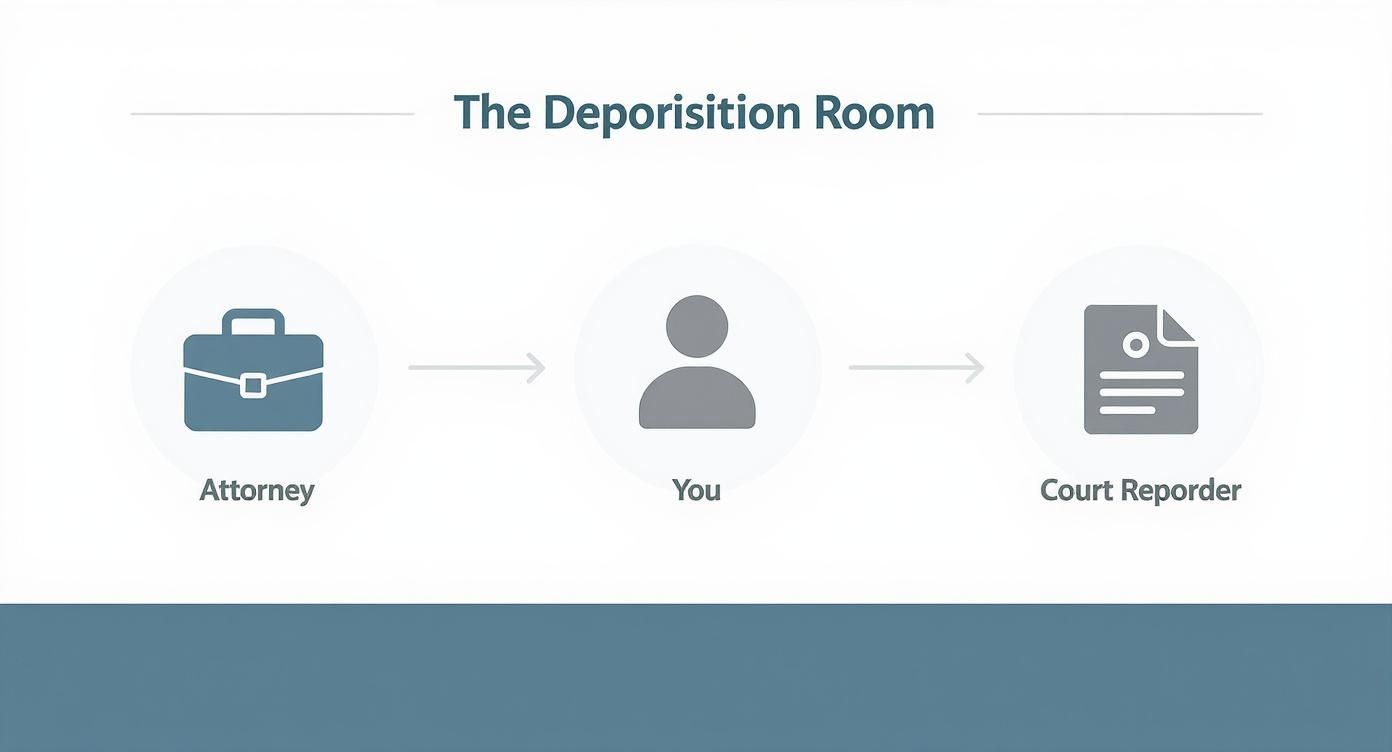
As you can see, it's a straightforward setup. Everything you say is on the record, which is why your attorney is there to support you.
The "Why" Behind Their Questions
The other lawyer isn't just throwing random questions at you. Every question has a purpose. They are trying to figure out what you know, how you'll present yourself as a witness, and whether your story has any holes.
Your deposition testimony is essentially a sneak peek of what you'd say in front of a jury. A clear, consistent, and truthful story is your most powerful tool. It often leads to a fair settlement offer long before a trial is ever necessary.
Once you understand these basics—who's involved, what their roles are, and why they're asking questions—you can start to prepare for a deposition with confidence instead of fear. At its core, the process is about getting to the truth, and your only job is to provide it, carefully and honestly.
Working With Your Attorney is Your Secret Weapon
The single most important thing you can do to get ready for a deposition is to work closely with your lawyer. Don't just think of them as your legal representative; see them as your coach, your strategist, and your partner in this process. Those meetings you have before your deposition aren't just casual check-ins. They are the strategy sessions where we lay the groundwork for a successful outcome.
This partnership is absolutely critical, which is why having the right legal team from day one is so important. If you’re still in the early stages, taking the time to understand how to choose a personal injury lawyer can make all the difference in building this essential alliance.

Making the Most of Your Prep Meetings
Your prep sessions are all about building a consistent, truthful narrative. You need to come ready to talk about every single detail of your case—yes, even the parts that seem small or are uncomfortable to discuss. The main goal here is simple: no surprises. Not for you, and not for your attorney.
Be prepared to dig deep into a few key areas:
- The Complete Timeline: We need to walk through the entire sequence of events with a fine-toothed comb. What were you doing just before the incident? What happened during it? What was the immediate aftermath? Every detail matters.
- The Full Impact of Your Injuries: This goes far beyond just a medical diagnosis. We need to talk about how these injuries have truly affected your life. Think about your daily pain, activities you can no longer do, the emotional toll, and the impact on your job and your family.
- The Tough Topics: You have to be completely honest about anything you think could be a weak spot in your case. Do you have a pre-existing injury? Are there gaps in your employment history? Your attorney absolutely needs to know about these things now so we can build a strategy around them, not be blindsided later.
When you're open about all this, you're giving your lawyer the ammunition needed to anticipate the other side's questions and protect you during the deposition.
Why a Practice Run is So Valuable
One of the best ways I prepare my clients is by running through a mock deposition. The point isn't to memorize a script—in fact, that's the last thing you want. Canned answers sound fake and can hurt your credibility. The real purpose is to get you comfortable with the rhythm and pressure of answering questions.
A practice deposition is like a dress rehearsal. It helps you build the muscle memory for telling your story clearly and honestly. You get to practice pausing, listening to the full question, and giving a concise answer without accidentally offering up extra information.
This run-through lets us polish your answers and make sure your testimony lines up perfectly with the hard evidence, like your medical records or the police report. I can throw some of the tricky questions at you that I know the opposing lawyer loves to ask, which will give you the confidence to handle them without getting flustered.
Questions You Need to Ask Your Attorney
Remember, this is a two-way street. You should feel completely comfortable asking me or any attorney questions until you feel 100% prepared. Never walk out of a prep meeting with unanswered questions or nagging doubts.
Here are a few essential things you should be asking:
What do you think the other side's main strategy will be?
Are there any specific documents I should review one last time before we go in?
What's the right way to handle a question if I don't understand it?
How will you let me know if I start talking too much or wandering into a tricky area?
When we work together this way, the deposition transforms from a scary interrogation into a controlled setting where you can simply and clearly present the facts. It’s this close collaboration that builds a powerful narrative that can withstand whatever the other side throws at you.
Getting Your Paperwork in Order
Think of your documents as the steel frame of your case. Your testimony is essential, but it’s the hard evidence—the paperwork—that provides the structure and proof. Getting this stuff organized before your deposition is one of the most important things you can do.
When you and your lawyer have every record neatly lined up, it sends a powerful message to the other side: you’re prepared, you’re serious, and your story is backed by facts. This isn’t just about looking good; it's practical. Good preparation can actually shorten the deposition itself, sometimes by 20-30%, saving everyone time and money.
The Must-Have Documents for Any Injury Claim
No matter how you were injured—in a car wreck, on the job, or in a way that led to a disability claim—some documents are non-negotiable. The other side’s attorney will be looking for any little mismatch between what you say and what the records show.
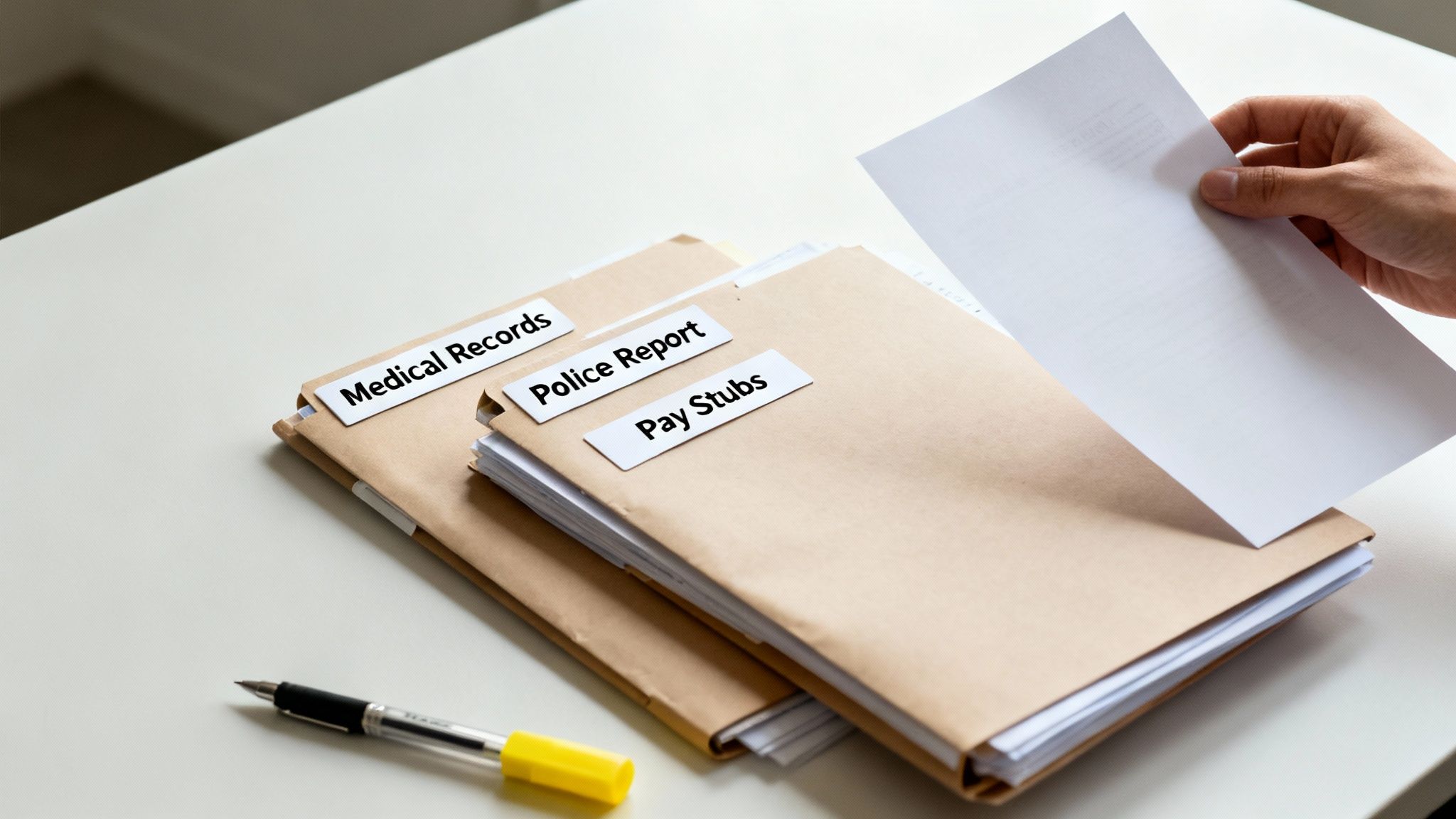
- Medical Records and Bills: This is the big one. We need everything from the first ER visit to your physical therapy notes and pharmacy receipts. These papers create a clear timeline of your injury and treatment.
- Official Reports: For a car crash, this is the police report. It’s a neutral account of what happened. If you were hurt at work, it’s the incident report you filed with your employer.
- Key Communications: Round up every email, letter, or note you have from conversations with insurance adjusters or your employer about the incident. You’d be surprised what can become important later.
You have to know these documents cold. If the police report says you complained of neck pain at the scene, you can't say in your deposition that the pain didn't start for two days. That's the kind of inconsistency opposing counsel lives for. Getting all these records can feel like a part-time job, but our guide on how to get medical records can walk you through it.
Case-Specific Documents You'll Need
Beyond the basics, different cases require different types of proof. Your lawyer will give you a specific list, but here’s a general idea of what to start looking for.
For an Auto Accident Case:
- Any photos or videos you have of the crash scene, the damage to the cars, and your injuries.
- Repair bills or estimates for your vehicle.
- A copy of your auto insurance policy and any letters or emails you've exchanged with them.
For a Workers' Compensation Case:
- Pay stubs from the months before and after you got hurt. This is how we prove your lost wages.
- Your employment file, especially things like performance reviews.
- Any written work restrictions or notes from your doctor about what you can and can't do.
A Quick Word of Advice: When you have all your documents in order, something great happens—you feel more confident. Knowing the facts are on your side because you've seen the proof makes it much harder for the opposing attorney to rattle you with tough questions.
With so many files, both paper and digital, using one of the best document archiving software options can be a lifesaver. It helps you and your legal team keep everything straight. In the end, we're building a clear, documented history of events that turns that stack of paper into one of your strongest assets.
How to Answer Questions Like a Pro
Once you're in that deposition room, how you answer a question is every bit as important as what you say. The other side’s attorney isn’t just listening to your words; they're watching your body language, gauging your confidence, and hunting for any inconsistencies.
Think of the following rules not as a rigid script, but as your playbook for staying calm and in control under pressure. Your lawyer will be right beside you, but you're the one on the field. Mastering these simple techniques will protect you and strengthen your case immeasurably.
The Power of the Pause
Your most powerful tool in a deposition costs nothing and requires no training: it's silence. Before you utter a single word in response to a question, take a deliberate pause. Just breathe.
That small gap is your best friend for a couple of critical reasons.
First, it gives your attorney a precious moment to jump in and object if the question is out of line. If you blurt out an answer, that opportunity vanishes.
Second, it forces you to actually hear and process the entire question. It stops you from cutting the lawyer off or answering the question you think they're asking, rather than the one they actually did.
Key Takeaway: The pause is your shield. It disrupts the other attorney's rhythm, gives your lawyer time to protect you, and ensures you're precise. Make it a habit for every single question, no matter how simple it seems.
This one simple act is a cornerstone of effective deposition preparation. It turns a potentially nerve-wracking interrogation into a controlled conversation where you hold the reins.
Answer Only the Question That Was Asked
The opposing attorney’s job is to dig for information. Your job is to give truthful answers to their questions—and nothing more.
It’s natural to want to be helpful or to explain the full context behind your answer. You have to fight that urge. Volunteering information is probably the single most common and damaging mistake people make in depositions.
Let’s look at a real-world example:
- Question: "Did you speak to your doctor on Tuesday?"
- The Wrong Way: "Yes, I did. I had to call her because my neck was killing me after physical therapy, and I was getting worried the treatment was making things worse. She suggested taking some extra ibuprofen."
- The Right Way: "Yes."
See the difference? The first answer just handed the other lawyer a whole new set of topics to explore: your physical therapy, your worries about your treatment, your medication. The second answer is truthful, complete, and concise. It forces the attorney to do their job and ask follow-up questions if they want more details. Stick to what you know and what they ask.
Your Three Most Important Phrases
You are not expected to have a perfect, photographic memory of every event in your life. In a deposition, "I don't know" can be the smartest and most honest answer you give.
Really, you only need three core responses in your toolkit:
"Yes." (If you are 100% sure the answer is yes.)
"No." (If you are 100% sure the answer is no.)
"I don't recall." or "I'm not sure." (If you genuinely don't remember or are uncertain.)
Never, ever guess. If the lawyer asks what the weather was like on the day of your accident three years ago and you can’t remember, "I don't recall" is the only correct answer. A guess can be easily disproven, which makes you look untrustworthy. An honest lack of memory is perfectly fine and completely normal.
This level of discipline pays off. In fact, well-prepared witnesses have been shown to have up to 40% fewer inconsistencies in their testimony. That kind of rock-solid credibility is exactly what wins cases. You can discover more insights about deposition trends to see just how critical consistency has become.
Before we move on, let's distill these behavioral tips into a quick-reference guide. Reviewing this table right before your deposition is a great way to refresh your memory on the key do's and don'ts.
Deposition Do's vs. Don'ts Quick Reference
| Pacing | Pause deliberately before every answer. | Answering immediately or interrupting. |
| Clarity | Listen carefully to the full question. | Answering the question you think was asked. |
| Scope | Answer only the specific question asked. | Volunteering extra information or context. |
| Memory | Say "I don't recall" if you aren't sure. | Guessing, speculating, or estimating. |
| Composure | Remain calm, polite, and professional. | Getting angry, argumentative, or sarcastic. |
| Documents | Look at a document before answering about it. | Answering from memory about a document's content. |
| Truthfulness | Be 100% honest, even if it feels unhelpful. | Exaggerating or hiding unfavorable facts. |
By sticking to these fundamental rules—pause, be concise, and be honest about what you do and don't know—you build a fortress of credibility around your testimony. It makes you a powerful witness and makes the other side’s job much, much harder.
Handling Difficult Questioning Tactics
The lawyer on the other side of the table is trained to find cracks in your story. They have a whole playbook of questioning techniques designed to poke and prod until they find a weak spot. A huge part of preparing for your deposition is pulling back the curtain on these tactics so you can see them coming.
Frankly, knowing their game plan is half the battle.
The goal here isn't to be clever or outsmart the attorney. It's to stay calm, stick to the truth, and give clear, simple answers that don't accidentally hand them ammunition to use against you. Your own lawyer will be right there to protect you, but when you understand these methods yourself, you stay in control of your own story.
Spotting Hypothetical Questions
One of the oldest tricks in the book is the hypothetical question. You'll recognize it when you hear phrases like, "What if..." or "Isn't it possible that..." The lawyer is trying to get you to guess or speculate about something that never actually happened.
For instance, they might ask, "What if you had looked to your left just one second sooner? You would have seen the other car, wouldn't you?"
This is a trap, plain and simple. You can't possibly know what might have happened in a different reality. Your only job is to talk about what did happen.
A perfect, truthful response is direct and firm:
- "I can't say what might have happened. I can only tell you what I actually saw."
- "I'm not going to guess about that. I can tell you what I did."
- "That's a hypothetical question. I can only speak to what really occurred."
These answers are polite but shut down the speculation immediately. They bring the focus right back to the facts, which is where it belongs. You are under no obligation to play their "what if" game.
Key Takeaway: Never speculate. Stick to what you know, what you saw, and what you did. Answering hypothetical questions creates a version of events that never existed, and the other side will absolutely try to use it against you.
Untangling Compound Questions
Another classic tactic is the compound, or "two-in-one," question. This is where the attorney crams multiple questions into a single sentence. They’re hoping you'll give a blanket "yes" or "no" that accidentally confirms something that isn't true.
Imagine you're asked: "So, you left the house late that morning and were speeding to get to work, correct?"
See what they did there? It’s two separate questions: (1) Were you running late? and (2) Were you speeding? Maybe you were running a few minutes behind, but you know for a fact you weren't speeding. A simple "yes" makes you a speeder, but "no" isn't quite right either.
The best strategy is to politely break the question apart for them.
- You can say, "That sounds like two different questions. Could you ask them one at a time, please?"
- Or, you can simply answer each part separately: "I was running a little behind schedule, but I was not speeding."
This simple move stops the other lawyer from putting words in your mouth and keeps the official record completely accurate.
Correcting a False Premise
Sometimes, a question will start with an incorrect statement that's presented as a fact. This is a test to see if you're paying attention and to try and trick you into agreeing with a lie.
Consider this: "After your doctor told you to stop all physical activity, you went on that hiking trip, didn't you?"
The hidden trap here is the false premise—your doctor never said to stop all physical activity. If you just answer "no," it sounds like you're denying you went on the trip. The trick is to correct the false part of the question before you answer the rest of it.
A much better response would be: "Actually, my doctor didn't tell me to stop all physical activity; he specifically said to avoid heavy lifting. And yes, I did go for a short walk on a flat trail." This is a similar kind of framing you might run into when learning how to deal with insurance adjusters, as they also love to use assumptions to their advantage.
By fixing the premise first, you control the narrative and stop a falsehood from slipping into the record unchallenged. Always listen carefully not just to the question, but to the assumptions baked into it. This is how you protect your case.
What Happens After the Deposition Ends
The moment you walk out of that conference room, you’ll probably feel a huge wave of relief. That’s completely normal. The hardest part is over, but it’s important to understand that the deposition isn't the finish line—it's a critical milestone that shapes everything that comes next.
Your testimony doesn't just get filed away. It's now a permanent, powerful piece of evidence that will echo throughout the rest of your case.
Reviewing the Official Transcript
A few weeks after your deposition, the court reporter will create a verbatim transcript of everything that was said. Your attorney will get a copy, and you’ll get a chance to review it. This is your one and only opportunity to make sure it’s 100% accurate.
Take this step seriously. Read through every page, looking for any mistakes. It's easy for small errors to creep in, and they can have a big impact.
You’re looking for things like:
- Typos: A simple misspelled word that accidentally changes the meaning of your answer.
- Misheard Words: The reporter might not have caught a complex medical term or a specific name correctly.
- Incorrect Numbers: A date, a dollar amount, or a time that was transcribed wrong.
You’ll note any corrections on a document called an "errata sheet." Once you sign off, that transcript is locked in as the official record. There are no do-overs.
How Your Testimony Shapes the Case
With your sworn testimony now on the record, both sides will pore over it to fine-tune their strategies. Your attorney will use the strong points from your testimony to build leverage for settlement talks. Meanwhile, the opposing counsel will be searching for any hint of a weakness they can exploit.
Your deposition transcript becomes the bedrock for the next phase of your case. A strong, consistent, and honest performance can dramatically improve your chances of getting a fair settlement offer, often avoiding the need for a trial altogether.
It's also interesting to see what happens behind the scenes. Legal teams are increasingly using technology, including sophisticated AI tools for deposition summaries, to rapidly digest and analyze testimony. In fact, a recent survey revealed that 60% of law firms now use AI-powered software for tasks like simulating questions and reviewing case files. You can learn more about these legal tech trends to see how the landscape is changing.
From here, your case moves forward. The next steps usually involve settlement negotiations, mediation, or—if a settlement can't be reached—preparing for trial. No matter which path your case takes, your deposition testimony will be guiding the way.
Last-Minute Questions Before Your Deposition
No matter how well we prepare, clients always have a few practical questions pop into their heads the day before a deposition. That's completely normal. Getting these details sorted out helps calm any last-minute nerves so you can walk in feeling confident and ready.
Let's run through some of the most common things people ask.
"What Should I Wear?"
This one comes up a lot. My best advice is to dress like you're going to an important business meeting or even to court itself. Think business-casual. Clean, well-fitting slacks or a skirt with a button-down shirt, a nice blouse, or a simple sweater is perfect.
Your goal is to look like you're taking this process seriously. It's a small thing, but it sets the right tone. I always tell my clients to leave these at home:
- Anything with big logos, graphics, or slogans.
- Jeans, shorts, t-shirts, or tank tops.
- Lots of flashy jewelry or any strong perfume or cologne.
Simple and professional is always the way to go.
"Can I Bring My Notes With Me?"
This is a big one, and the answer is almost always a firm no. Here's why: anything you bring into that room—a piece of paper, a notebook, even a sticky note—can be taken and examined by the other lawyer. They can literally ask, "What's that you're looking at?" and then they have the right to see it and question you about every single word on it.
This is why our preparation sessions are so important. We'll have gone over everything so thoroughly that the key facts will be fresh in your mind. Trust your memory. And remember, it's perfectly okay to say, "I don't recall," if that's the honest truth.
"What If I Need a Break?"
Depositions can be a real marathon, both mentally and physically. So, yes, you can and should ask for a break if you need one. If you start to feel tired, foggy, or just need to use the restroom or grab a glass of water, just say so.
It's far better to take a five-minute breather to clear your head than to press on while you're exhausted and give a confused or inaccurate answer.
There’s just one firm rule: you can't take a break with a question hanging in the air. You have to answer the question that's been asked, and then we can pause.
It's interesting to see how technology is changing these old-school legal procedures. The entire legal tech industry is growing fast—it’s projected to become a $25 billion market by 2025—and that includes making depositions more efficient. You can discover more insights about deposition trends on JD Supra if you're curious. But for your purposes, just knowing these simple logistical answers can make a world of difference in feeling prepared.
At Bell Law, we know that being thoroughly prepared is the single most important factor in a successful deposition. If you've been injured and need an experienced guide for the Oregon legal system, we're here for you. Contact us today for a free consultation.
Disclaimer: The information on this page is provided for general informational purposes only and is not legal advice. Reading this content does not create an attorney-client relationship. For advice about your specific situation, please contact a licensed attorney.