
PTSD and Social Security A Guide to Navigating Your Claim
"I was satisfied once John Bell took over my case."
"Communication was always timely."
PTSD and Social Security A Guide to Navigating Your Claim
Living with Post-Traumatic Stress Disorder (PTSD) can present significant challenges, and holding down a steady job may feel difficult. Social Security disability benefits, through either Social Security Disability Insurance (SSDI) or Supplemental Security Income (SSI), are programs designed to provide assistance to individuals who cannot work due to a medical condition. The process involves showing not only that you have a diagnosis of PTSD, but also how its limitations may prevent you from working full-time.
How PTSD Can Affect Your Ability to Work
PTSD is a complex condition that can change the way an individual perceives and reacts to the world. This can become especially challenging in a work environment, where focus, interpersonal skills, and consistent performance are often expected.
A disability claim for PTSD generally focuses on one critical point: how an individual's specific symptoms create real-world limitations that make it difficult to maintain a job. It's about connecting the diagnosis to daily struggles.
Common Work-Related Challenges with PTSD
Symptoms like flashbacks, significant anxiety, and hypervigilance may interfere with the ability to perform job duties. For instance, a loud noise outside the office might be a minor annoyance for some, but for someone with PTSD, it could trigger a severe stress response, potentially derailing their concentration for the rest of the day.
Consider these common situations:
- Trouble Focusing: When intrusive thoughts or flashbacks occur, it can be incredibly hard to follow directions, finish tasks without errors, or stay productive through an entire shift.
- Difficulty with People: Avoidance is a core symptom of PTSD, which may lead an individual to withdraw from colleagues. Irritability can also cause conflicts with a boss or customers, making teamwork or service jobs challenging.
- Missing Work: Panic attacks, severe anxiety, and significant fatigue are not always easy to "push through." They may lead to calling out sick, which can make it tough to meet the basic attendance requirements of a job.
- Handling Stress: Normal workplace pressures like deadlines, performance reviews, or unexpected problems can feel overwhelming, potentially making PTSD symptoms more pronounced.
The real-world impact can be significant. Lost productivity is a major issue. On average, people with PTSD miss about 9.7 days of work a year and struggle with an additional 33.1 days of "presenteeism"—where an individual is physically at work but too impaired to function properly. This data, highlighted on psychiatrist.com, illustrates how deeply PTSD can affect a person's ability to stay employed.
The Social Security Administration (SSA) looks at an individual's ability to perform "substantial gainful activity," or SGA. This is their term for earning over a certain amount of money each month. A central part of a disability claim is showing that PTSD prevents a person from performing SGA consistently.
When PTSD co-occurs with other conditions, the situation can become more complicated. Understanding comorbid Posttraumatic Stress Disorder is important, as conditions like depression, anxiety, or substance use often accompany PTSD. These overlapping issues can create more layers of challenges that should be documented to show the full picture of an individual's limitations.
How the SSA Actually Evaluates a PTSD Disability Claim
When you apply for Social Security Disability with PTSD, the Social Security Administration (SSA) is not just looking for a diagnosis on paper. They have a specific, rule-based process to determine how a condition impacts an individual's ability to hold a job. This process is guided by their official "Blue Book," which is a list of medical conditions and the criteria used in their evaluation.
For PTSD, the key section is Listing 12.15 for Trauma- and Stressor-Related Disorders. This listing can be thought of as a checklist. The SSA will go through medical records to see if the evidence aligns with their requirements. This is not about judging an experience; it's about applying a consistent standard to every claim.
This flowchart maps out the general journey from a PTSD diagnosis to filing a disability claim when the condition gets in the way of working.
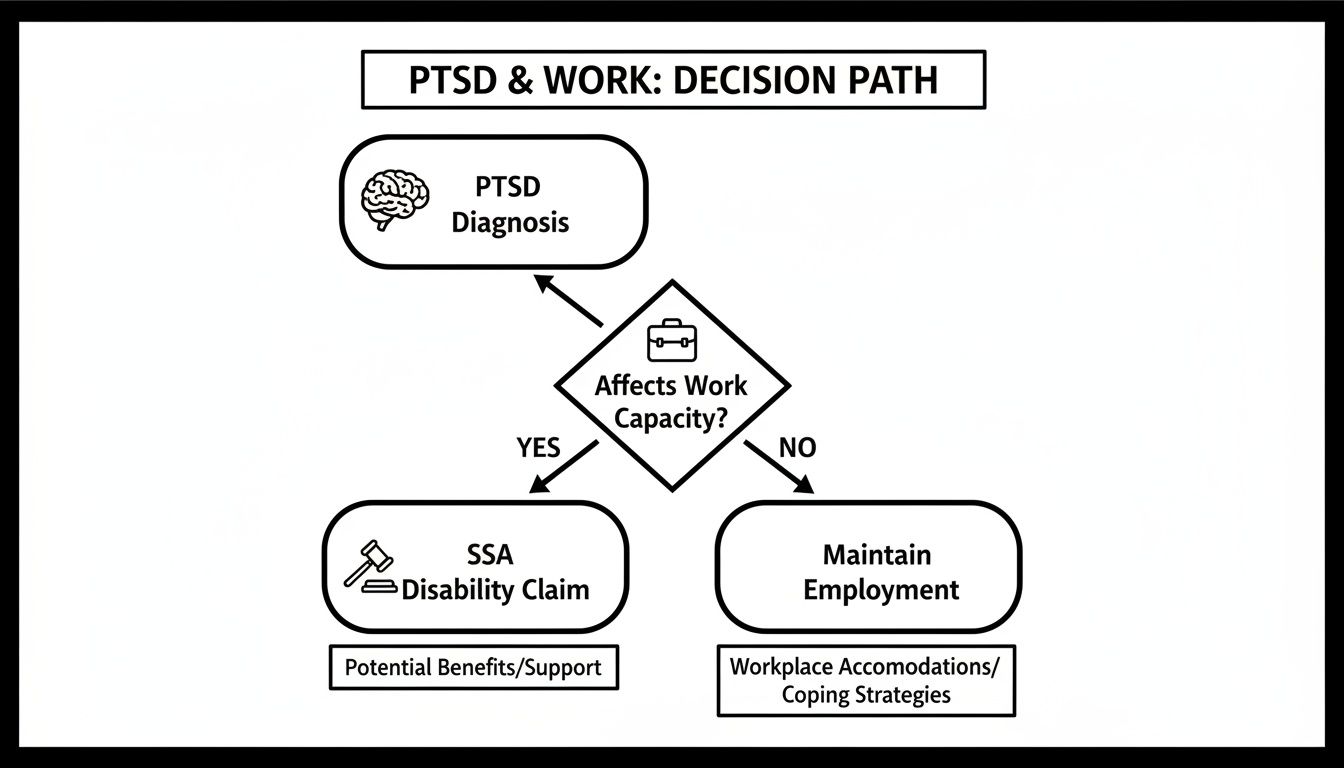
As the chart illustrates, the diagnosis is just the first step. The real question the SSA seeks to answer is whether the symptoms and limitations from that diagnosis are severe enough to prevent an individual from working. That is where a disability claim begins.
The Medical Evidence You Need for Listing 12.15
First, medical documentation needs to establish the core components of PTSD. It should clearly show exposure to a traumatic event—actual or threatened death, serious injury, or violence.
Then, the records must detail how the hallmark symptoms of the condition are consistently experienced. The SSA looks for specifics, such as:
- Involuntary re-experiencing of the trauma, like intrusive memories, flashbacks, or nightmares.
- Avoidance of people, places, or situations that are reminders of what happened.
- Negative changes in mood and thinking patterns, like persistent fear, guilt, or detachment.
- Alterations in arousal and reactivity, which can look like hypervigilance, irritability, or an exaggerated startle response.
This first part of the listing, often called "Paragraph A," is about building the medical foundation. It’s how an individual shows the SSA that their symptoms are a recognized result of a trauma-related disorder.
Proving Your Functional Limitations
This next part is often a challenging, yet crucial, piece of the puzzle. It’s not enough to just have the symptoms; the claim must show how those symptoms severely limit the ability to function.
The SSA needs to see that PTSD causes an "extreme" limitation in one, or "marked" limitations in at least two, of the following four areas of mental functioning:
When evaluating a PTSD claim under Listing 12.15, the SSA considers how the condition limits abilities in these four key mental areas. Medical records should ideally provide insight into these domains.
The Four Areas of Mental Functioning the SSA Assesses
| Understand, Remember, or Apply Information | Can you follow instructions, learn new tasks, solve problems, and use judgment? |
| Interact with Others | Can you get along with coworkers, supervisors, and the public without being disruptive or isolating yourself? |
| Concentrate, Persist, or Maintain Pace | Are you able to stay focused long enough to finish tasks? Can you work at a reasonable speed without getting sidetracked? |
| Adapt or Manage Oneself | Can you regulate your emotions, control your behavior, and handle changes in a work environment without falling apart? |
The goal here is to connect documented symptoms to real-world work limitations. For instance, hypervigilance (a symptom) might make it difficult to concentrate on tasks or interact appropriately with coworkers (functional limitations).
What do "marked" and "extreme" mean to the SSA? A "marked" limitation is a step beyond moderate—it means the impairment seriously interferes with your ability to function on your own. An "extreme" limitation means you are completely unable to function in that area independently.
What if You Don't Fit the Mold? The "Serious and Persistent" Rule
Sometimes a person's situation is severe, but it doesn't quite meet all the criteria in the standard framework. For these cases, the SSA has an alternative path known as the "Paragraph C" criteria.
This rule is designed for individuals who have a documented history of a "serious and persistent" mental disorder that has lasted for at least two years. To qualify this way, an applicant has to show two things:
They have received ongoing medical treatment, therapy, or support that helps diminish their symptoms.
Despite that support, they have very little capacity to adapt to new situations or demands outside of their familiar, everyday routine.
This path essentially acknowledges that some people can function primarily because of a highly structured environment and intensive support system. You can explore more about how different mental health conditions are handled in disability claims by navigating mental health disability benefits.
To help build a stronger case, clinicians often use standardized tests to provide objective data. For example, the GAD-7 (Generalized Anxiety Disorder 7-item scale) can be used to measure the severity of anxiety symptoms, turning subjective feelings into concrete scores that the SSA can more easily evaluate.
The Role of Medical Evidence in Your Disability Claim
A disability claim can be thought of as a bridge. On one side is life before the disabling condition, and on the other is the potential for financial support. The pillars holding that bridge up are medical records. Without a strong, consistent, and detailed medical history, the claim may face challenges under the Social Security Administration's (SSA) scrutiny.
The SSA examiner reviewing the file only has the objective evidence in front of them to make a decision. A personal story is vital, but it needs to be backed up by what doctors, therapists, and other professionals have documented over time. The goal is to present a clear narrative of how PTSD impacts the ability to function and work.

The Importance of Consistent Treatment
A steady history of treatment can be a powerful part of a claim. Seeing a psychiatrist, psychologist, or therapist on a regular basis sends a signal to the SSA that the condition is serious, ongoing, and that you are actively trying to manage it.
On the flip side, long gaps in a treatment record can raise questions for an examiner. A consistent record shows the persistent nature of the symptoms and documents efforts to get better—a key element in their evaluation process.
What Makes Medical Notes Compelling
Not all medical records are created equal. A simple note saying "Patient has PTSD" is a starting point, but it may not be enough. The records that can make a difference are the ones that paint a detailed picture of real-world limitations.
Compelling clinical notes may get specific about:
- Symptom Severity and Frequency: How often do flashbacks or panic attacks happen? What do they look like? How long do they last?
- Treatment and Response: What medications have been tried? At what doses? Did they help, or did the side effects cause other problems? What has the response to therapy been?
- Functional Observations: Does a doctor’s note mention that a patient had trouble maintaining eye contact, difficulty concentrating during the appointment, or showed a flat affect? These in-the-moment observations can be very valuable.
- Daily Functioning: Notes describing an inability to handle a crowded grocery store, manage finances, or maintain personal relationships provide the concrete, real-world examples the SSA looks for.
The SSA is looking for a longitudinal record—a history that shows the course of a condition over time. This includes not only symptoms but also the treatments received and how effective (or ineffective) they have been.
PTSD affects 2.6% of men and 6.0% of women among U.S. civilians. Over 1.2 million people receive disability payments for PTSD, and 85.9% of them are civilians. The SSA sees a lot of these claims, which is why documentation needs to be exceptionally clear and thorough to present a strong case. You can learn more about the national impact from the U.S. Department of Veterans Affairs.
Beyond Your Therapist: Supporting Evidence
While mental health records are the main event, other types of evidence can add crucial support and depth to a claim. It can be helpful to think of it as bringing in witnesses to corroborate a story.
Each piece of information from a different part of your life helps build a more complete, three-dimensional picture of your struggles for the SSA. Knowing how to gather these documents is a critical part of the process, which you can learn more about in a formal Social Security medical records request.
What Other Evidence Can Help?
- Primary Care Physician Records: A family doctor often sees the physical effects of severe mental distress. Things like stress-induced headaches, high blood pressure, or digestive problems noted in their records can support a mental health diagnosis.
- Third-Party Statements: Letters from people who know you well can be effective. A former boss might write about declining performance at work. A family member could describe daily struggles at home. These firsthand accounts can capture nuances of a condition in a way that clinical notes sometimes can't.
In the end, the goal is to provide the SSA with a file so comprehensive and well-supported that it clearly demonstrates the severity of the PTSD and why it prevents an individual from working.
What Is Your Residual Functional Capacity?
What happens if medical records show a clear struggle with PTSD, but the case doesn’t neatly check every single box under the Social Security Administration's (SSA) official Listing 12.15 for trauma disorders?
This is a very common situation, and it’s where the concept of Residual Functional Capacity (RFC) comes into play. For many people, the RFC becomes a critical part of their disability claim.
An RFC can be thought of as a detailed inventory of what an individual is still able to do in a work environment, despite the daily challenges and limitations from their PTSD. It’s not a medical diagnosis; it's a practical assessment the SSA creates by reviewing all the medical evidence to form a picture of an individual's maximum work abilities.

This evaluation essentially connects the dots between a diagnosis and the final decision. For many applicants, the entire claim may hinge on the specific limitations identified in this RFC assessment.
How the SSA Builds Your Mental RFC Profile
When it comes to a PTSD claim, the SSA isn’t just looking at whether someone can lift a box. They are focused on creating a mental RFC—an analysis of how symptoms impact the ability to handle the mental and social parts of a job.
An examiner will review everything in the file—therapist notes, psychologist reports, questionnaires from family—to answer some very specific questions:
- Can you stay on task? It can be hard to concentrate for long stretches when hypervigilance or intrusive thoughts are a constant issue.
- How do you handle stress? The normal pressures of a job, like a deadline or feedback from a boss, can be overwhelming for someone with PTSD.
- Can you get along with people? Symptoms like irritability or avoidance can make it difficult to sustain professional relationships with coworkers, supervisors, or the public.
- Are you able to follow instructions? Memory gaps and concentration problems can make it tough to remember and carry out even simple directions, let alone complex ones.
The SSA then uses the answers found in the medical records to form a detailed opinion about an individual's true capabilities in these areas.
An RFC isn't about what you want to do. It’s about what the evidence indicates you can do, on a sustained basis, for 8 hours a day, 5 days a week. Every limitation noted in an RFC should be directly supported by the medical evidence in the file.
Connecting Your RFC to Your Ability to Work
Once the SSA finalizes the mental RFC, they move on to the last steps of the process. This is where they take that RFC profile and see if it rules out the ability to work.
First, they will look at a person's job history. They ask, "With these specific mental limitations, could this person still do the work they used to do?"
If the answer is no, they don't stop there. The next question is, "Is there any other type of work out there that this person could do, considering their RFC, age, education, and past experience?"
Examples of RFC Limitations in Action
Here’s how specific PTSD symptoms can translate into work-related limitations that may eliminate jobs:
- Limitation: "Unable to interact appropriately with the general public."
- Impact: This could rule out entire fields like retail, customer service, or any front-facing position.
- Limitation: "Requires a low-stress work environment with only occasional and superficial contact with coworkers and supervisors."
- Impact: This might make it difficult to work in a fast-paced, collaborative office or on any job requiring significant teamwork.
- Limitation: "Will be off-task 20% of the workday due to an inability to maintain concentration and pace."
- Impact: This can be a significant factor. Vocational experts often state that few employers will tolerate an employee being unproductive for such a large portion of the day.
Ultimately, if the limitations in an RFC are severe enough to prevent an individual from doing both their old job and any other job that exists in the economy, the SSA may find that person disabled. This is why a detailed, well-supported RFC is critical to a disability claim for PTSD.
Navigating the Application and Appeals Process
The path to getting Social Security Disability benefits for PTSD can be a long one. It’s a structured journey with distinct stages, each with its own paperwork and non-negotiable deadlines. Understanding how this process works can help demystify it and reduce some of the anxiety involved.
Your journey starts the day you file your initial application. From there, your claim goes through a detailed evaluation. It is common for initial applications to be denied, so a denial is not necessarily the end of the road; for many, it's the starting point for the appeals phase.
The Standard Path of a Disability Claim
When an appeal is filed, the Social Security Administration (SSA) has a set process it follows. While every case is unique, knowing the general flow provides a roadmap for what to expect and helps in preparing for the long haul.
Here are the typical stages of an appeal:
Reconsideration: This is the first level of appeal. The file goes to a new examiner who was not involved in the first decision. They will look at all the original information, plus any new evidence provided, to see if they reach a different conclusion.
Hearing Before an Administrative Law Judge (ALJ): If the reconsideration is also denied, a hearing can be requested. This is a significant step. It is a chance to present the case in person (or by video) to a judge who is an expert in Social Security law.
Appeals Council Review: If the ALJ's decision is unfavorable, you can ask the Appeals Council to review it. They will not rehear the case but will check to see if the judge made any legal or procedural mistakes.
Federal Court Review: The final step is to file a lawsuit in a U.S. District Court.
At every stage, meeting deadlines is absolutely critical. The SSA generally provides 60 days to file each appeal. If that window is missed, an individual will likely have to start the entire application process over from scratch.
The real-world impact of PTSD on a person's ability to work is enormous, contributing to an estimated $46.2 billion in excess unemployment costs in the U.S. back in 2018. With about 1.2 million adults receiving disability payments for PTSD, it’s clear that holding down a job is not an option for many. You can discover more insights about the connection between PTSD and disability over on the CPTSD Foundation's website.
Preparing for the Long Haul
Patience is a key part of this process. The time from filing an application to getting a final decision can be long, especially if it involves multiple appeals. Waiting for a hearing with a judge, for instance, can take many months, and the wait times vary a lot from one region to another.
While waiting, it is essential to continue with medical treatment. Consistent care not only helps manage symptoms but also creates the ongoing medical record that forms the backbone of the claim. Every new diagnosis, therapy note, medication change, or doctor's report is another piece of evidence that can strengthen the case as it moves through the system.
When to Think About Getting a Representative
When first applying for Social Security Disability benefits for PTSD, the process might seem straightforward. Many people handle the initial application on their own.
However, the process can get complicated, especially if a claim is denied and heads into the appeals process. The rules become more technical, and the stakes get higher. This is often the point where having professional assistance can be beneficial.
What Can a Representative Actually Do for You?
As a case moves forward, particularly toward a hearing with a judge, the work involved becomes more technical. A representative can be thought of as a guide who knows the process. They can handle many of the details, allowing you to focus on your health.
Here’s what that can look like in practice:
- Building Your Medical File: They can review your records and identify any missing pieces. A representative knows how to work with doctors to get specific statements that explain, in the SSA's language, how your PTSD interferes with work.
- Handling the SSA: They can become the main point of contact for the Social Security Administration, managing paperwork and deadlines.
- Getting You Ready for the Hearing: The hearing is a chance to tell your story, but it can be intimidating. A representative can prepare you for the kinds of questions the judge may ask and help you articulate how your symptoms affect you.
- Making the Legal Argument: They connect the medical evidence to Social Security law, identifying which rules apply to your situation and building a persuasive argument for the judge.
A representative’s role is to take all the pieces of your story—your medical records, your work history, your personal struggles—and assemble them into a compelling case that is designed to meet the SSA’s strict criteria.
What About the Cost?
This is a major question for most people. The good news is that nearly all disability representatives work on a contingency fee basis.
Simply put, this means you don't pay anything upfront. The representative only gets paid if you win your case and are awarded past-due benefits. Their fee is a percentage of that back pay—an amount that's capped and regulated by the Social Security Administration. This system is designed to give everyone access to help, regardless of their financial situation.
You can learn more by reading about typical Social Security attorney fees.
Your Top Questions About PTSD and Social Security Answered
Trying to understand the Social Security Disability rules for PTSD can be overwhelming. It’s a complicated system, and it’s natural to have many questions about how it works, especially when you’re already dealing with so much.
Let's address some of the most common questions on this topic.
Can I Still Get Disability for PTSD If I'm Working Part-Time?
This is a common question. The Social Security Administration (SSA) has a specific earnings limit they review, called Substantial Gainful Activity (SGA). If you are earning more than the SGA amount each month, the SSA may determine that you are not disabled because you are able to work.
However, staying under that SGA limit does not automatically mean a case will be approved. The SSA will still review the entire file to see if PTSD symptoms prevent an individual from holding down a full-time job consistently. They will evaluate whether you can show up and perform work reliably, day in and day out.
How Long Does It Really Take to Get a Decision on a PTSD Claim?
The timeline can vary significantly. You should be prepared for a long process. Getting an initial decision usually takes at least several months. If you need to appeal (which many people do), the process can stretch out much longer.
The wait time for a hearing in front of a judge is often the biggest delay, and it varies a lot from one office to another. Several things can affect how long your claim takes:
- How complete the initial application is.
- How quickly the SSA can get all the medical records from doctors and hospitals.
- The backlog of cases at the local SSA office and hearing office.
It is often helpful to see this process as a marathon, not a sprint. The journey from first applying to getting a final answer can involve a lot of waiting and multiple steps.
Does It Matter What Caused My PTSD?
Whether PTSD is from military combat, a serious accident, or another traumatic experience, the SSA’s evaluation process is the same. Their primary focus is not on the cause of the trauma, but on the effect it has on you today.
They want to know how severe the symptoms are and, most importantly, how those symptoms limit the ability to function and work. While the cause is a vital piece of an individual's medical history, the final disability decision hinges on functional limitations. It is also important to note that if PTSD resulted from an event like an accident, there might be a separate personal injury case, but that is a completely different legal process from a Social Security claim.
Navigating a Social Security claim for PTSD can be a difficult and confusing experience. If you're in Oregon and need help making sense of your situation, the team at Bell Law is here to provide information. To talk about your situation, please get in touch with us at https://www.belllawoffices.com.
Disclaimer: The information on this page is provided for general informational purposes only and is not legal advice. Reading this content does not create an attorney-client relationship. For advice about your specific situation, please contact a licensed attorney.