
Securing PTSD SSI Benefits A Guide for Applicants
"I was satisfied once John Bell took over my case."
"Communication was always timely."
Securing PTSD SSI Benefits A Guide for Applicants
Supplemental Security Income (SSI) may be available for individuals with Post-Traumatic Stress Disorder (PTSD) through a detailed application process. The Social Security Administration (SSA) evaluates whether an applicant's condition is severe enough to prevent them from working and whether they meet specific financial limits.
Understanding PTSD and SSI Eligibility
Navigating a Social Security claim for PTSD involves understanding how the system functions. Having a diagnosis is a starting point, but the process also requires showing the SSA how PTSD symptoms may prevent an individual from maintaining employment.
When you apply for SSI benefits for PTSD, the SSA generally looks at two main areas: your financial situation and your medical condition. An applicant must meet the criteria for both. Let's break down what that means before getting into the details of gathering evidence and filing an application.

The Financial Requirements for SSI
First, SSI is a needs-based program. This means an applicant's income and personal assets (what the SSA calls "resources") must be below a certain low threshold. The SSA has very specific rules for what counts as income and which assets they look at.
These financial limits are based on federal standards. This is a critical hurdle. It is possible for an applicant with a well-documented medical case to be denied if their financial situation does not meet the SSI program's requirements.
Medical Qualification Under SSA Rules
The second piece of the puzzle is establishing medical disability according to SSA rules. The SSA needs to see that PTSD is a "medically determinable impairment" that prevents an individual from engaging in what they call “substantial gainful activity” (SGA). In practical terms, this means the condition is severe enough to prevent someone from earning more than a certain amount each month.
To evaluate a case, the SSA uses a specific medical listing for trauma- and stressor-related disorders. To meet the requirements of this listing, medical records should clearly document specific symptoms and limitations.
This can include things like:
- Exposure to a traumatic event: The records should show the incident or situation that is linked to the PTSD.
- Persistent symptoms: The file should contain evidence showing intrusive memories, flashbacks, nightmares, or intense emotional distress tied to the trauma.
- Avoidance behavior: The notes may reflect how an individual actively avoids people, places, or even thoughts that remind them of what happened.
- Negative changes in mood or cognition: This covers everything from persistent negative thoughts and detachment to an inability to experience positive emotions.
- Alterations in arousal and reactivity: This is where things like irritability, being constantly on edge (hypervigilance), a jumpy startle response, or an inability to concentrate are documented.
The SSA doesn’t just review a list of symptoms. The evaluation process is focused on one question: How do these symptoms prevent an individual from functioning in a work environment? This is a central part of the assessment.
To help you see the big picture, here’s a quick summary of what the SSA may look for.
Key Factors in an SSI Claim for PTSD
| Medical Evidence | A formal PTSD diagnosis from a qualified professional, backed by detailed treatment notes and reports, can be essential. |
| Symptom Documentation | Records should clearly describe specific PTSD symptoms like flashbacks, avoidance, and hypervigilance. |
| Functional Limitations | The evidence should show how symptoms impact the ability to perform basic work-related tasks. |
| Financial Need | An applicant's income and countable resources must be below the strict federal limits set for the SSI program. |
A claim connects all these dots, aiming to paint a clear picture for the person reviewing the file.
Linking Symptoms to Functional Areas
To gauge the severity of a condition, the SSA may look at an individual's limitations across four key areas of mental functioning. To meet the listing, an applicant generally needs to show an extreme limitation in one of these areas or “marked” (serious) limitations in at least two of them.
The four areas are:
Understanding, remembering, or applying information.
Interacting with others.
Concentrating, persisting, or maintaining pace.
Adapting or managing oneself.
Having doctors specifically document how PTSD impacts these functions can be a powerful part of a claim. Part of that involves consistently attending treatment. Finding the best therapy for PTSD is not only important for well-being but also for building the medical record.
The Role of Medical Evidence in a PTSD Claim
Medical records can be thought of as the foundation of an entire disability claim. For the Social Security Administration (SSA), a diagnosis of PTSD is not enough; the administration needs to see a detailed, consistent story of how the condition impacts an individual's ability to function and hold a job. This is where medical evidence becomes absolutely critical.
These records should come from qualified professionals—such as psychiatrists, psychologists, and therapists. Their notes should go far beyond a simple diagnosis. They should aim to paint a clear picture of an individual's journey with PTSD over time, covering everything from the initial diagnosis to specific symptoms and the history of treatments attempted.

What Makes Medical Records Compelling
When it comes to SSA claims, the details are very important. Vague notes from a doctor may not be as powerful as specific, descriptive entries that chronicle the day-to-day reality of living with PTSD.
A file can be strengthened when it contains notes describing things like:
- Intrusive Symptoms: How often do flashbacks or nightmares occur? How intense are they? This should be documented.
- Avoidance Behaviors: The records should show how an individual actively avoids people, places, or situations that trigger their trauma.
- Hypervigilance: A detailed file will include observations about a heightened startle response, constant anxiety, or being perpetually "on guard."
- Negative Mood and Cognition: This includes notes on persistent guilt, feeling detached from loved ones, or an inability to feel joy.
It’s also crucial that records detail the medications taken and any side effects experienced, especially those that interfere with concentration or stamina. Any and all effective PTSD treatments that have been attempted and their outcomes—good or bad—should be part of this official record.
Communicating with Your Healthcare Providers
This part is up to the individual. Doctors are focused on treatment, not necessarily on building a disability case. It can be helpful to be proactive and talk to them about how symptoms affect the ability to function in a work-like setting.
Be specific. Instead of just saying you have trouble concentrating, explain that your lack of focus prevents you from following multi-step instructions. If you struggle with social anxiety, tell them how it makes interacting with supervisors or the public feel challenging. When these real-world impacts are in a file, the SSA can get a much clearer understanding of an individual's limitations. You can learn more about how the SSA evaluates these conditions in a guide on SSI for depression and anxiety.
The goal is to ensure your medical records accurately reflect the full scope of your challenges. A file that consistently documents your struggles over a long period provides a powerful, longitudinal view of your condition that can be informative.
The Financial Impact of PTSD on a Societal Level
While the personal cost of PTSD is immense, it's also important to understand its economic toll. A 2018 study estimated the total excess economic burden of PTSD at $232.2 billion a year. That breaks down to about $19,630 for every person affected.
A significant piece of that pie—$32.3 billion—is from excess disability benefits. Of that, $14.5 billion went to civilians. In fact, of the roughly 1.2 million adults receiving disability benefits for PTSD, nearly 86% were civilians. This isn't just a military issue; it's a widespread public health crisis impacting people from all walks of life.
This data illustrates that PTSD is a serious condition that may prevent people from working. It’s why having a robust, detailed medical history is a very important factor in building a case for ptsd ssi benefits.
Connecting PTSD Symptoms to What You Can No Longer Do at Work
Getting a formal PTSD diagnosis is the first step, but it’s just that—a first step. The Social Security Administration (SSA) focuses its attention on one core question: how, exactly, do an individual's symptoms stop them from being able to work? Medical records might confirm the diagnosis, but the application needs to draw a clear line from those symptoms to specific, real-world limitations on the job.
This is an area where some applications can fall short. The SSA needs to see the functional impact. It may not be enough for a doctor to simply write "anxiety" or "poor concentration" in a chart. It can be helpful to translate those medical terms into the language of work—the language the SSA understands.
From Symptoms to Functional Limitations
Think of a diagnosis as the "what" and functional limitations as the "so what?" These limitations are the specific tasks and abilities that PTSD symptoms actively impair. This is the bridge that can help the SSA get from a diagnosis to a decision.
For instance, hypervigilance isn't just a feeling of being on edge. In a work context, that might translate to being unable to handle a busy, open-plan office or reacting poorly to a supervisor unexpectedly approaching from behind. Intrusive memories aren't just a personal struggle; they can shatter an individual's ability to focus on a spreadsheet or maintain a consistent pace on an assembly line.
The goal is to show the SSA adjudicator how your symptoms cause significant problems in these key areas:
- Understanding, Remembering, or Applying Information: Memory gaps from PTSD might make it difficult to follow multi-step instructions. Or perhaps an individual can't learn a new software system because the concentration isn't there.
- Interacting with Others: This is a significant area. Social withdrawal, irritability, or severe anxiety can make it challenging to collaborate with a team, take feedback from a manager, or deal with the public.
- Concentrating, Persisting, or Maintaining Pace: If flashbacks or constant high-alert states break focus, an individual may not be able to complete tasks on time or stay on task for an 8-hour shift. This is a critical point to document.
- Adapting or Managing Oneself: Can an individual handle normal workplace stress? What happens when a deadline changes unexpectedly? If emotional dysregulation leads to outbursts or if anxiety makes any change in routine feel catastrophic, that can be a severe functional limitation.
The SSA Function Reports
One of the main tools the SSA uses to assess this is the Adult Function Report (Form SSA-3373-BK). This form is an opportunity to paint a vivid picture of daily struggles in an applicant's own words.
This is not the place for one-word answers. Answering "no" when asked if you can cook is a missed opportunity. Instead, it can be helpful to explain why. For example, "My concentration is so poor that I have started fires by forgetting food on the stove. I am concerned about my ability to cook safely anymore."
When you're filling out a Function Report, the principle of "show, don't tell" can be useful. For every limitation, give a concrete, real-world example. The more detailed and specific you are, the more credible your claim can become.
Think through what a normal workday used to look like. Can you still get yourself up, dressed, and out the door on time, every single day? Could you handle the pressure of a looming project deadline? Can you sit in a meeting without feeling trapped? The answers can be valuable for your case.
Why Statements from Others Can Be Powerful
The SSA understands that a claimant's perspective is just one piece of the puzzle. That’s why they may put weight on what others see. This is where the Third-Party Function Report (Form SSA-3380-BK) can be an incredibly valuable tool.
Having someone who knows you well—a spouse, a sibling, a close friend—fill this out can be beneficial. Their perspective can validate what you've said. They can provide objective observations, like noticing that you no longer leave the house alone or that you have angry outbursts over small things. It can add a layer of credibility.
Even more powerful can be a statement from a former boss or coworker. A letter from a supervisor explaining that an individual was let go because of frequent absences, an inability to get along with the team, or because they couldn't manage the stress of the job provides direct, compelling evidence of work-related limitations. This kind of corroborating evidence helps weave together a consistent story that the SSA may find persuasive.
Navigating the SSI Application and Appeals Journey
The road to getting Supplemental Security Income (SSI) for PTSD can be a lengthy one. It’s a journey with distinct stages and potential roadblocks. Knowing what to expect can make a difference, from filing the first application to navigating the appeals system if a denial occurs. Patience and attention to detail are important.
Most people get started either online or by visiting a local Social Security Administration office. The initial application is the foundation—it’s where you lay out the basics of your financial life, your medical diagnosis, and your work history.
This flow chart gives a good visual of how everything connects—from your PTSD symptoms to the work limitations they cause, and how you need to report that connection.
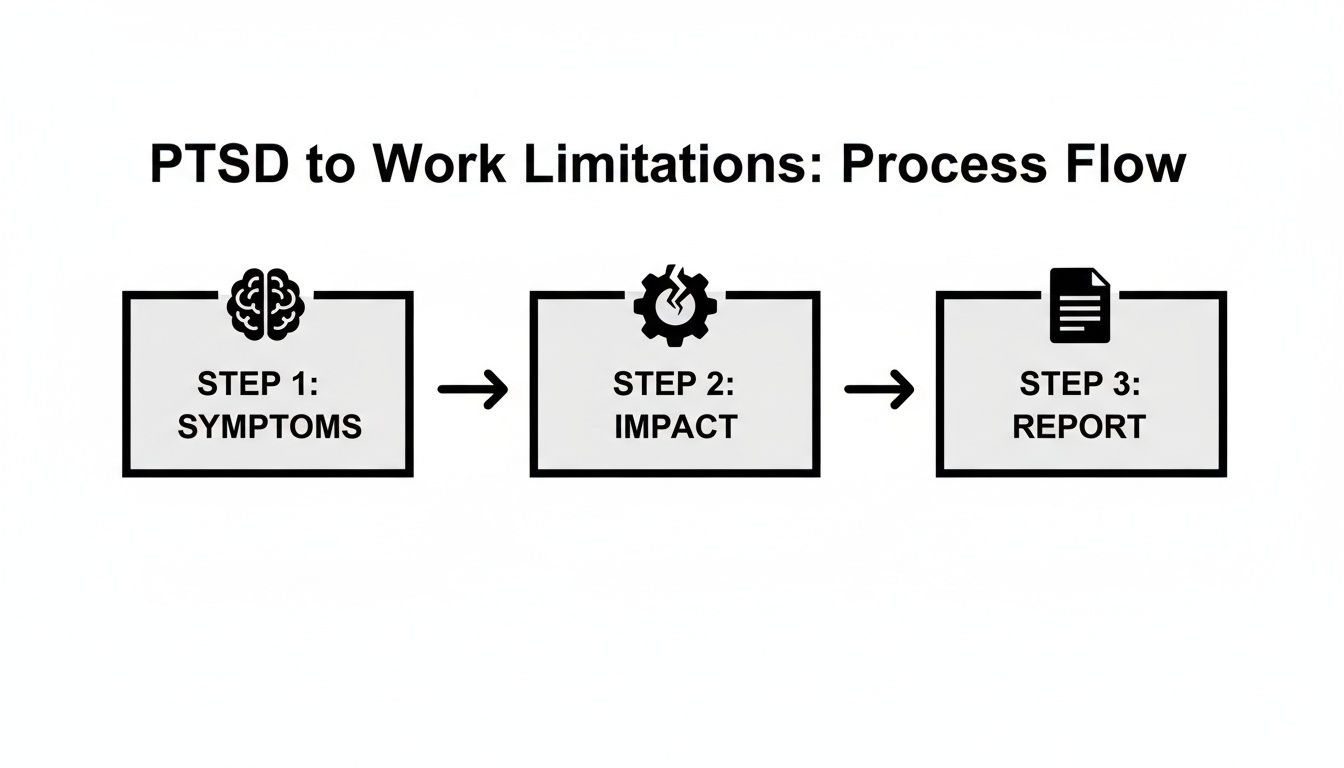
As you can see, a claim isn't just about having a diagnosis. It’s about drawing a clear, undeniable line from your medical reality to the real-world reasons you can’t hold a job, and then backing it all up with solid evidence.
The Initial Application and Review
Once an application for ptsd ssi benefits is submitted, it is sent to a state agency, often called Disability Determination Services (DDS). There, an examiner and a medical consultant will review all the evidence provided. Their job is to gather the medical records and documentation needed to make a decision.
It is not unusual for this initial review to take several months. A common reason for denial at this stage is incomplete information. If the DDS examiner can’t get the records they need, or if the file doesn't clearly spell out how PTSD limits an individual's ability to function at work, the claim might be denied. It is critical to be accurate and to respond to any SSA requests promptly.
The Reconsideration Stage
If an initial application is denied, it is not the end of the process. The first step in appealing is to file a Request for Reconsideration. This must be done within 60 days of receiving the denial letter, so it is important not to delay.
At this stage, a different examiner at DDS will take a fresh look at the entire file, including any new evidence that can be provided. This is an opportunity to fill in any gaps. An applicant can submit updated medical records, new letters from doctors, or statements from people who have seen firsthand how PTSD affects them. This is still a review on paper—there is no in-person meeting at this stage.
It's easy to feel discouraged by an initial denial, but this is a common part of the process. The most important thing is to act fast and file that appeal within the 60-day window. Missing the deadline might mean having to start the whole application over from the beginning.
The Administrative Law Judge Hearing
If the reconsideration is also denied, the next step is to request a hearing with an Administrative Law Judge (ALJ). This is a significant step in the process and, for many people, it is the stage where their claim may be approved. For the first time, an applicant gets to appear before the person making the decision and explain in their own words how PTSD impacts their life.
The ALJ will have the entire file but may also ask questions directly. Often, a vocational expert will be there to give testimony on what kinds of jobs, if any, a person with specific limitations could perform. Preparing for this hearing is very important. It’s the best opportunity to present a full, compelling, and human story of the situation.
While it’s a different system, we can learn from how the VA handles PTSD disability benefits. The VA also bases its decisions on how the condition affects a person’s ability to function at work and in social settings. The 70% disability rating for PTSD—which signifies severe impairment—is the most common rating awarded to veterans (28% of cases). Furthermore, 90.7% of veterans rated for PTSD get a rating of 30% or higher. This shows that when symptoms are severe and well-documented, disability systems recognize the profound impact. You can get more insight by seeing how PTSD claims are evaluated in other contexts.
When to Consider Seeking Legal Assistance
Deciding to hire a disability attorney for a PTSD SSI claim is a personal choice. Many people try to navigate the system on their own, and some are successful. However, the Social Security Administration has its own language, rules, and procedures. An experienced attorney knows how to speak that language and frame a case in a way that aligns with SSA requirements.
It is common for people to start the application process feeling confident about their medical records. After all, a diagnosis exists. But the journey is not always that simple. A claim isn't just about proving you have PTSD; it's about meticulously connecting that diagnosis to an inability to work.
After an Initial Denial
Receiving a denial letter can be difficult. It can feel like a final judgment, but it is often just part of the process. This is the point where many people start thinking seriously about getting legal help.
A denial does not necessarily mean a case is weak. It may mean the evidence was not presented in the way the SSA needed to see it, or that a critical piece of documentation was missing. An experienced attorney can review a denial letter, identify the stated reason for the denial, and work on shoring up those areas—whether it's getting more specific medical opinions or better documenting day-to-day functional limits—to build a stronger case for an appeal.
A denial is not the end of the road. It's an opportunity to re-evaluate a claim, gather more targeted evidence, and present a more compelling argument during the appeals process.
Preparing for a Hearing
If a claim is denied again at the reconsideration stage, the next stop is a hearing in front of an Administrative Law Judge (ALJ). This is, without a doubt, a critical stage of the claim. It’s a real chance to tell a story directly to the person making the decision, and having professional representation can be beneficial.
Here’s how an attorney can help prepare for that hearing:
- Organizing Your Evidence: An attorney can take all the medical records, work history, and other documents and weave them into a clear, compelling story for the judge.
- Developing Your Testimony: The hearing can be intimidating. An attorney can go over the kinds of questions the judge might ask and help you practice answering them in a way that clearly and honestly explains how your PTSD affects you.
- Questioning Experts: The SSA will often have its own medical and vocational experts at the hearing. A lawyer can cross-examine these experts to challenge opinions that might not accurately reflect the claimant's condition.
When the Process Feels Overwhelming
Living with PTSD is challenging enough. Adding a complex, bureaucratic application process with extensive paperwork and rigid deadlines can feel overwhelming. If the stress of managing a claim is making a condition worse or if it is simply a struggle to keep up, that’s a clear sign it might be time to ask for help.
Passing the procedural work to a professional lets you step back and focus on your health. Just knowing someone else is tracking the deadlines, handling the phone calls, and filing the paperwork can be a massive relief, reducing anxiety and making sure nothing falls through the cracks.
For a deeper dive, take a look at our guide on what to consider when hiring a lawyer for an SSI claim. Making an informed choice about getting legal help is a crucial part of the process.
Your Top Questions About PTSD and SSI Claims, Answered
When you're trying to get SSI benefits for PTSD, it's natural to have a lot of questions. It's a confusing process. Let's walk through some of the most common things people ask, so you can get a clearer picture of what's ahead.
Can I Still Work While Applying for SSI Benefits for PTSD?
This is a key question, and the answer is complex. The Social Security Administration (SSA) has very rigid rules about working while you apply for Supplemental Security Income (SSI). Since SSI is a program based on financial need, a major part of qualifying is showing your condition keeps you from doing what they call Substantial Gainful Activity (SGA).
Think of SGA as an earnings limit. The SSA sets a new dollar amount each year, and if you earn more than that in a month, they may deny your claim—even if your medical evidence is strong. From their perspective, if you can earn that much money, you may not be "disabled" according to their rules. It's a technicality that can affect many applicants.
Does It Matter If the Trauma Happened a Long Time Ago?
Not necessarily. The SSA isn't focused on when the traumatic event happened. What they care about is how your PTSD symptoms are affecting your life and your ability to work right now.
PTSD is a complex condition. Symptoms can appear years after the event, or they can suddenly get much worse long after the fact. An applicant's role is to show the SSA the severity of their current symptoms and how they limit them today. This is where medical records become critical. They should paint a clear, consistent picture of ongoing struggles, regardless of when the trauma itself occurred.
The SSA's decision often hinges on the current intensity of PTSD symptoms and their real-world impact on an individual's ability to work. The date of the trauma is secondary to present-day medical evidence and functional limitations.
How Does the SSA Look at PTSD When I Have Other Health Problems?
It is incredibly common for people with PTSD to also struggle with other issues, like depression, anxiety, or chronic physical pain. The SSA is required by law to look at the combined effect of all of an individual's health conditions.
They don't evaluate each diagnosis in a vacuum. Instead, they look at the whole picture. For example, a physical injury might prevent someone from doing jobs that require lifting or standing, while their PTSD makes it difficult to handle the stress and concentration needed for a desk job. It's the cumulative impact of all impairments that determines whether an individual can work.
What’s a Consultative Examination? Do I Have to Go?
Sometimes, the medical records in a file may not be sufficient for the SSA to make a decision. When that happens, they might schedule a Consultative Examination (CE). This is a medical appointment that the SSA arranges and pays for with an independent doctor or psychologist.
It is important to attend this appointment. If an applicant misses a scheduled CE without a very good reason, the SSA has grounds to deny the claim on the basis of insufficient evidence. The report from this one-time exam gives the claims examiner a fresh, objective look at the condition, so it’s a crucial step in the process.
Trying to navigate an SSI claim for PTSD on your own can feel like an uphill battle. If you feel overwhelmed, the team at Bell Law is ready to help you figure out your next steps. You can contact us for help with your Social Security Disability case.
Disclaimer: The information on this page is provided for general informational purposes only and is not legal advice. Reading this content does not create an attorney-client relationship. For advice about your specific situation, please contact a licensed attorney.