
Your Guide to Slip and Fall Injury Claims in Oregon
"I was satisfied once John Bell took over my case."
"Communication was always timely."
Your Guide to Slip and Fall Injury Claims in Oregon
It’s a scenario no one plans for. You're walking on someone else's property and suddenly, you slip, trip, or fall because of a hazardous condition. This is often called a slip and fall injury, but it's rarely a simple "accident." These incidents can cause serious harm and leave you wondering about responsibility and what to do next.
Understanding the Basics of a Slip and Fall Injury

A slip and fall can happen almost anywhere—a slick spot on a freshly mopped grocery store floor without a warning sign, a poorly lit staircase, or a badly cracked public sidewalk. These everyday situations are at the heart of what we're talking about.
What turns a fall into a potential legal matter is a concept called premises liability. At its core, this general legal principle suggests that property owners may have a duty to keep their spaces reasonably safe for people who are legally there.
What Is Premises Liability?
When you enter a business or public space, there may be an expectation that the owner has taken basic steps to prevent foreseeable harm. If a property owner knows about a hazard—or, in some cases, should have known about it through regular upkeep—they may have a responsibility to address it.
This responsibility can look like:
- Mopping up a spill promptly.
- Fixing a broken handrail or uneven step.
- Putting out highly visible signs for wet floors or icy sidewalks.
- Making sure hallways and stairwells have proper lighting.
When a property owner fails to meet these duties and someone gets hurt as a result, that's where premises liability principles may come into play.
The Immediate Aftermath of an Injury
The moments right after a fall can be a blur of pain and confusion. Your first priority is your health. The physical toll can range from a few bruises to serious injuries like broken bones, traumatic brain injuries, or spinal cord damage.
The consequences of a fall can extend beyond the immediate physical pain. They can introduce unexpected medical bills, time away from work, and a period of uncertainty about recovery and financial stability.
Getting a handle on the basics of a slip and fall injury can help you see it not just as a random, unfortunate event, but as a situation that may be governed by principles of responsibility. Of course, the best way to deal with a fall is to prevent one from happening in the first place. For great tips on home safety, check out a comprehensive guide to preventing falls in the home. Understanding potential hazards is the first step toward protecting yourself and your family.
Key Concepts in a Premises Liability Claim
When you're trying to understand a slip and fall claim, it can feel like you're learning a new language filled with legal jargon. But the core ideas are often more straightforward than they seem. The situation may revolve around a concept called premises liability, which is about the responsibility a property owner may have to keep their space reasonably safe for others.
Let's break down the foundational ideas that work together to create a framework for looking at what happened and why.
The Duty of Care
First up is the duty of care. Think of this as a general standard for safety. Property owners in Oregon may have a responsibility—a "duty"—to act with reasonable care to prevent harm to people who are legally on their property. This doesn't mean they have to create an environment where no one could ever possibly get hurt.
It’s more about taking practical, reasonable steps to maintain the property. This could mean things like:
- Regularly checking for spills or tripping hazards.
- Fixing a broken handrail or a crumbling step without unnecessary delay.
- Putting up a highly visible "wet floor" sign next to a freshly mopped area.
- Making sure stairwells and hallways are well-lit.
This duty is a baseline expectation for property owners. For a deeper dive, check out our full explanation of what premises liability law covers.
The Principle of Negligence
When a property owner does not fulfill their duty of care, that failure is sometimes called negligence. It's helpful to understand that negligence isn't about someone intending to cause harm. It’s about a failure to act as a reasonably careful person might have in the same situation.
Imagine a grocery store manager sees that a freezer is leaking, creating a puddle in an aisle. If they do nothing about it for hours, and then a shopper slips and falls, that inaction could be considered in a negligence analysis. The hazard was known, and a reasonable person might have cleaned it up or at least cordoned off the area.
A key part of a premises liability claim can be showing that a property owner did not meet established safety standards. For example, knowing the details in a guide to building regulations for balustrades can be informative, as these rules exist to help prevent falls and protect people.
Understanding Comparative Fault
Another important concept is comparative fault (also known as comparative negligence). This principle recognizes that sometimes, more than one person might be partially responsible for an accident. Oregon law uses this idea to look at the actions of everyone involved.
For example, if a person was texting and not looking where they were going when they tripped over an obvious hazard, their own inattention could be taken into account. A court or insurance company may look at the whole picture—the property owner's potential negligence and the injured person's actions.
This doesn't automatically mean a person doesn't have a claim. It’s a way to get a more complete understanding of how the slip and fall happened.
To bring these ideas together, here's a quick reference table.
| Concept | General Description |
| Duty of Care | A property owner's responsibility to take reasonable steps to keep visitors safe. |
| Negligence | The failure to meet that duty of care, which may result in a dangerous condition that causes an injury. |
| Comparative Fault | A legal principle that may divide responsibility between parties involved in an incident. |
These three concepts—duty of care, negligence, and comparative fault—are building blocks used to analyze a premises liability claim. Understanding them is a good first step toward understanding your situation.
The Broader Impact of a Slip, Trip, and Fall
When you get hurt in a slip and fall, it’s easy to feel like it was a freak accident—a moment of personal bad luck. But in reality, these incidents are a major public health and safety issue across the country, affecting millions of people every year.
Understanding this bigger picture can be a helpful first step. It helps reframe what happened not as a simple, random accident, but as part of a predictable pattern of harm. The sheer volume of these injuries is a reason why property owners may have a legal and ethical duty to keep their premises safe. The risk is real, and the consequences can be significant.
The Startling National Statistics
The numbers behind slips, trips, and falls tell a shocking story. In 2023 alone, falls resulted in over 8 million emergency room visits nationwide, making up an incredible 21.3% of all ER admissions. Of those, more than 1 million were specifically from slips and falls.
These aren't just abstract figures; they represent real people whose lives were impacted in everyday places.
At work, the situation is just as serious. According to the Bureau of Labor Statistics, workplace falls led to 450,540 injuries and 865 deaths in a single year. This makes falls a leading cause of missed workdays and a constant threat in environments from offices to construction sites. For a deeper dive into these workplace statistics, you can review the full report discussed on Pearson Koutcher Law's blog.
The data makes one thing clear: a slip and fall is rarely a minor issue. For hundreds of thousands of Americans, it can mean serious medical bills, lost income, and a long road to recovery that affects not just them, but their families and employers, too.
The infographic below touches on a few of the core legal ideas that may be examined when figuring out responsibility after an injury.
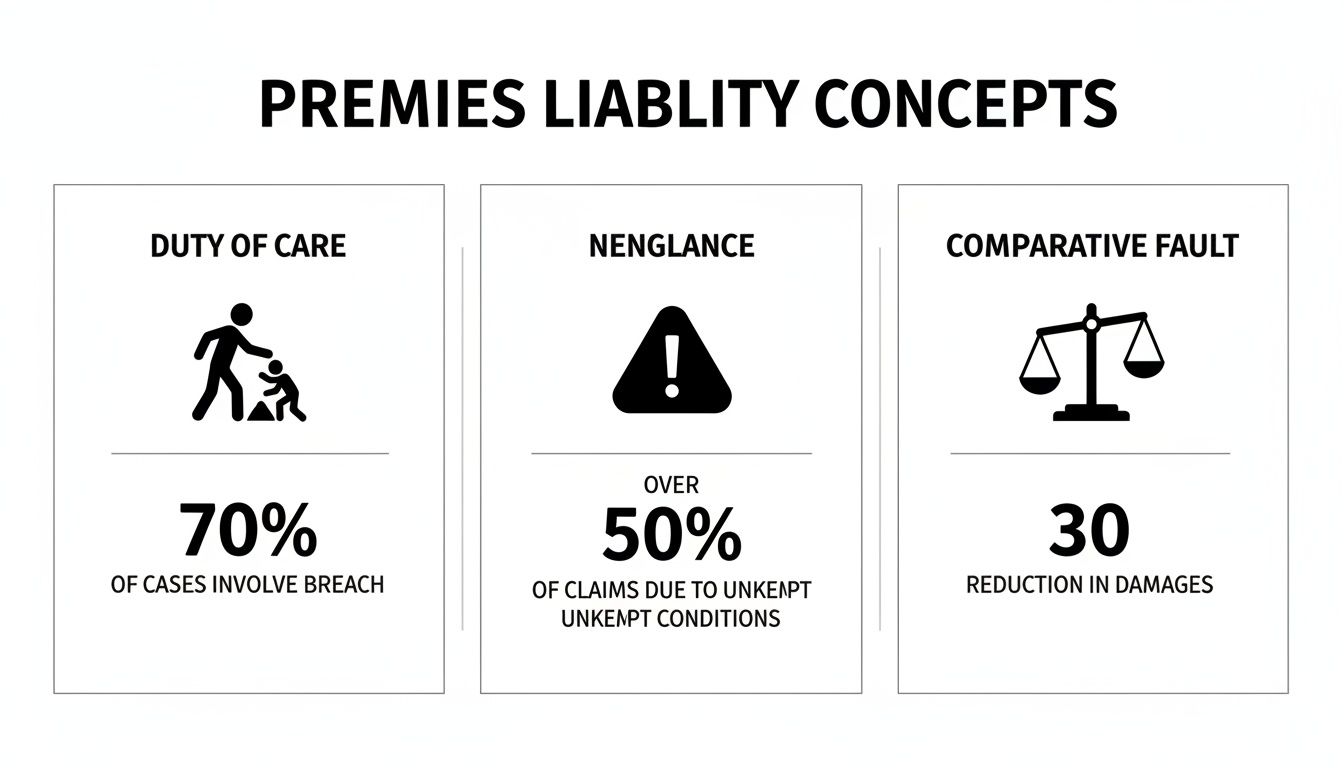
It introduces concepts like duty, negligence, and fault—the building blocks for understanding how a slip-and-fall claim might work in Oregon.
Why This Matters for Your Situation
It can be validating to know you’re not alone. The fact that these injuries happen so often only highlights how important basic property maintenance can be. When a store owner ignores a puddle from a leaky freezer or a landlord fails to fix a broken stair, they are not just neglecting a small detail. They may be ignoring a known risk that can lead to injuries.
Your slip and fall isn't just a personal story; it can be seen as a data point in a national trend. This perspective shows why it's important for property owners to be held accountable for providing a safe environment.
This national context is a reason premises liability laws exist. These laws were created to address this type of problem by setting a standard: property owners should take reasonable care to prevent foreseeable harm. When someone is injured, their situation may be measured against this standard of care. Recognizing the scale of the problem reinforces why your situation should be taken seriously, and the full impact on your health, your job, and your life is never minimized.
What to Do Right After You Fall

The moments after a sudden slip and fall can be a blur of shock, pain, and confusion. It’s easy to feel overwhelmed. But what you do in the minutes and hours that follow can be significant, both for your health and for any potential claim. Knowing what steps to consider can give you a sense of control when you need it most.
Think of this as a practical checklist for general information. While your health is always the top priority, these are some actions you might consider taking to preserve important details about what happened.
First Things First: Your Health
Your well-being is the most important thing. It is advisable to get medical attention, even if you think you’re “fine.” Some serious injuries, like concussions or internal bleeding, don't always show immediate, obvious symptoms. A doctor’s visit can help you get a proper diagnosis and the right care.
Getting checked out promptly also creates a medical record. This official documentation can be helpful because it may connect your injuries back to the fall. When you see the doctor, be sure to explain how you fell so their notes are accurate and complete. We have a detailed guide that explains how to get medical records and why this paperwork can be so vital.
Document Everything You Can
If you're able, take a few minutes to capture the scene of the fall. This isn't just about remembering what happened; it's about preserving evidence of the conditions that may have caused your injury.
Here’s a quick rundown of what to consider:
- Take Photographs: Use your phone to take pictures of the exact spot where you fell. Get shots of the hazard from different angles and distances. Was it a puddle with no warning sign? A cracked piece of pavement? Bad lighting in a stairwell? Snap photos of it all.
- Report It Immediately: Find a manager, supervisor, or the property owner and tell them what happened. This creates an official record of the incident. It is a good idea to ask for a copy of any written report they create.
- Save Your Clothes: The shoes and clothes you were wearing can be evidence. You may want to put them in a bag and set them aside. Not washing them could preserve residue or other clues about the surface you fell on.
Documenting the scene is about creating a snapshot in time. Conditions can change quickly—a spill gets cleaned up, a broken step is repaired, or lighting is fixed. Preserving the scene as it was when you fell provides a clearer record.
Collect Key Information
If anyone else saw you fall, they could be an important witness. You might calmly ask for their name and phone number. Having an independent person who can describe what they saw can be helpful for building a complete picture of what happened.
Finally, as soon as you can, jot down everything you remember. Write down the date, the time, and what the weather was like if you were outside. What were you doing right before the fall? The small details that seem insignificant now could become important later on.
How a Slip and Fall Claim Works in Oregon
So, you’ve been injured in a slip and fall. What happens next? Knowing how the process generally works here in Oregon can take some of the mystery and stress out of the situation. The path from injury to a resolution may have a few key stages, and it's good to have a roadmap of what to expect.
The very first thing to know about is the statute of limitations. Think of it as a legal countdown clock. For personal injury claims in Oregon, the law provides a set amount of time to file a lawsuit. If that deadline is missed, you could lose your right to seek compensation in court. It is very important.
Two Paths for a Claim
After the injury, a claim will often follow one of two routes. Which path a case takes depends on the specific details and the willingness of the other side to negotiate.
Settlement Negotiations: This is how many cases are resolved. It’s a process of back-and-forth between your legal representative and the property owner's insurance company. Evidence is presented—such as medical bills, proof of lost wages, and the story of what happened—to work toward an agreement without going to court.
Going to Trial: Sometimes, an insurance company may not offer a settlement that is considered fair. When that happens, filing a lawsuit and taking the case to trial is a possible next step. It’s a more structured process where a judge or jury hears the evidence and makes a final decision.
The team at Bell Law Offices, with offices in Eugene, Portland, Salem, Roseburg, and Clackamas, is familiar with both of these paths. The job of a legal professional is to handle the tough conversations, wrangle all the paperwork, and represent you so you can put your energy where it belongs: on getting better.
The legal system has its own set of rules and procedures, but it doesn't have to be a maze. The goal of a legal team is to light the path forward and make sure you understand what's happening every step of the way.
The Role of Professional Representation
Trying to manage a slip and fall claim on your own can be a tough road. You may be up against insurance companies with teams of people whose job is to pay out as little as possible. An experienced attorney can level that playing field. They handle complex communications and make sure evidence, from medical charts to the incident report, is collected and used effectively.
This is especially true here in Oregon, with construction booming in places like Portland and Salem. Our local tradespeople face these risks every day. With over 6.8 million Americans needing medical care for fall injuries each year, getting legal help early can make a difference.
Quickly documenting an injury and staying in close contact with your doctors are crucial first steps. From there, a good legal team can draft demand letters, lead settlement talks, and, if it comes to it, take your case to trial, all while giving you the support you need. For a deeper look at the risks, the Bureau of Labor Statistics offers detailed reports on fatal falls in the construction industry.
In the end, whether a case settles or goes to trial, the objective is the same: to seek a fair resolution based on the facts. It can be a long journey, but understanding the basics of how a claim works is the first, most important step.
How a Personal Injury Firm Can Help Your Case
After a serious slip and fall, navigating a complicated legal claim is a difficult task. You're trying to heal. You're dealing with doctor's appointments, watching medical bills pile up, and possibly missing work. The stress can feel overwhelming. This is where a personal injury firm can step in to lift that burden off your shoulders.
Think of a legal team as your dedicated advocate. They can handle the time-consuming tasks required to build your case, starting with managing phone calls and emails from insurance companies. An insurance company's goal may be to minimize their payout, so having a professional represent you from day one helps ensure your story is told correctly and your rights are protected.
Organizing the Evidence and Building Your Claim
One of the most critical things a legal team does is gather and organize all the scattered pieces of your case. Their job is to weave together the evidence into a clear, compelling story that shows what happened and how it has impacted your life.
This isn't just about paperwork; it's about building a solid foundation for your claim. This process often includes:
- Collecting Medical Records: They track down and compile every relevant medical document—from the initial ER report to physical therapy notes—to create a complete timeline of your injuries and treatment.
- Calculating Your Damages: They meticulously document all financial losses. This means adding up not just the medical bills you see, but also potential lost wages from time off work and any other costs that have surfaced because of the injury.
- Managing Deadlines and Paperwork: The legal system runs on strict deadlines. A legal team makes sure every form is filed correctly and on time, so nothing falls through the cracks.
For many people, the big question is knowing the right moment to get this help. Understanding when to hire a personal injury attorney is often the first and most important step.
Providing Clear Guidance and a Path Forward
Beyond the logistics, a good attorney offers clear, straightforward guidance. They cut through the legal jargon and explain your options in plain English. They can help you understand the different directions your case could go, from a negotiated settlement to a potential trial. This support empowers you to make informed choices, not ones based on stress or confusion.
An attorney’s role is to level the playing field. They bring experience and knowledge to your corner, ensuring that your rights are protected throughout the entire process and that your focus remains on healing.
With offices in Eugene, Portland, and Salem, Bell Law Offices provides Oregonians with accessible, hands-on support. We want you to feel confident knowing you have a caring, local team ready to help you understand your rights and options every step of the way.
Frequently Asked Questions About Slip and Fall Claims
When you're dealing with the shock and pain of an unexpected fall, questions are bound to pop up. We've gathered some of the most common ones we hear to give you some clarity. Think of this as a starting point to help you get your bearings before you speak with an attorney about your specific situation.
What If the Property Owner Blames Me?
It is not uncommon for a property owner to try to shift the blame onto you. The best thing you can do in that moment is to avoid getting into an argument. Focus on the facts and document everything you can remember.
Oregon law handles these situations using a concept called comparative negligence. This isn't about finding one person who is 100% at fault. Instead, the law looks at the entire situation to determine what percentage of responsibility each person may hold for the incident. It’s a nuanced part of the law, and an experienced attorney can walk you through how it might apply to the facts of your case.
Does a Warning Sign Mean I Don't Have a Case?
Not necessarily. Putting up a "Wet Floor" sign doesn't automatically absolve a property owner of all responsibility. That sign is just one piece of evidence in a much larger picture.
It is important to ask if the warning was effective. Was it placed somewhere obvious, where someone paying reasonable attention would see it? Was it big enough and clear enough to read easily? Or was it tucked away in a corner or knocked over?
A warning sign is a factor, but it is weighed against all the other facts of what happened.
How Much Does It Cost to Hire a Personal Injury Attorney?
This is a huge concern for most people, and understandably so. You're already dealing with medical bills and potentially lost wages, so the last thing you need is another expense. That’s why many personal injury attorneys, including our firm, work on what’s called a contingency fee basis.
In simple terms, this means you don't pay us any fees unless we win your case. Our fee is a pre-agreed-upon percentage of the money recovered for you.
Here’s what that looks like in practice:
- No Upfront Costs: You won’t have to pay anything out of your own pocket to get your case started.
- We Only Get Paid If You Do: If a settlement or verdict is not secured for you, you owe us no attorney fees.
- Everything Is Clear from the Start: We'll go over the exact percentage and all the terms in a written agreement before we begin any work.
We always start with a free consultation, which is the perfect time to ask about our fee structure and get answers to all of your questions without any pressure.
If you've been hurt in a slip and fall and have more questions, the team at Bell Law is here to help. Contact us for a free consultation to understand your rights and options.
Disclaimer: The information on this page is provided for general informational purposes only and is not legal advice. Reading this content does not create an attorney-client relationship. For advice about your specific situation, please contact a licensed attorney.