
uber accident claim: Your Guide to Fair Compensation
"I was satisfied once John Bell took over my case."
"Communication was always timely."
uber accident claim: Your Guide to Fair Compensation
The moments right after an Uber crash are a blur of confusion and adrenaline. What you do in that initial shock, however, can define the outcome of your claim. Your first priorities are always safety and getting help, but the information you gather at the scene is the bedrock of your fight for fair compensation.
What To Do Immediately After an Uber Accident
In the chaos following a collision, it's hard to think straight. But taking a deep breath and following a few key steps will protect your health and your legal rights. Think of yourself as a first responder to your own case—your job is to secure the scene and document everything. Every detail matters.
The immediate actions are similar to any car wreck, but the involvement of a rideshare company like Uber adds layers of complexity. While our general guide on what to do after a car accident is a great resource, let's focus on the unique aspects of an Uber crash.
First, Secure the Scene and Call for Help
Before anything else, check on everyone’s safety. If it’s possible and safe to do so, move vehicles out of the way of traffic to avoid a second collision. Assess yourself, your passengers, and the people in the other car for injuries.
Once the immediate danger has passed, call 911. Don't hesitate. This one call is crucial for two reasons:
- It brings the police. An official police report is one of the most credible pieces of evidence you can have. It’s an unbiased account that documents the scene, notes initial findings of fault, and includes witness information.
- It summons medical help. Paramedics can provide immediate care and assess whether anyone needs to go to the hospital. This is vital for your health, and it also creates an official record connecting your injuries directly to the crash.
Get Medical Attention, No Matter What
Even if you feel okay, get a medical evaluation. Adrenaline is a powerful painkiller and can easily hide serious injuries like whiplash, internal bleeding, or a concussion. Symptoms might not show up for hours or even days.
A huge mistake we see people make is telling an insurance adjuster, "I feel fine." If you wait to see a doctor, the insurance company will jump at the chance to argue your injuries happened after the crash, not because of it.
Go to an urgent care clinic, the ER, or your family doctor as soon as possible. This creates the medical records you need to prove the crash caused your injuries.
Document Everything at the Scene
While you wait for help to arrive, become your own investigator. Don't assume the Uber driver or anyone else will gather the evidence you need.
Use your phone to take pictures and videos of absolutely everything:
- The damage to all cars involved, from every angle.
- License plates and VINs (usually visible on the dashboard or inside the driver's door).
- The wider scene: traffic lights, stop signs, road conditions, skid marks.
- Any visible injuries on yourself or others.
Next, exchange information. You need more than just the Uber driver’s name. Get the full name, contact info, and insurance details from every driver involved. Just as importantly, get the names and phone numbers of any witnesses who saw what happened. Their independent testimony can be incredibly powerful.
These accidents can be serious. Research shows that between 2017 and 2018, 91 fatal crashes involving Uber drivers led to 107 deaths in the U.S., often linked to factors like speeding or impairment. Learn more about these rideshare accident findings. This is exactly why being meticulous about gathering your own evidence is so critical to the success of your Uber accident claim.
Navigating Uber's Complex Insurance Policies
Figuring out who pays for your injuries after a rideshare crash is often the most confusing part of the whole ordeal. It's rarely a straightforward process. Uber's insurance is a moving target, with coverage that shifts dramatically based on what the driver was doing at the precise moment of the collision.
The entire system is broken down into different "periods" or phases of the driver's activity. The amount of insurance money available to you hinges entirely on which period the driver was in. Knowing this is the key to identifying the right policy to file your claim against.
The Three Periods of Uber Insurance Coverage
It helps to think of the Uber driver's journey in three distinct stages. Each one comes with its own set of insurance rules, which can feel impossible to untangle without a clear guide.
The driver’s status when the crash happened dictates everything. Was their app off? Were they waiting for a ride request? Or were you already in the car heading to your destination? The answer determines whether you're dealing with the driver’s personal policy, Uber’s limited coverage, or Uber's full $1 million commercial policy.
This diagram shows the first critical steps you should always take. Following them helps establish the crucial facts needed to figure out which insurance period applies.
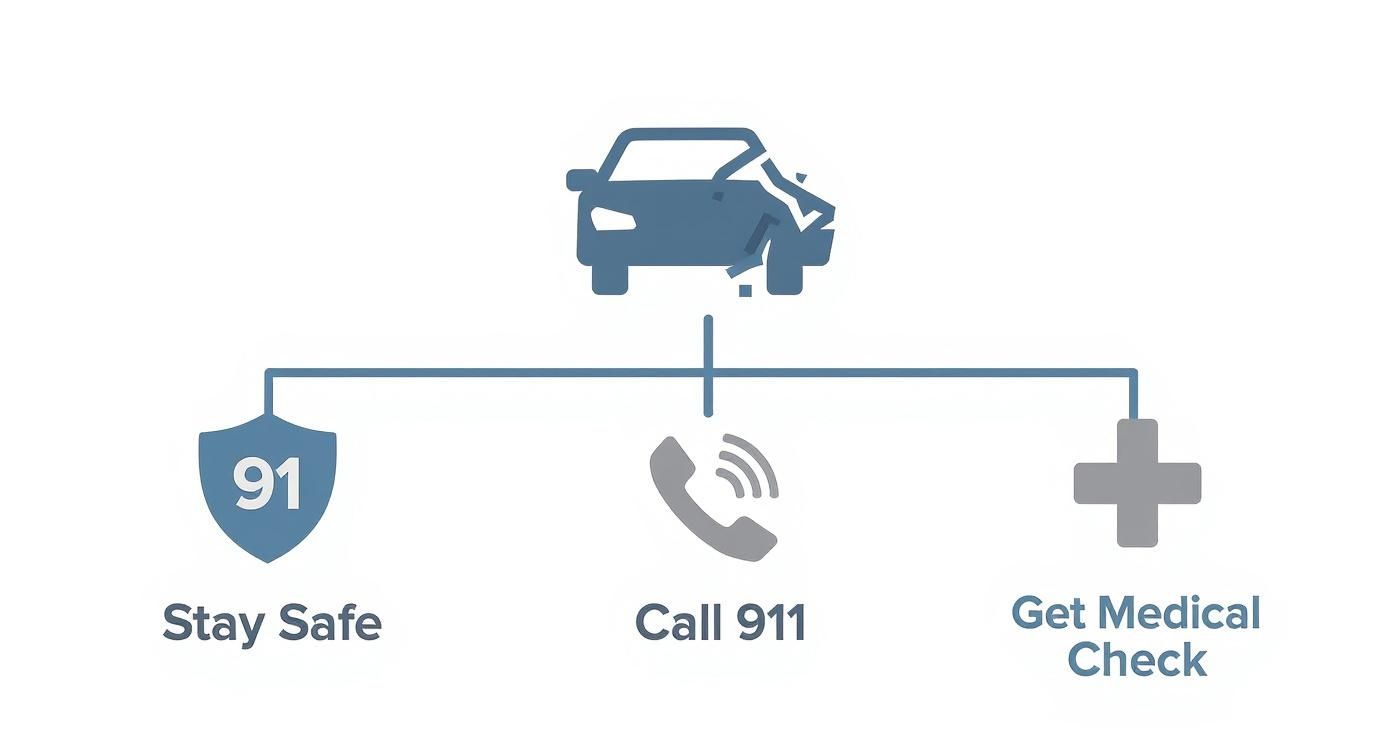
These initial safety and documentation steps lay the groundwork for a strong claim, no matter which insurance period you fall into.
To make this clearer, I've broken down how Uber's coverage works depending on the driver's status at the time of an accident.
Uber Insurance Coverage by Driver Status
| Period 1 | App is on; driver is waiting for a request. | $50,000/person, $100,000/accident liability; $25,000 property damage. | Not typically provided by Uber in this phase. |
| Period 2 | Driver has accepted a request and is en route to pick up a passenger. | $1 million third-party liability. | Included. |
| Period 3 | Passenger is in the vehicle. | $1 million third-party liability. | $1 million included for passengers. |
As you can see, the difference in available coverage is massive. This is why proving the driver's status is absolutely essential for your case.
Period 1: When The Driver Is Waiting For A Ride
This initial phase starts the moment a driver logs into the Uber app and is available to accept a ride, but hasn't been matched with a passenger yet. They are essentially "on the clock" but are still waiting for work.
During this time, the driver's personal auto insurance is technically the primary coverage. Here’s the catch: most personal policies contain a "commercial use exclusion," which means they won't cover an accident if the driver was using their car for business—and yes, that includes waiting for a rideshare request.
To plug this gap, Uber offers what’s called contingent liability coverage. If the driver's personal insurer denies the claim (which they almost always do), Uber's policy is supposed to step in.
- Bodily Injury Liability: Up to $50,000 per person.
- Total Bodily Injury Liability: Up to $100,000 per accident.
- Property Damage Liability: Up to $25,000 per accident.
These are Oregon's minimums, and they are much lower than what's available in other periods. This coverage also only applies if the Uber driver is proven to be at fault for the crash.
We see this all the time: a driver's personal insurance company will deny a claim by arguing they were engaged in commercial activity. This is why getting the app's digital records to prove the driver's status is so critical to your case.
One of the thorniest issues is distinguishing between commercial and personal auto insurance, as it dictates everything. This single detail is precisely where many valid claims fall apart without expert help.
Period 2: En Route To Pick Up A Passenger
The second a driver accepts your ride request and starts driving to you, the insurance situation gets much better. This is known as Period 2.
In this phase, Uber's full $1 million third-party liability policy kicks in. This is a commercial policy designed to protect people who might be injured by the Uber driver, like other drivers, pedestrians, or cyclists.
The coverage limits jump significantly to include:
- $1 million in third-party liability coverage.
- Uninsured/Underinsured Motorist (UM/UIM) bodily injury coverage.
So, if an Uber driver who is on their way to pick someone up hits you, this substantial policy is there to cover your damages.
Period 3: When You Are In The Uber
The highest level of protection applies from the moment you get into the Uber until the second you step out at your destination. This is Period 3, and it offers the most comprehensive coverage, especially for passengers.
During this ride, you are protected by two crucial policies from Uber:
$1 Million Third-Party Liability: This covers damages if your Uber driver causes a wreck that injures people in another car or pedestrians.
$1 Million Uninsured/Underinsured Motorist (UM/UIM) Coverage: This is the most important policy for you as a passenger. If another at-fault driver hits your Uber and they are uninsured, underinsured, or flee the scene (hit-and-run), this policy covers your injuries and losses up to $1 million.
This robust coverage is meant to be the primary safety net for passengers. Knowing these policies exist is one thing, but actually getting the insurance company to pay requires proving which period the accident occurred in and who was at fault—a battle that is often much harder than it should be.
Building a Bulletproof Evidence File for Your Claim
After a crash, memories get foggy and stories can change. The one thing that doesn't lie? Hard evidence. Putting together a detailed, organized evidence file isn't just a good idea—it's the bedrock of a strong Uber accident claim. Insurance adjusters are paid to find holes in your story, but they have a much harder time arguing with clear, undeniable proof.
Think of yourself as the lead detective on your own case. Every photo you take, every receipt you save, and every note you jot down is another piece of the puzzle. Together, they create a full picture of what happened and how this crash has turned your life upside-down. This isn't about picking a fight; it's about being prepared.
Capturing the Scene with Photos and Videos
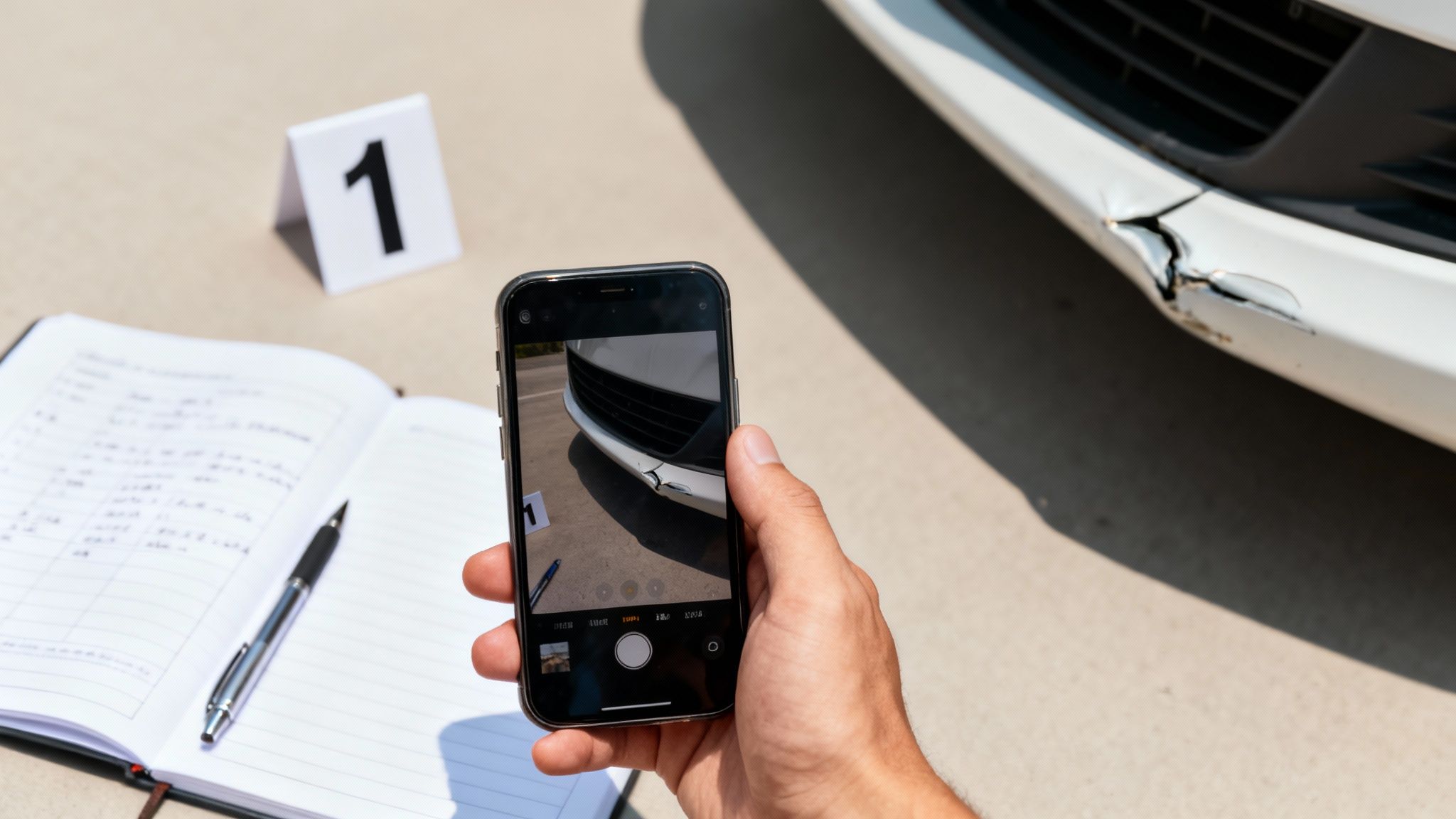
Your smartphone is your best friend in the moments after an accident. Don't just grab a couple of quick shots of the damage. You need to create a complete visual story of the entire scene.
- Go Wide, Then Get Close: Start by taking wide shots that show everything—the final positions of the cars, traffic lights, stop signs, and any nearby buildings. Then, zoom in for close-ups of the damage on every vehicle involved, making sure to shoot from several different angles.
- Document Road Conditions: Look for skid marks, debris scattered on the road, and even the weather. Was it raining? Foggy? These details are crucial for accident reconstruction experts to understand how the crash happened.
- Photograph Your Injuries: Take clear pictures of any cuts, bruises, or swelling right away. Keep taking photos over the next few days as bruises darken or other injuries become more visible.
For an even bigger advantage, nothing beats video footage. If you're frequently in rideshares or drive for a living, investing in a reliable dash cam provides indisputable proof of what happened leading up to the impact.
Meticulous Medical Record-Keeping
Your health comes first, and the paper trail of your medical journey is the core of your injury claim. Every single doctor's visit, prescription, and therapy session helps to prove the full extent of your injuries and the true cost of your recovery.
Start a dedicated folder (physical or digital) right away. This is where you'll keep:
- All Medical Bills: This means everything—the ambulance ride, the ER visit, hospital stays, follow-up appointments, and any specialists you see.
- Receipts for Out-of-Pocket Expenses: Don't let the small stuff slip through the cracks. Save receipts for prescriptions, pain medication, crutches, braces, and even the gas or parking fees for your medical appointments.
- Doctor's Notes and Diagnoses: Get copies of your treatment plans, MRI or X-ray reports, and any notes from your doctor that detail your injuries and recovery timeline.
Getting these records isn't always straightforward. We've put together a guide on how to get your medical records to walk you through the process.
A huge mistake I see people make is creating gaps in their medical treatment. If you stop physical therapy or skip follow-up appointments, the insurance adjuster will argue that you either weren't really hurt or that you've already recovered. Consistency is key.
Proving Your Financial Losses
The financial fallout from a crash goes way beyond just medical bills. You also have to show exactly how it has impacted your wallet, and for most people, that means lost income.
To build a solid case for your lost wages, you need to provide clear proof. It’s not enough to just say you missed a week of work. You need to show your consistent earning history and how the accident directly interrupted it.
Make sure you gather this documentation:
Recent Pay Stubs: Collect a few months' worth of pay stubs from before the accident to establish your average earnings.
A Letter from Your Employer: This is a big one. Ask your manager or HR department for an official letter on company letterhead that confirms your job title, your rate of pay, and the specific dates you were out of work because of your injuries.
Tax Returns: If you’re a freelancer, self-employed, or have a fluctuating income, your tax returns from previous years are the best way to prove your earning capacity before the crash.
By gathering this evidence piece by piece, you transform your claim from a simple request into a well-supported, undeniable demand for fair compensation. This file is your greatest asset, ensuring you can justify every single dollar you're asking for.
Figuring Out What Your Uber Accident Claim is Really Worth
It often happens fast. Shortly after the crash, you get a call from an insurance adjuster with a settlement offer. It might even sound like a decent amount of money at first. But you have to remember who they work for. Their job is to protect their company's bottom line by closing your claim for as little as possible.
That first offer is almost never what you're truly owed.
To make sure you get a fair settlement, you first need to get a handle on every single loss you've suffered because of the accident. This isn't just about the stack of medical bills on your kitchen table. A proper valuation looks at the complete picture—the hard financial costs and the very real, personal impact the crash has had on your life.
The Black-and-White Costs: Economic Damages
This is the most concrete part of your claim. We call these economic damages, and they represent the specific, verifiable financial hits you’ve taken. Think of them as any loss you can back up with a receipt, invoice, or pay stub.
Getting this right means being meticulous. Your list should include:
- All Medical Bills: Don't just count the big stuff. This includes the ambulance ride, ER visit, surgeries, physical therapy, prescriptions, and even the cost of gas for driving to and from all your appointments.
- Lost Wages: This is the income you missed out on because you were too injured to work. You'll need to gather pay stubs or get a letter from your employer to document this.
- Loss of Future Earning Capacity: What if your injuries are serious enough that you can't go back to your old job, or you can't work as many hours? You have a right to be compensated for that long-term drop in your income.
- Property Damage: This covers the repair or replacement costs for your car and anything else that was destroyed in the crash, like your phone, laptop, or even your glasses.
The Human Cost: Non-Economic Damages
This is where so many people unknowingly leave a huge amount of money behind. Non-economic damages are meant to compensate you for the personal, non-financial suffering the accident forced on you. They’re harder to put a number on, but they are just as valid and often make up the largest portion of a settlement.
These damages are all about the human toll of the collision.
Insurance adjusters are masters at minimizing these "subjective" damages because there's no simple bill for them. But your physical pain, the anxiety, the sleepless nights—those are real losses, and you deserve to be compensated for them.
Here’s what non-economic damages cover:
- Pain and Suffering: This is for the physical pain, discomfort, and general misery your injuries have put you through.
- Emotional Distress: A serious crash is terrifying. This accounts for the anxiety, fear, depression, and even PTSD that can linger long after the physical wounds have healed.
- Loss of Enjoyment of Life: This addresses how the injury has robbed you of the ability to do things you once loved. If a back injury means you can no longer go on your weekly hike with your family or even play on the floor with your kids, that is a profound loss with real value.
We often calculate the value here using a "multiplier" method. Your total economic damages are multiplied by a number—usually between 1.5 and 5—depending on how severe your injuries are and how dramatically your life has been altered.
The risks are undeniable. Recent data shows that from 2019 to 2022, Uber-related crash fatalities jumped by 40%. What’s really telling is that over 95% of those deadly accidents were caused by other drivers, not the person behind the wheel of the Uber. This just goes to show how often an innocent person's life is turned upside down by someone else's mistake, reinforcing why it’s so critical to account for every single loss. You can discover more insights about these rideshare statistics to understand the full scope of the problem.
Why an Oregon Attorney Is Your Best Ally

After an Uber crash, it’s tempting to try and handle the insurance claim yourself. The thinking is often, "Why should I give a lawyer a cut when I can just deal with the adjuster directly?" I've seen this line of reasoning many times, and it almost always ends up costing the victim far more than any attorney's fee.
The reality is that insurance companies are not on your side. Their entire business model is built on paying out as little as possible. An experienced Oregon attorney doesn’t just fill out paperwork; they level a very uneven playing field. You’re putting a legal professional in your corner to go head-to-head with the insurance company's pros.
Navigating Insurance Company Tactics
Insurance adjusters are highly trained negotiators. Their job is to protect their company's bottom line, and they have a playbook of tactics to minimize or deny your uber accident claim. Without an expert fighting for you, it's incredibly easy to fall into one of their traps.
Here are a few common moves I see all the time:
- The Quick, Lowball Offer: They'll often dangle a fast settlement check in front of you, sometimes just days after the crash. This is a classic move to close your case for pennies on the dollar before you even understand the full extent of your injuries and future medical needs.
- The Recorded Statement Trap: An adjuster will politely ask to record your conversation. They’re hoping you’ll say something innocent like "I'm doing okay" or "I feel better," which they can later twist to argue your injuries weren't that serious.
- Delay and Deny: Another favorite is to simply drag their feet. They might ignore your calls or request endless documents, hoping the mounting financial pressure will force you to accept a bad offer out of sheer desperation.
Having an attorney means you don't have to deal with any of it. We take over all communication, and we know what to say—and more importantly, what not to say—to protect the value of your case.
Maximizing Your Compensation
A good lawyer looks far beyond your immediate medical bills. We bring in medical and financial experts to build a complete picture of your losses. This includes future surgeries, ongoing physical therapy, lost earning capacity if you can't work, and the very real—but often overlooked—cost of your pain and suffering.
The real value of a claim isn't just about receipts. It’s about the human cost—the pain, the missed family moments, the loss of enjoyment in life. An attorney knows how to translate that suffering into a dollar amount that reflects its true impact.
With over two million rideshare drivers on the road, accidents are on the rise. In fact, studies show these vehicles are on the road so much more than personal cars that they're about 73% more likely to be involved in a crash. This complex environment raises tough questions about liability that an attorney is best equipped to answer, ensuring you get the compensation you deserve. You can learn more about these rideshare accident risks to see just how complicated these cases can be.
Understanding Oregon’s Legal Deadlines
This is a big one. In Oregon, you have a strict deadline, known as the statute of limitations, to file a personal injury lawsuit. For most cases, you have just two years from the date of the accident.
If you miss that deadline, even by one day, your right to seek compensation is gone forever. An attorney manages all these critical dates for you, making sure every document is filed correctly and on time so you can focus on healing.
Finally, you might be worried about the cost. Most personal injury attorneys in Oregon, including our firm, work on a contingency fee basis. It’s simple: you pay nothing upfront. Our fee is a percentage of the money we recover for you. If we don’t win your case, you don’t owe us a dime. This system ensures that everyone has access to justice. Our guide on hiring a personal injury attorney explains this in more detail.
Your Top Questions About Oregon Uber Accident Claims Answered
When you’re in a crash involving an Uber, the aftermath is a confusing whirlwind of pain, paperwork, and insurance jargon. You’re hurt, your car might be wrecked, and you’re suddenly thrust into a claims process that feels designed to be complicated. It’s no surprise that you have questions.
Getting straight answers is the first step toward getting back on your feet. Here, we'll tackle some of the most common and critical questions we hear from people involved in rideshare accidents across Oregon.
How Long Do I Really Have to File a Claim in Oregon?
This is, without a doubt, one of the most important questions, and the answer is written in stone. In Oregon, the law gives you a strict deadline, known as the statute of limitations. For most personal injury claims, including car accidents, you have two years from the date you were injured to file a lawsuit.
If you miss that two-year deadline, your claim is almost certainly barred forever. The court will not hear your case, and you lose your right to seek compensation.
While a few rare exceptions exist, you should never, ever bank on them applying to your situation. That clock starts ticking the moment the crash happens. It's vital to speak with an attorney long before the two years are up, giving them enough time to properly investigate, gather evidence, and prepare a strong case.
What Happens If the Other Driver Was Uninsured or Drove Off?
It's a nightmare scenario: the driver who hit you either has no insurance or simply flees the scene. This is precisely where Uber's insurance policy becomes a critical safety net, especially for passengers.
If you were injured in a hit-and-run or by an uninsured driver while on an Uber trip (either on the way to pick you up or during your ride), you can tap into Uber's Uninsured/Underinsured Motorist (UM/UIM) coverage.
This is a huge deal. Uber's policy carries up to $1 million in coverage for your injuries and damages in these exact situations. It essentially steps into the shoes of the insurance that the at-fault driver was supposed to have.
To make a successful claim, however, you have to act fast. Reporting the crash to the police immediately is essential. Insurance companies require an official police report to verify a hit-and-run before they will even consider a UM/UIM claim. An experienced lawyer can help you navigate this process to make sure all the boxes are checked correctly.
Can I Still Get Compensation If I Was Partially to Blame?
Yes, absolutely. Oregon law recognizes that accidents are often not 100% one person's fault. Our state follows a legal principle called modified comparative negligence. It sounds complex, but the idea is fairly straightforward:
- You can recover damages as long as your share of the fault is not greater than the other party's. In simple terms, you must be found 50% or less at fault for the crash.
- Your final settlement or award will be reduced by your percentage of fault.
Let's say your total damages—medical bills, lost wages, pain and suffering—add up to $100,000. If a jury decides you were 20% responsible for the collision, your award would be cut by that 20% (or $20,000), meaning you could still recover $80,000.
Be warned: assigning fault is where the biggest battles with insurance adjusters happen. Their job is to minimize their payout, and one of the easiest ways to do that is by pinning more of the blame on you. This is why having a strong legal advocate in your corner is crucial in any shared-fault case.
Navigating the aftermath of an Uber accident is tough, but you don’t have to do it alone. If you have more questions or need help understanding your rights in Oregon, the team at Bell Law is here to bring clarity to the chaos and fight for the compensation you need to recover. Contact us for a free, no-obligation consultation.
Disclaimer: The information on this page is provided for general informational purposes only and is not legal advice. Reading this content does not create an attorney-client relationship. For advice about your specific situation, please contact a licensed attorney.