
What is a Functional Capacity Evaluation? A Quick Guide
"I was satisfied once John Bell took over my case."
"Communication was always timely."
What is a Functional Capacity Evaluation? A Quick Guide
After an injury, it can be incredibly frustrating trying to explain your new physical limits. Saying things like "it hurts to lift" or "I can't sit for long" is one thing, but how do you prove it? This is where a Functional Capacity Evaluation, or FCE, comes in.
An FCE is a comprehensive set of standardized tests designed to objectively measure what your body can and cannot do after an injury. Think of it as a data-driven snapshot of your real-world abilities, from lifting and carrying to how long you can safely sit, stand, or walk.
Understanding Your Functional Capacity Evaluation

It’s one thing to see an injury on an X-ray or MRI, but that image doesn’t tell the whole story. While a scan shows the source of the problem, an FCE demonstrates the real-world effect of that injury on your ability to function every day.
The evaluation translates your subjective feelings of pain and limitation into objective, measurable evidence. It’s less like a routine doctor’s visit and more like a highly detailed performance test for your physical abilities, administered by a licensed physical or occupational therapist.
The Core Purpose of an FCE
The main goal here is to create an official, unbiased baseline of what you can physically handle. The evaluation, which can last for several hours, is designed to answer critical questions that medical opinions alone often can't.
This process is a cornerstone of many legal and medical claims because it produces solid, defensible data. Insurers, doctors, and lawyers all rely on this information to make crucial decisions about your case.
An FCE provides clear, solid information about what you’re able to do after an injury. Employers, insurance companies, and medical professionals often use the results to make informed decisions about an employee’s ability to return to work, work restrictions, or potential disability benefits.
For a different perspective on the fundamentals, you might find this a concise guide to functional capacity evaluation to be a useful resource.
To help clarify what an FCE covers, this table breaks down its key components.
Functional Capacity Evaluation at a Glance
| Material Handling | Your ability to lift, carry, push, and pull various weights. | Directly relates to job requirements and determines if you can perform essential work tasks. |
| Positional Tolerances | How long you can sit, stand, walk, crouch, or kneel. | Impacts your ability to sustain a full workday and can justify the need for accommodations. |
| Mobility and Agility | Your ability to climb, balance, crawl, and move with coordination. | Essential for jobs requiring physical movement beyond a desk and highlights safety risks. |
| Consistency of Effort | Whether you are giving a consistent and reliable effort during testing. | Assesses the validity of the test results and your credibility in the eyes of an insurer or judge. |
Ultimately, the results of these tests provide the concrete evidence needed to move your claim forward.
Who Orders an FCE and Why?
You don’t typically request an FCE for yourself. Instead, it’s ordered by one of the key parties in your case when they need objective data to make a decision.
Here’s who usually makes the request and why:
- Your Doctor: To get a clear picture of your physical limitations. This helps them create an effective treatment plan, guide your rehabilitation, or establish permanent work restrictions.
- An Insurance Company: Insurers often use FCEs to verify the extent of your limitations in workers' comp, disability, or personal injury claims before approving or denying benefits.
- Your Employer: They might need an FCE to see if you can safely return to your old job. The results will also show if you need modified duties or specific accommodations to prevent re-injury.
- An Attorney: A lawyer may recommend an FCE to build a stronger case. The report provides powerful, objective evidence that proves how your injury has impacted your ability to work and earn a living.
In short, the FCE serves as the critical bridge between your medical diagnosis and your real-world ability to function. It provides the hard evidence that guides major decisions about your health, your job, and your legal claim.
Why Would an FCE Be Ordered for Your Claim?
An FCE isn't just another routine check-up. It’s a targeted, strategic evaluation that gets ordered when a claim hits a critical crossroad. Think of it as a fact-finding mission that gets triggered when your own reports of pain and physical limits are no longer enough for the insurance company, your employer, or even your doctor. They need hard, measurable data to make big decisions about your future.
When you get the notice for an FCE, it’s a strong signal that your claim is shifting gears. It’s the point where everyone involved—from the insurance adjuster trying to manage costs to the employer figuring out if you can come back to work—needs a clear, unbiased picture of what you can actually do, safely and consistently.
You've Reached Maximum Medical Improvement (MMI)
One of the most common reasons an FCE is ordered is because your doctor has declared you've reached Maximum Medical Improvement (MMI). This doesn't mean you're 100% healed. It simply means your condition has plateaued, and you aren’t expected to get significantly better with more standard medical treatment.
At this point, the focus of your claim pivots from active recovery to figuring out the long-term reality of your injury.
- Defining Permanent Restrictions: MMI is the line in the sand where permanent work restrictions have to be set. An FCE provides the objective data needed to establish these limits, like a permanent lifting restriction of 20 pounds, for instance.
- Calculating Impairment Ratings: The results are a cornerstone for assigning a permanent impairment rating, a number that directly influences the size of your settlement or disability award.
- Closing the Medical Chapter: It gives doctors a formal way to document your final functional status before they close out the active treatment phase of your claim.
Hitting MMI makes the FCE a crucial tool for quantifying your injury's lasting impact, which is essential for calculating your final benefits.
Your Abilities and Limitations Need to Be Verified
Sometimes, a gap forms between what you say you can do and what the insurance company or employer believes is possible. An FCE is ordered to bridge that gap with objective proof. It’s their way of putting your reported limitations to the test in a controlled, clinical setting.
The FCE is designed to be a neutral, third-party assessment. Its goal is to validate your true functional capacity, providing concrete evidence that can either confirm—or challenge—the limitations you've described.
This kind of objective data is incredibly important for making sure decisions are fair, especially when significant amounts of money are on the line. It helps insurers feel confident in approving the benefits you need or, alternatively, in challenging claims they feel are inconsistent with what the FCE shows.
The demand for these objective assessments is surging. The global market for Functional Capacity Evaluation software is projected to grow from an estimated US$1.8 billion in 2024 to US$3.2 billion in just a few years, all because of the increasing need for legally sound evaluation tools.
A Safe Return-to-Work Plan Is Needed
For any employer, bringing an injured worker back is a big deal, and safety is their top priority. They can't risk letting you return to a job where you might get hurt again. An FCE gives them a detailed blueprint of your physical capabilities, which is exactly what they need to make a responsible decision about your return. As you go through this, it’s also wise to have a full grasp of your workers' compensation benefits.
The evaluation gives your employer direct answers to their most pressing questions:
Can you do your old job? The FCE will directly compare your tested abilities to the physical demands of your specific job description.
Do you need a modified role? If your original job is off the table, the results can help create a new, modified position for you, either temporarily or permanently.
What accommodations are required? The report might recommend specific changes to your workstation or duties, like getting you an ergonomic chair or limiting how long you can stand.
Ultimately, an FCE is brought in to make sure that any return to the workplace is safe for you and legally defensible for your employer.
What to Expect During Your FCE Test
It’s completely normal to feel a bit on edge before a Functional Capacity Evaluation. These tests are incredibly thorough, often lasting several hours, because the whole point is to build a detailed, real-world picture of your physical abilities and limitations. Knowing what’s coming can make a world of difference, helping you stay calm and focused on giving an honest account of what you can and can’t do.
Think of it less as a single, high-stakes test and more like a series of building blocks. The evaluation starts with a simple conversation and then progresses into hands-on physical tasks designed to mimic the demands of your job and daily life. A specially trained physical or occupational therapist will guide you through the process, documenting every step.
The Initial Interview and Medical Review
Before you lift a single box, the evaluator will sit down with you for a detailed interview. This isn't just small talk; it's the foundation of the entire evaluation. They need to understand the full story behind your injury, the treatment you've received, and how you feel your limitations are affecting you.
You can expect to cover a few key areas:
- Your Medical History: The therapist will have your medical records on hand—doctor's notes, MRI reports, surgical summaries—and will ask you questions to fill in any gaps. They need a solid clinical understanding of your injury.
- Your Job Demands: You’ll need to paint a clear picture of your job. What did a typical day look like? What’s the heaviest thing you had to lift? How much time did you spend sitting, standing, walking, or climbing? The more detail, the better.
- Your Reported Symptoms: This is your opportunity to explain, in your own words, how the injury impacts you. Be specific. Where does it hurt? What makes the pain flare up? What activities have you had to stop doing?
This conversation is critical because it helps the therapist tailor the physical tests to your specific situation and know what to watch for once you get moving.
This diagram shows how insurers, employers, and doctors all rely on the FCE to get a clear, objective assessment.
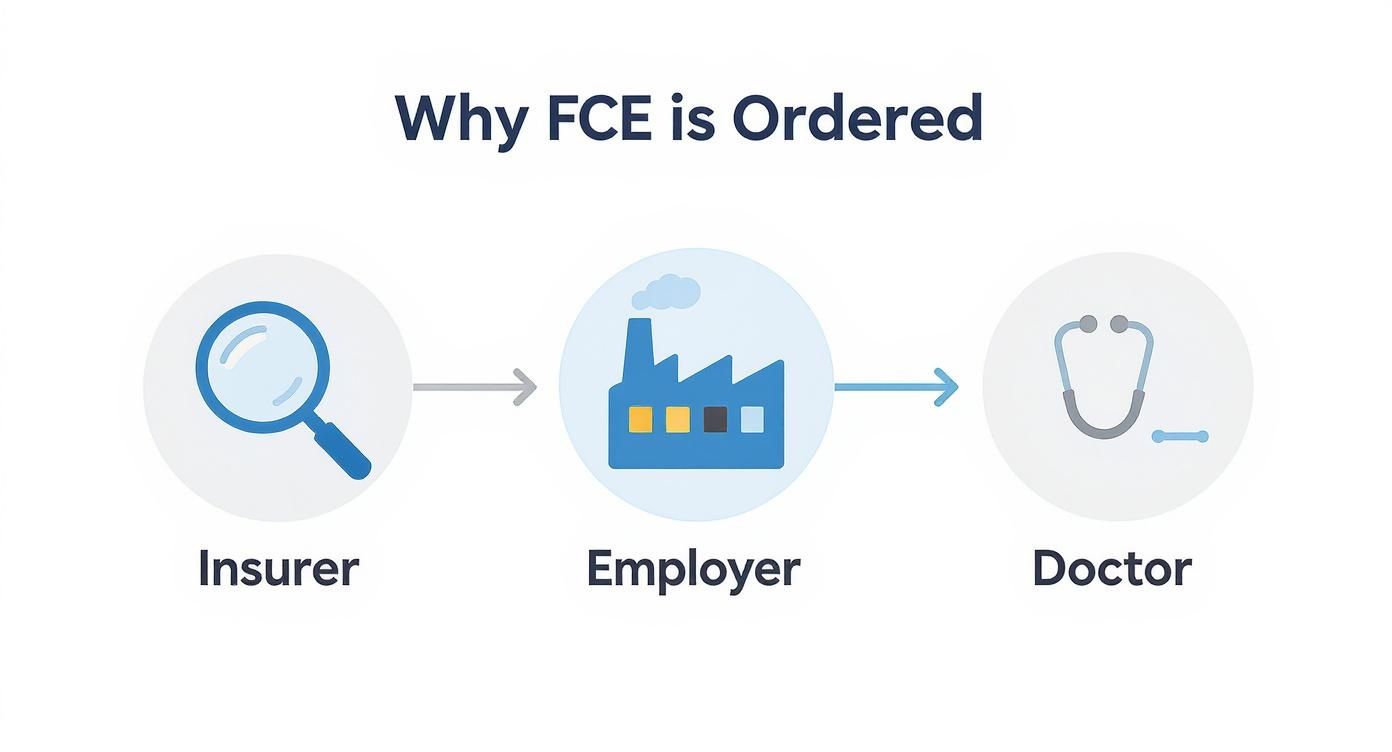
As you can see, the FCE acts as a central hub of information, providing the hard data everyone needs to make sound decisions about your claim and your return to work.
The Standardized Physical Testing Phase
After the interview, it’s time to move on to the physical portion. This is the heart of the FCE, where your functional abilities are measured through a series of carefully designed, standardized tests. The goal isn’t to push you past your limits, but to find out exactly where your safe maximum capabilities are.
You’ll be asked to perform a variety of tasks that might include:
- Material Handling Activities: This is all about strength. You'll likely be asked to lift boxes from different heights, carry weights over a certain distance, or push and pull a weighted cart. The evaluator starts with light weights and gradually increases them until you reach the most you can handle safely.
- Positional Tolerances: How long can you stay in one position? These tests measure your endurance. The therapist will time how long you can comfortably sit, stand, walk, kneel, or bend.
- Mobility and Agility Tasks: Here, they're looking at your balance, coordination, and flexibility. This could involve climbing a short flight of stairs, balancing on one foot, crouching down, or reaching for objects overhead.
- Fine Motor Skills: If your job involves detailed handwork, you may be tested for dexterity. Tasks like placing pegs in a pegboard or manipulating small nuts and bolts help assess your grip strength and hand-eye coordination.
The entire time, the therapist is taking meticulous notes. They're tracking your heart rate, observing your posture and movements, and asking you about your pain levels.
A critical part of any FCE is the evaluator’s assessment of your consistency of effort. They are trained to use built-in checks and balances to make sure the results are reliable. This is a key factor in whether the final report is considered valid.
For instance, they might test your grip strength several times throughout the evaluation. If the results are all over the place, it could be flagged as an inconsistent effort. They are also comparing what they see (your body language and movements) with what you say (your reported pain) to check for consistency.
How Pain and Effort Are Documented
Pain is personal and subjective, but the FCE process uses objective methods to record it. You’ll probably be asked to rate your pain on a 1 to 10 scale before, during, and after each specific activity. This creates a data-driven log of exactly which movements trigger your symptoms.
Your body language also tells a story. The therapist is trained to watch for non-verbal cues—things like wincing, guarding a sore area, limping, or catching your breath. These are documented as objective observations of pain behavior and add another layer of detail to the report.
Ultimately, you can think of the FCE as a comprehensive performance review of your physical self. By understanding each component of the test, you can walk in prepared, confident, and ready to give an honest effort that truly reflects your capabilities.
How FCE Results Can Make or Break Your Case
When you finish a Functional Capacity Evaluation, the report that follows is much more than a simple summary of physical tests. It’s a powerful piece of evidence—a detailed story told through objective numbers and clinical observations that can completely change the direction of your claim. Every data point, from your maximum lifting capacity to how long you can comfortably stand, becomes a foundational block for major legal and financial decisions.
Think of the FCE report as the official translation of your injury into a language that insurance companies, employers, and judges understand. Your personal account of pain and how it limits you is crucial, but the FCE provides the hard data they rely on to justify their decisions. A well-documented, favorable FCE can be the very key that unlocks the benefits you need. On the other hand, a report that misrepresents your true abilities can throw up a massive roadblock.
Turning FCE Data Into Real-World Consequences
The numbers jotted down in your FCE report aren't just abstract figures; they have immediate, real-world consequences. When an evaluator determines you can lift a maximum of 25 pounds every so often, that isn't just a clinical note. It becomes a definitive line in the sand, dictating whether you can ever return to a job that requires you to lift 30-pound boxes.
Here’s a clearer picture of how that data gets put into action:
- Can You Do the Job? Your tested abilities are laid right alongside the official physical demands of your old job. If the FCE shows you can only stand for 30 minutes at a time, but your job had you on your feet for hours, it provides concrete proof that sending you back to that role is unsafe.
- Calculating Settlement Offers: Make no mistake, insurance adjusters pore over these reports to figure out what to offer you. A report that clearly shows significant, permanent limitations will almost always result in a higher valuation of your claim than one suggesting you're mostly fine.
- Determining Disability Ratings: In states like Oregon, the objective findings from an FCE are absolutely critical for establishing your permanent disability rating. This percentage directly drives the calculation for the final value of your workers' compensation award.
Essentially, the FCE draws a detailed map of your physical world, and from that point on, everyone involved in your case has to navigate within its borders.
The Role of FCEs in Oregon Workers’ Compensation
Within Oregon's workers' compensation system, the FCE carries enormous weight. Once a claim is ready for closure, the FCE report is often the single most important document used to establish the extent of any permanent damage or impairment. The data gives an attending physician or an independent medical examiner (IME) the objective information they need to assign specific impairment values to your condition.
An FCE provides the objective evidence needed to move a claim from a subjective report of pain to a quantifiable level of impairment. This transition is essential for calculating final awards and ensuring the resolution of a claim is based on measurable data, not guesswork.
This heavy reliance on data highlights just how important it is for the evaluation to be accurate. When an FCE can single-handedly determine the outcome of a claim, you begin to see the criticality of data quality in healthcare and the ripple effect it has on your life. An inaccurate or biased report can easily lead to an unfairly low impairment rating, costing you benefits you desperately need.
The Make-or-Break Moment
At the end of the day, the FCE can either become the strongest pillar supporting your claim or the biggest hurdle standing in your way.
A "Make" Scenario (A Supportive FCE):
Picture a warehouse worker who suffered a serious back injury. Their FCE report documents a consistent, honest effort and concludes they can only lift 15 pounds, can’t bend over frequently, and can only sit for 20 minutes before pain becomes overwhelming. This report does everything right: it validates their symptoms, proves they can't return to their physically demanding job, and lays the groundwork for a strong disability claim and a fair settlement.
A "Break" Scenario (An Unfavorable FCE):
Now, think about an office worker with a repetitive strain injury in their wrist. If the FCE evaluator notes "inconsistent effort" in the report or finds their grip strength is near normal despite the pain they describe, that report can be weaponized against them. The insurance company will likely argue the injury isn't as bad as they claim, which could lead to a flat-out denial of benefits or a frustratingly low settlement offer.
This is precisely why understanding what a Functional Capacity Evaluation is and its profound impact is so critical. The few hours you spend at that testing facility can shape the outcome of your case for years to come.
Common Problems and Pitfalls to Watch Out For with FCEs
In a perfect world, a Functional Capacity Evaluation would be a purely objective, scientific tool. But we don't live in a perfect world. The entire process—from the instructions you're given to the final interpretation of the data—is run by a human evaluator. And that opens the door to subjective opinions, unconscious biases, and other problems that can skew the results.
Knowing these common pitfalls is one of the most important things you can do to protect your claim. An FCE report that doesn't paint an accurate picture of your abilities can do serious, lasting damage. Being able to spot the red flags gives you the power to fight back against a report that just doesn't tell the truth.
The Problem with an Evaluator’s “Opinion”
A huge chunk of the FCE report isn't based on lifting weights or turning knobs; it's based on the evaluator's personal observations of you. They're watching and noting every little thing—a wince, a sigh, the way you shift your weight, or how you get up from a chair. These notes are supposed to provide context, but they can easily become a source of bias.
Think about it: an evaluator might see you hesitate before a lift and write it down as a lack of effort. But you might have been hesitating because you were terrified of re-injuring your back. If the evaluator decides you weren't giving a "good faith effort," that single opinion can invalidate the entire test, even if you were pushing yourself to the absolute limit of what was safe.
An evaluator’s opinion about your effort can carry just as much weight as the actual numbers from the tests. Phrases like "inconsistent effort" or "symptom magnification" are huge red flags—they're exactly what an insurance company loves to see and will use against you.
This isn't a secret; it's a well-known challenge within the industry. While FCEs are standard practice, they struggle with consistency precisely because so much depends on the clinician's subjective take during the physical tests. As one major review of FCE tools pointed out, this can cause serious reliability issues, making it dangerous to use an FCE as the only reason to send someone back to work. If you want to dive deeper into the science, you can explore the research on FCE reliability.
The "Snapshot in Time" Flaw
Here’s another massive limitation: an FCE only measures what you can do on one particular day, for a few hours. That's a huge problem for anyone whose condition isn't the same day in and day out.
Just look at these examples:
- Chronic Pain: If you live with something like fibromyalgia or complex regional pain syndrome (CRPS), you know you have good days and bad days. An FCE on a "good day" will give a completely misleading picture of what your life is actually like.
- Flare-Ups: Conditions like arthritis are unpredictable. You might feel okay during the test itself, but the sheer exertion could put you in bed for the next three days. The FCE doesn't capture that.
- Your Mental State: Let's be honest, these tests are stressful. Feeling anxious or intimidated by the evaluator can absolutely affect your physical performance, but that's almost never mentioned in the final report.
What the FCE fails to measure is sustainability. The report might proudly state that you can lift 30 pounds once. What it won’t show is the searing pain you felt later that night or the week-long flare-up that single lift caused.
At the end of the day, the test gives the insurance company a single photograph, not the full-length movie of what it's like to live with your injury. It’s critical to remember this. That one snapshot might not reflect your daily reality at all, and that’s a weakness we can challenge if the report is used to deny your benefits.
Preparing for a Fair and Accurate FCE

It’s completely normal to feel a bit anxious about an upcoming FCE. But it's important to remember this isn't a test you can "pass" or "fail." The real goal is much simpler: to give the most accurate, honest snapshot of your physical abilities on that given day.
Proper preparation is about more than just showing up in comfortable clothes after a good night's rest (though you should definitely do that!). It's about being ready to give a genuine effort while clearly and consistently communicating your limitations and pain levels.
Finding the Right Balance
Walking into an FCE feels like a tightrope walk. You don't want to overdo it, but you also don't want to underperform. Falling into either extreme can seriously undermine your claim.
- Avoid Exaggerating Symptoms: Evaluators are highly trained to spot inconsistencies. If the pain you're describing doesn’t line up with what they're seeing, they’ll flag it as "symptom magnification," which can be very damaging to your credibility.
- Avoid Pushing Past Your Limits: On the flip side, now is not the time to be a hero. Pushing through intense pain just to lift a heavier box might feel impressive, but it creates a false picture of what you can do day-in and day-out. Worse, it could set you back and cause a serious re-injury.
Your best strategy is to perform every task to the absolute best of your safe ability. The moment you feel pain that stops you from continuing without risk, you stop. Then, you clearly tell the evaluator what you're feeling and why you had to stop.
This honest, real-time feedback is crucial. A major international study confirmed that a patient’s own report of their pain level is one of the biggest factors in FCE results, explaining a huge part of the differences in outcomes. Your voice matters. To dig deeper, you can review the research on factors influencing FCEs and see just how critical your input is.
It also helps to be organized. Have a clear timeline of your injury, treatments, and key medical appointments in your mind. This will help you answer any questions accurately and confidently. If you need help gathering your documentation, our article explains how to get medical records and can be a great starting point.
What to Do If You Disagree with FCE Results
Getting an FCE report that says you’re more capable than you feel can be a gut punch. It’s frustrating, and it can feel like your struggle is being dismissed. But it's important to know this report isn’t the final say. You absolutely have the right to push back on findings that don't match your reality.
The very first thing you need to do is get your hands on the entire FCE report. Don't settle for a quick summary from the insurance company. Go through it page by page, looking for anything that seems off—mistakes in the notes, tests you don't remember doing, or conclusions that just don't make sense based on your experience.
Building Your Counter-Argument
With the report in hand, it's time to build a case to challenge its conclusions. This isn't something you have to figure out on your own; there are clear, effective steps you can take.
Here’s what you should do next:
- Get a Second Opinion: You can ask for a completely new FCE from a different evaluator. A fresh set of eyes can provide a powerful, independent assessment that directly counters the first one.
- Request an Independent Medical Examination (IME): An IME is conducted by a doctor, not a therapist. Their medical opinion can carry significant weight and challenge the vocational assumptions made in the FCE.
- Talk to an Experienced Attorney: This is your strongest move. A good lawyer knows how to pick apart an FCE report, question the evaluator's methods, and gather the medical evidence needed to prove your side of the story.
A Functional Capacity Evaluation is a powerful tool, but it's just one piece of the puzzle. An attorney makes sure it’s put in the proper context, preventing one bad report from derailing your entire claim.
Fighting an unfair FCE report is a lot like fighting a benefits denial. For a deeper dive into that process, check out our guide on how to appeal a workers' comp denial. A bad FCE result does not have to be the end of the road.
An inaccurate FCE report can put the benefits you rely on at risk. If the results don’t line up with your limitations, contact Bell Law to talk about your options. Our experienced Oregon attorneys are here to protect your rights and fight for the fair outcome you deserve.
Disclaimer: The information on this page is provided for general informational purposes only and is not legal advice. Reading this content does not create an attorney-client relationship. For advice about your specific situation, please contact a licensed attorney.