
What Is MMI? Understanding Maximum Medical Improvement
"I was satisfied once John Bell took over my case."
"Communication was always timely."
What Is MMI? Understanding Maximum Medical Improvement
When you’re recovering from an injury, the road ahead can feel long and full of unknowns. One term you may encounter is MMI, or Maximum Medical Improvement. This isn't just medical jargon; it's a critical milestone that can signal a major shift in an injury claim. It means a medical condition has stabilized to a point where, in a doctor's opinion, it is not expected to get significantly better with more treatment.
Defining a Critical Turning Point in Your Injury Claim
So, what exactly is Maximum Medical Improvement? Think of it this way: MMI does not necessarily mean an individual is 100% healed or "back to normal." It generally means a recovery has hit a plateau.
Imagine a healing process is like climbing a mountain. At first, you might be making steady progress, moving upward. Reaching MMI could be compared to arriving at a stable ridge near the summit. You might not be at the absolute peak of your pre-injury health, but you may have gotten as far as is medically expected with active treatment.
Once this point is reached, the focus of medical care can shift. Instead of trying to "cure" the injury, the goal may become managing the condition as it is. This could mean ongoing pain management, physical therapy to maintain the current level of function, or learning to adapt to new, long-term limitations.
To help clarify, here's a quick breakdown of what MMI can mean for an individual and their claim.
Key Aspects of Maximum Medical Improvement (MMI)
| A Medical Plateau | A condition is considered stable. Further major improvements may be considered unlikely, even with more treatment. | This is a point where the full, long-term impact of an injury can be assessed. |
| Not a "Full" Recovery | An individual may still have pain, limitations, or a permanent impairment. MMI is not a cure. | A claim may now move forward to address permanent disability, future care needs, and potential settlement. |
| Shift in Treatment Focus | Care shifts from "curative" (healing the injury) to "palliative" (managing symptoms and maintaining function). | The costs of future maintenance care can be calculated and included in a final settlement valuation. |
This table provides a snapshot, but the implications of an MMI determination can run deep, shaping the future of a claim.
Why MMI Is a Foundational Concept
Reaching MMI can be a significant event in personal injury, workers' compensation, and disability cases. It’s the moment when the dust settles, giving everyone a clearer picture of the potential long-term consequences of an injury.
Here’s why it’s so important:
- It Establishes a Baseline: A doctor can document a clear baseline for a permanent condition.
- It Clarifies Future Needs: This helps determine what kind of future medical care may be needed to maintain health, rather than to improve it.
- It Kicks Off the Next Steps: MMI can be the trigger for the next phase of a claim, whether that's getting a permanent impairment rating or starting settlement negotiations.
MMI in Different Legal Contexts
The idea of MMI is common across many types of injury claims because it creates a medically-backed point in time to assess the total damages.
For example, in a workers' comp case, an MMI report can lead to an impairment rating, which is a number that helps calculate benefits for any permanent disability. In a personal injury lawsuit, that same MMI report gives an attorney the information they need to demand compensation for everything from the final medical bills to the cost of future care.
MMI is less about the end of a healing journey and more about the beginning of understanding its long-term effects. It's the point where the medical picture becomes clear enough to address the legal and financial aspects of an injury.
Injury claims involve a ton of paperwork and analysis. If you're curious about how lawyers break down these complex issues, you might find it interesting to learn more about understanding legal memoranda, which are documents used to lay out legal arguments in a case.
How Doctors Determine You Have Reached MMI
Figuring out when someone has reached Maximum Medical Improvement isn't as simple as checking a box. It’s a careful, considered judgment a doctor makes after looking at the big picture of a recovery. Think of it less as a single event and more as a conclusion drawn from weeks or months of observation and treatment.
The primary treating doctor is often the one to make this call. They have been involved from the beginning, tracking progress from the initial injury through every physical therapy session, medication adjustment, and follow-up visit. Their opinion is built on a foundation of evidence gathered throughout the entire healing journey.
This is why sticking to a treatment plan is so important. Every appointment and therapy session creates a detailed record, giving a doctor the clear, consistent story they need to make an informed decision about future recovery.
This flow chart gives a bird's-eye view of the path from the initial injury to reaching that point of medical stability.
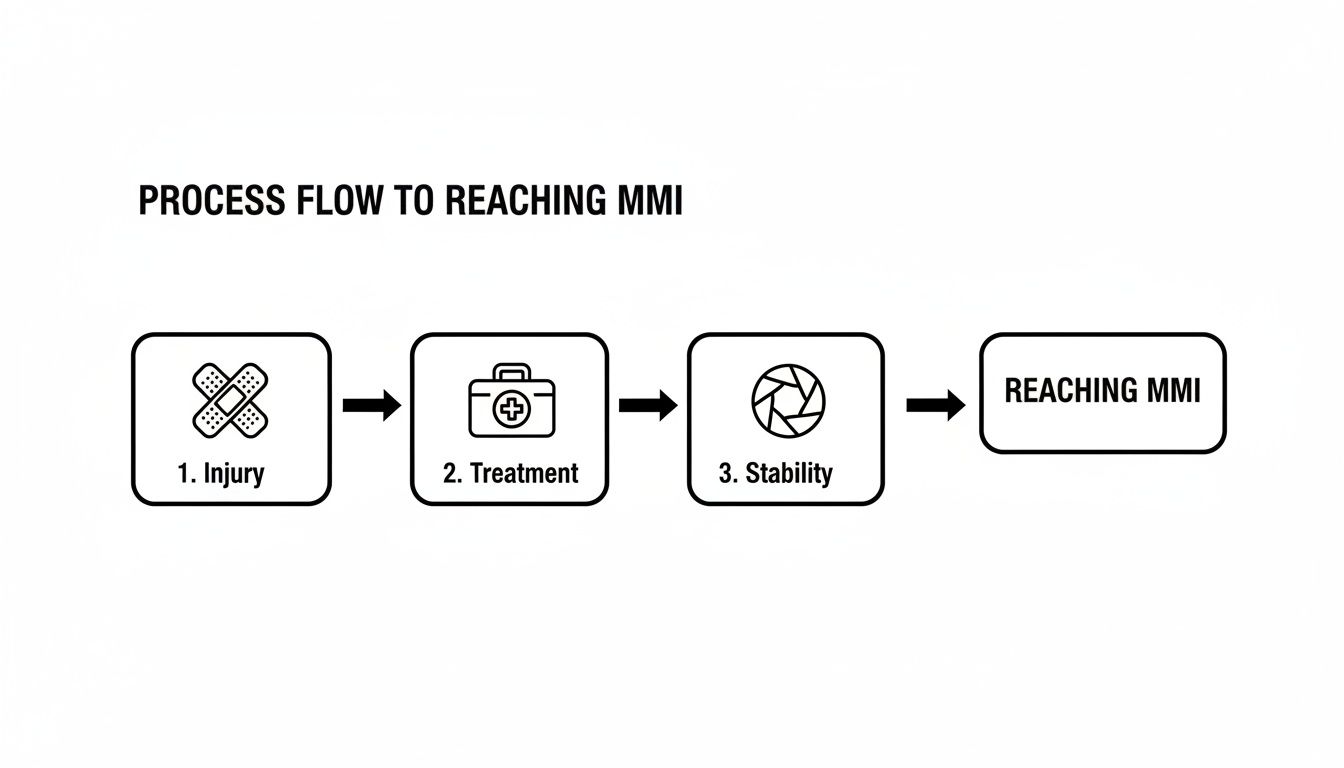
As you can see, the process isn't instant. It involves the injury itself, a period of active care aimed at healing, and finally, a plateau where a condition is considered unlikely to get much better.
Evaluating Treatment Progress
A huge piece of the puzzle is looking at how you've responded to everything you've done so far. A doctor will ask: Have the treatments been working? Are you still making meaningful gains? They are looking for signs that a condition has leveled off, even with ongoing medical care.
Let's say you've been in physical therapy for months after a car accident. A doctor will review the therapist's notes, looking at the data. Are you still gaining range of motion? Is your strength still increasing? If those key metrics haven't budged for several weeks, it could be a strong indicator that you’ve hit a plateau.
A declaration of MMI is a medical opinion grounded in a thorough review of the patient's entire course of care. It considers not just where the patient is now, but how they got there and what can reasonably be expected in the future.
Every piece of documentation from every provider helps paint this objective picture of a recovery timeline.
The Role of Diagnostic Tools and Specialist Input
Hard, objective evidence is key when it comes to an MMI decision. Doctors don't just go on gut feelings; they rely on concrete data from a variety of tools and experts to understand what’s happening inside your body.
This often includes:
- Imaging Scans: Things like X-rays, MRIs, and CT scans give a clear visual of a healed bone or the current state of a soft tissue injury. By comparing a new scan to one from a few months ago, a doctor can see if the physical damage has stabilized.
- Functional Capacity Evaluations (FCEs): These are specialized tests that measure what you can and can't do physically—how much you can lift, how long you can stand, and so on. FCEs provide objective numbers to back up a doctor’s assessment of your limitations.
- Specialist Consultations: Your main doctor might send you to a specialist, like a neurologist for a nerve injury or an orthopedist for a complex fracture. That specialist’s report adds another expert opinion on your condition's stability and long-term outlook.
When you combine a treating doctor's long-term observations with input from specialists and objective test results, you get a solid basis for an MMI determination.
Independent Medical Examinations
Sometimes, especially in workers' compensation or contested auto claims, another doctor is brought in to offer a second opinion. This is called an Independent Medical Examination (IME).
The IME doctor isn't your treating physician. Their job is to review all your medical records, perform their own physical exam, and provide an impartial opinion on your condition.
This examiner looks at the very same evidence—your treatment history, diagnostic scans, and specialist reports—to decide for themselves whether you’ve reached MMI. An IME report can either support what your doctor has said or, in some cases, offer a different take on your medical status.
Why MMI Is a Game-Changer for Oregon Auto Accident Claims
When you're recovering from an auto accident in Oregon, the road ahead can seem long and unclear. Reaching Maximum Medical Improvement (MMI) is a major milestone on that journey. It’s the point where your doctor says your condition has stabilized and isn’t likely to get significantly better with more treatment. This declaration is incredibly important because it allows everyone involved to get a clearer, more complete picture of how the accident has affected your life.
Before you reach MMI, you're dealing with many unknowns. What will the final medical bills look like? Will you need care in the future? Are you left with any permanent limitations? It’s like trying to put together a puzzle with half the pieces still in the box—you can't see the whole picture yet.

An MMI report is what provides those missing pieces. It gives you a medically backed snapshot of your condition once all the aggressive, curative treatments are done. That clarity is what is needed to move forward with a claim.
Putting a Number on the True Cost of Your Injuries
Once a doctor confirms you've hit MMI, you can begin to calculate the full value of your damages. Until that moment, figuring out the total financial and personal cost of your injuries can be speculative.
The MMI determination helps bring these critical pieces into sharp focus:
- Final Medical Bills: Your active treatment is over, so now you can gather every single bill. From the first ambulance ride to the last physical therapy session, you get a concrete total for all your past medical care.
- Future Medical Needs: The doctor’s MMI report will often detail any ongoing care you’ll need to manage your condition, like pain management, prescriptions, or therapy to maintain your function. This allows an expert to project the costs for all your future care.
- Permanent Impairment: If the accident left you with a permanent loss of function, a doctor might assign an impairment rating. This rating is an objective way to measure the long-term physical impact of your injury.
This detailed medical evidence is the bedrock of a bodily injury claim. Understanding how your medical reality connects to the financial side of the claim is a key part of pursuing a fair outcome.
Don't Settle Too Soon: The High Cost of a Premature Agreement
It can be tempting to settle an auto accident claim quickly, but doing so before reaching MMI can be a huge risk. Any settlement you accept will be based on incomplete information and speculation, not hard facts. That can leave an individual facing major financial trouble later on.
Imagine an injury that seems to be healing just fine. You accept a settlement, but a few months later, you find out you need an unexpected surgery. If you've already settled, the cost of that procedure may come out of your own pocket. The MMI report provides the medical certainty needed to avoid these kinds of scenarios.
Reaching MMI is not just a medical term; it is the point at which the true and lasting consequences of an injury can be understood and documented. It provides the foundation upon which a fair evaluation of a claim is built.
Waiting for your condition to stabilize is one way to help ensure every single loss—both economic and non-economic—is accounted for.
Your MMI Report: The Key Piece of Evidence
Think of the MMI report as much more than a doctor's note. It’s a powerful piece of evidence. This document summarizes your entire treatment history, describes your current medical status, and gives a professional opinion on your long-term prognosis. It becomes the factual foundation for negotiating the true value of your claim.
The report helps paint a picture of not just the financial costs, but the human ones, too. It details how your injury impacts your daily life, your ability to work, and your overall quality of life. For anyone navigating the MMI process in Oregon, it’s helpful to find providers who know the local system. You can find information about local healthcare services in Oregon to see what resources are out there. Ultimately, a thorough MMI report gives you the clarity and leverage needed to properly address the fallout from an accident.
How MMI Works in Oregon Workers’ Compensation Cases
When you're dealing with an Oregon workers' compensation claim, you may eventually hear the term Maximum Medical Improvement, or MMI. This isn't just another piece of jargon; it's a critical turning point in a case. MMI is the moment a doctor decides a work-related injury has healed as much as it is going to.
Think of it as a plateau in your recovery. Your condition has stabilized, and while you might need ongoing care to manage symptoms, significant improvement isn't expected from further treatment. This declaration signals a major shift, moving the focus from active healing to figuring out the long-term consequences of your injury and how to close out your claim.

Once MMI is declared, the type of benefits you can receive may change. It’s essentially the dividing line between the recovery phase and the long-term compensation phase of a claim.
From Temporary to Permanent Disability Benefits
The most immediate change you may see after an MMI determination involves your disability benefits. While you're actively recovering and can't work, you may be eligible for Temporary Total Disability (TTD) benefits. These payments are designed to cover a portion of your lost wages during your healing period.
But once your doctor says you've reached MMI, those TTD payments might stop. The system may no longer consider you to be "temporarily" disabled. The focus now pivots to a crucial question: has the injury left you with any permanent limitations? For workers in Oregon, this is when a claim transitions from TTD to an evaluation for Permanent Partial Disability (PPD).
This is what leads to the next step—putting a number on your permanent functional loss.
The Permanent Impairment Rating
After you’ve hit MMI, your doctor may perform an evaluation to determine your Permanent Impairment Rating (PIR). This is a formal medical assessment meant to measure the degree of permanent functional loss you've sustained because of your work injury.
The physician uses specific medical guidelines to come up with this rating. They’ll look at concrete factors like:
- How much range of motion you’ve lost in an affected joint.
- Any reduction in your strength or grip.
- Lingering nerve damage or sensory loss.
- Any other measurable physical deficits that are now considered permanent.
The result is a percentage that reflects the level of impairment to a body part or your body as a whole. This PIR is a key number used to calculate the money you may receive for your permanent partial disability award. For a deeper dive, our guide on what MMI means in workers' comp breaks this down even further.
The Notice of Closure and Your Options
Once the doctor submits the MMI report and your impairment rating, the insurance company may issue a formal document called a "Notice of Closure." This document is a big deal—it can officially close the claim and spells out what benefits may be awarded for your permanent disability.
It's crucial that you read the Notice of Closure from top to bottom. It lays out the insurer's final decision based on the medical evidence at the time of MMI, summarizing the impairment findings and how much you may be compensated.
What if you disagree? If you don't believe you're truly at MMI, or you think your impairment rating is too low, you don't have to just accept it. The Oregon system has an appeal process built in. You can challenge the decision, which might involve getting a second opinion from another doctor or taking your case before an administrative judge. Knowing you have these options is key to making sure the final outcome is fair.
The Connection Between MMI and Social Security Disability
When you're dealing with a serious injury, you might find yourself navigating a few different systems at once. This is especially common when a personal injury or workers' comp claim overlaps with an application for Social Security Disability (SSD) benefits. While these processes are separate, a declaration of Maximum Medical Improvement can be a surprisingly powerful piece of evidence for an SSD case.
It's important to understand that the Social Security Administration (SSA) plays by its own rulebook. Reaching MMI in your injury case does not automatically mean you will be approved for disability benefits. But what it does do is provide clear, objective medical proof that helps build a stronger application.
Think of it this way: an MMI report gives the SSA a snapshot of your long-term reality. It essentially says, "This person's condition has stabilized, and this is as good as it's going to get." That statement can be a crucial piece of the puzzle for a disability claim.
How MMI Supports an SSD Claim
At its core, a Social Security Disability claim is about proving your medical condition is so severe it prevents you from doing what the SSA calls substantial gainful activity (SGA). You also have to show that this condition is expected to last for at least 12 months or result in death.
This is where the MMI report becomes so valuable. It directly supports both of those points.
The report shows that your condition isn't just a temporary setback; it's stable, and it's here to stay. By documenting that your medical treatment has hit a plateau, the MMI report makes a compelling case that your inability to work is a long-term problem, not a short-term one.
An MMI finding can be a game-changer for a disability claim. It shifts the narrative from a "wait and see" situation to a medically documented, stable condition, helping to establish the permanent nature of your limitations for the Social Security Administration.
The Role of Medical Evidence
The SSA bases its decisions on your complete medical history. An MMI report, especially one that includes a Permanent Impairment Rating (PIR), adds a heavy dose of concrete, medically-sound evidence to your file.
Here's how it helps build a case:
- Proves Duration: It helps meet the 12-month duration requirement by showing a condition is permanent and unlikely to improve.
- Defines Your Limitations: The report gets specific about what you can and can't do, which the SSA can then compare against the demands of different jobs.
- Offers Objective Proof: It's not just your word against theirs; it’s a formal medical opinion from a doctor about your prognosis and permanent restrictions.
Getting a handle on the SSA’s specific criteria is key. If you're considering this path, it’s a good idea to learn more about the general Social Security Disability requirements to understand what you'll need to prove. The details in your MMI report can line up with the kind of evidence the SSA is looking for.
Common Questions About Maximum Medical Improvement
After an injury, you're bound to have a lot of questions. As you navigate your recovery and deal with an insurance claim, the term Maximum Medical Improvement will come up, and it can be a bit confusing. Let's clear up some of the most common questions people have about MMI and what it really means.
Does Reaching MMI Mean I Am Completely Healed?
This is probably the biggest and most important question out there. The short answer is: not necessarily. Reaching MMI does not mean you're back to 100% or that you've returned to your pre-injury self.
Think of MMI as the point where your medical condition has leveled off. Your doctor has determined that even with more treatment, you are not likely to see any significant improvement. You can absolutely be at MMI and still live with chronic pain, permanent physical limitations, or need ongoing care just to manage your symptoms.
MMI is a medical and legal marker of stability, not a certificate of complete healing. It simply establishes a baseline for your long-term condition.
Can My MMI Status Ever Change?
It can. While MMI means your condition is stable right now, it's essentially a snapshot in time. It is possible for a medical situation to change after a doctor makes that call.
For example, a condition might unexpectedly get worse down the road. Or, a brand new medical treatment might become available that wasn't an option when you were first evaluated. In legal systems like workers' compensation, there are often rules that allow a claim to be reopened if there is proof of a medically documented "worsening of condition."
This just goes to show that an MMI determination isn't always set in stone. Your future health and the specific rules of your claim system can play a big role.
What Happens If I Disagree with a Doctor’s MMI Decision?
It is common for people to feel they are still getting better, even after a doctor has declared them at MMI. If you find yourself in this situation, there may be options.
In most systems, especially workers' comp, there are formal procedures for getting a second opinion or challenging an MMI determination. This could involve something called an Independent Medical Examination (IME). An IME is performed by a neutral, third-party doctor who reviews your entire medical file and conducts their own exam to offer an impartial opinion on your status.
So, an initial MMI finding isn't always the final word. Depending on your type of claim and where you live, there are often avenues for getting another look.
Is There a Difference Between MMI and a Permanent and Stationary Status?
You might hear the term "Permanent and Stationary" (or P&S) thrown around, particularly in workers' compensation cases. For all practical purposes, MMI and P&S mean the exact same thing.
Both terms describe the point when an injury has stabilized and isn't expected to get much better or worse. The specific term used often just depends on the state you're in or even the insurance company's internal jargon.
Here’s a simple way to think about it:
- Maximum Medical Improvement (MMI): The most common term for when your recovery has hit a plateau.
- Permanent and Stationary (P&S): Another way of saying the same thing, just with an emphasis on the condition being both permanent (long-term) and stationary (not changing).
No matter what they call it, the concept is the same: the active healing phase is considered over, and the focus can now shift to figuring out the long-term impact of the injury.
Why Is Waiting Until MMI to Settle a Claim So Important?
This is a critical piece of information you’ll hear often. Settling a claim is final. Once you accept that check and sign the paperwork, you can't go back and ask for more money later, even if your injury gets worse.
Before you reach MMI, it’s impossible to know the answers to some crucial questions:
- What will the total cost of your medical bills be?
- Will you need future care, like another surgery, physical therapy, or long-term medication?
- What is the full extent of any permanent impairment or disability?
- How will this injury affect your ability to earn a living for the rest of your life?
If you settle before you have these answers, the settlement amount is just a guess. It’s a gamble based on speculation, not medical facts. This could leave you on the hook for massive expenses down the road if things turn out worse than you thought. Waiting for MMI gives you the medical certainty needed to understand the true, full value of your claim.
Understanding your rights and options after an injury is the first step toward protecting your future. If you have questions about your auto accident, workers' compensation, or Social Security Disability claim in Oregon, the team at Bell Law is here to provide clarity and guidance. For a comprehensive review of your situation, contact us for a consultation at https://www.belllawoffices.com.
Disclaimer: The information on this page is provided for general informational purposes only and is not legal advice. Reading this content does not create an attorney-client relationship. For advice about your specific situation, please contact a licensed attorney.