
What Is Pain and Suffering Damages An Oregon Explainer
"I was satisfied once John Bell took over my case."
"Communication was always timely."
What Is Pain and Suffering Damages An Oregon Explainer
When you're hurt in an accident, it’s easy to focus on the bills piling up. Medical treatments, car repairs, lost paychecks—these are the tangible, measurable costs that hit your bank account immediately.
But what about the costs you can't see? The legal world has a name for this: pain and suffering. It’s the legal term for the physical and emotional toll an injury takes on your life, and it's a critical part of many personal injury claims.
The Two Sides of Personal Injury Compensation
A personal injury claim can be thought of as having two distinct parts. On one side, you have the straightforward, black-and-white financial losses. On the other, you have the deeply personal, human impact of the injury.
These two sides are known as economic damages and non-economic damages. Understanding the difference is the first step in seeing the full picture of a potential claim.
Here's a quick breakdown to help you tell them apart:
Economic vs Non-Economic Damages at a Glance
| Economic Damages | Verifiable, out-of-pocket financial losses that may result from the injury. | Medical bills, lost wages, property damage, future medical expenses. |
| Non-Economic Damages | The non-financial, personal impact of the injury on a person's life. This is where "pain and suffering" lives. | Physical pain, emotional distress, loss of enjoyment of life, anxiety. |
Simply put, economic damages cover the money that may have been lost, while non-economic damages acknowledge the life that may have been lost.
Putting a Number on the Unseen Toll
Let’s consider a general scenario where a person is driving home on I-5 after a long day at work. Out of nowhere, another driver collides with them, leaving them with a debilitating back injury. The pain is constant, and they can no longer pick up their kids, go for a run, or even sit comfortably through a movie.
This is what pain and suffering damages are designed to address. It's compensation for the physical agony and emotional distress that goes far beyond medical bills and time off work. It’s a reality for millions; in 2021 alone, low back pain affected 628.8 million people across the globe, with 266.9 million of those being new cases. You can read more about these staggering numbers in the Global Burden of Disease study.
While a receipt can prove the cost of an MRI, no document can capture the true cost of chronic pain, sleepless nights, or giving up the hobbies a person once loved. Pain and suffering damages are the legal system's way of acknowledging this profound human toll.
This concept is essential because it validates that the harm suffered is about more than just money. It’s about recognizing the very real, human consequences that an accident can force upon someone.
The Different Forms of Pain and Suffering
When legal professionals talk about "pain and suffering," it can be thought of as a broad term that covers all the ways an injury can chip away at a person's quality of life. It’s less about one specific thing and more about the collection of personal harms—the real, human toll an accident takes that can't be itemized on a medical bill.
To get a handle on what this means for a claim, it helps to look at the different pieces that make up the whole. These are often split into two main categories: the physical and the mental. They're frequently intertwined, but seeing them separately makes it clearer just how deeply an injury can affect someone's day-to-day existence.
Physical Pain and Suffering
This is what most people think of first. It’s the actual, physical hurt from the injuries themselves. This refers not just to the pain felt at the moment of the accident, but also the discomfort that follows through recovery and, in some cases, the chronic pain that may never truly go away.
For example, a construction worker in Clackamas who injures their back on a job site might be left with nagging, chronic pain that makes simple things like bending over or sitting for long periods a daily struggle. This kind of ongoing physical torment is a huge factor. It's a massive global issue, too—musculoskeletal conditions affect an astonishing 1.71 billion people and are the leading cause of disability worldwide. You can learn more about this global health challenge from the World Health Organization.
This category can cover things like:
- The initial, acute pain from the injury.
- The discomfort that comes with surgeries, physical therapy, and other treatments.
- Chronic pain that lingers long after the initial wounds have healed.
- Permanent disabilities or new physical limitations.
Mental Pain and Suffering
An injury rarely stops at the physical. The emotional and psychological fallout can be just as devastating, leaving deep scars that aren't visible to the naked eye. This part of a pain and suffering claim is about acknowledging the full spectrum of an injury's mental impact. It's the internal battle that doesn’t show up on an MRI but can be just as debilitating as a shattered bone.
Mental suffering is the invisible weight of an injury. It’s the jolt of fear a person might feel getting behind the wheel after a bad car wreck, the anxiety that robs them of sleep, or the deep frustration of realizing they can't live their life the way they used to.
Common examples include:
- Emotional Distress: This can show up as persistent fear, anger, anxiety, or even feelings of humiliation.
- Mental Anguish: This covers more severe psychological impacts, like depression, profound grief, or shock.
- Sleep Disturbances: Many accident victims struggle with insomnia or are haunted by nightmares related to the trauma.
- Post-Traumatic Stress Disorder (PTSD): For some, the event is so traumatic that it leads to a formal PTSD diagnosis.
Loss of Enjoyment of Life
This is a huge and often overlooked part of a pain and suffering claim. Loss of enjoyment of life is the legal term for when an injury robs someone of the ability to take part in the activities that once brought them joy and purpose. It’s the recognition that an injury doesn't just hurt you—it can steal the best parts of your life.
Think about an avid hiker from Roseburg who now can't set foot on Oregon's beautiful trails because of a permanent leg injury. Or a grandparent in Portland who can no longer pick up their grandchild. This is a profound, real, and compensable loss. It measures the gap between the life a person had before the accident and the one they may now be forced to live.
How Is a Value Placed on Pain and Suffering?
After a crash, it’s fairly straightforward to add up hard costs like medical bills and missed paychecks. But how is a price tag put on the pain itself? Or the anxiety, the sleepless nights, and the life that can no longer be lived?
This is where things can get complex in a personal injury claim. There’s no simple calculator that provides a number for human suffering.
Instead, insurance companies and attorneys may rely on a couple of common methods to begin a conversation. Think of these less as rigid formulas and more as frameworks for figuring out a fair number. They’re tools to translate a very personal, human experience into a dollar amount for settlement talks.
The Multiplier Method
A common approach in many personal injury cases is the Multiplier Method. The concept is fairly straightforward: you take the total of the concrete financial losses (what are called economic damages, like medical bills and lost wages) and multiply it by a number.
This number, the "multiplier," often falls somewhere between 1.5 and 5, though it can be higher in extreme cases. It isn’t just pulled out of a hat. The multiplier is related to the severity of the injuries and how much they’ve upended a person's life. A minor sprain that heals in a few weeks might suggest a 1.5 multiplier. A life-changing injury that leaves someone with permanent pain could suggest looking at a 4 or 5.
Several things can help determine the right multiplier:
- The severity of the injuries.
- The total cost of medical bills.
- The length and intensity of the treatment.
- The long-term outlook for recovery.
- The profoundness of the impact on day-to-day living.
This process shows how a single physical injury can snowball into something much bigger, affecting every corner of a person's life.
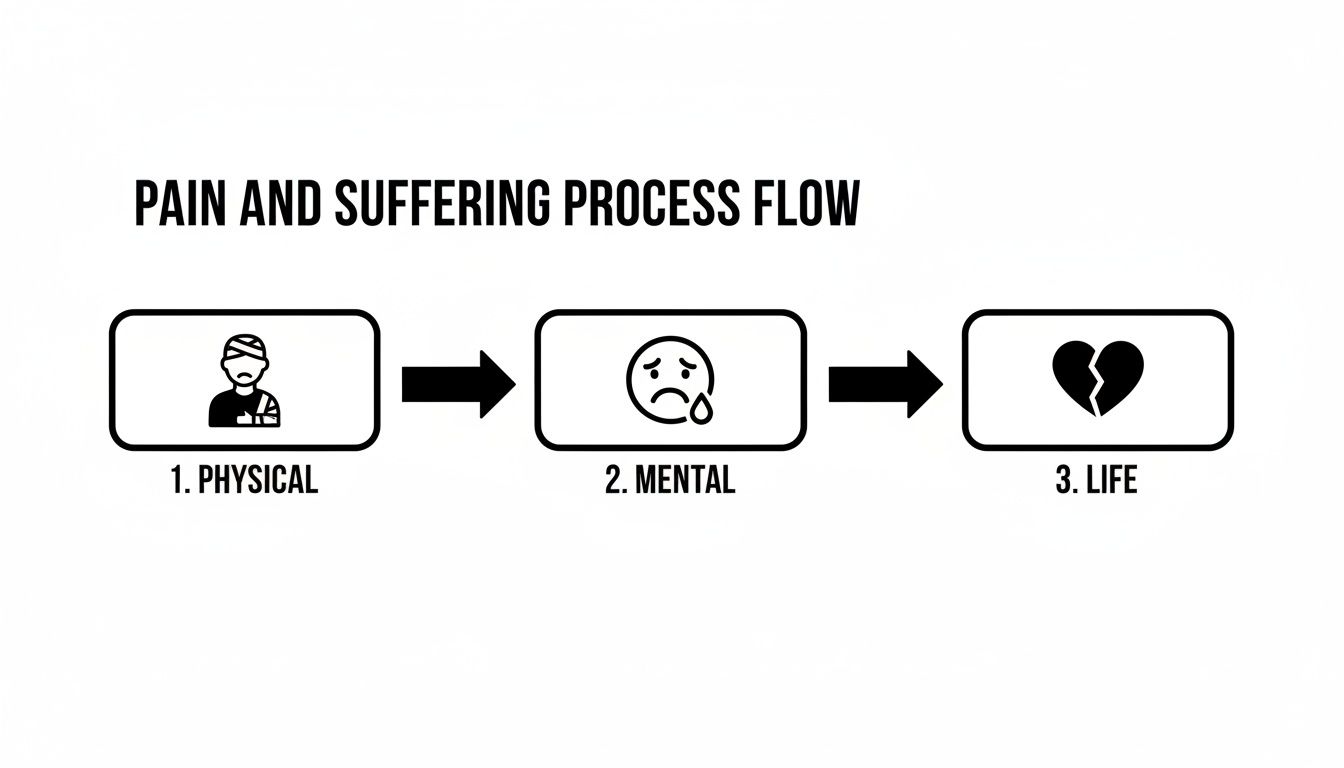
As you can see, the real toll can go way beyond the initial physical event. It’s about the mental and emotional fallout that follows.
The Per Diem Method
Another way to approach this is called the Per Diem Method. "Per diem" is just Latin for "per day." With this method, a daily rate is assigned for a person's suffering, starting from the day of the accident and ending when they’ve reached maximum medical improvement.
Maximum medical improvement, or MMI, is the point where a doctor indicates a person's condition has stabilized. To get the daily rate, some may look at what the person earned per day at their job. The reasoning is that if someone can go to work for a certain amount of money, then enduring a day of pain could be considered worth at least that much.
For instance, if someone earned $200 a day before they were hurt, and it took 100 days to reach MMI, the per diem method might suggest their pain and suffering is worth $20,000 (100 days x $200 per day).
Important Note: Both the Multiplier and Per Diem methods are just starting points. They are tools for building a case, not guarantees of a specific outcome. The final number in any claim is the result of negotiation or, if it comes to it, a jury's decision.
Because there's so much room for interpretation, figuring out how much pain and suffering is worth in a specific case can be one of the biggest challenges. The right approach and a powerful argument can make all the difference. The goal is to paint a clear, honest picture of how this injury has changed a person's life, using these methods as a guide.
Documenting Your Pain and Suffering Claim in Oregon

While formulas like the multiplier or per diem method give a starting point for valuing a claim, they're just numbers on a page. To make them mean something, they need to be backed up with compelling proof. Building a persuasive case for pain and suffering damages is about telling a story—your story—supported by clear, powerful documentation.
This evidence is what translates the real, human cost of an injury into a language that insurance companies and courts can understand. Every document, every note, and every photo can serve as a chapter in the story of a recovery, showing just how deeply the accident has impacted a life.
The Power of Medical and Professional Records
The most credible evidence in many personal injury cases comes straight from the experts: doctors and therapists. Their records provide a clinical, unbiased view of the injuries and the toll they’ve taken on a person's physical and mental health.
Key documents can include:
- Comprehensive Medical Records: Think of these as the official timeline of the injury. Detailed notes from every doctor, specialist, and hospital visit map out the diagnosis, treatment, and progress.
- Physician Reports: A narrative report from a doctor can be incredibly powerful. It explains the nature of the injuries, the pain they cause, and what the future may hold for recovery.
- Mental Health Documentation: The emotional fallout from an accident is just as real as the physical pain. Records from therapists, psychologists, or psychiatrists are crucial for demonstrating issues like anxiety, depression, or PTSD.
To add another layer of objective proof, assessments like a Functional Capacity Evaluation (FCE) may be used. This evaluation can provide hard data on physical limitations and ability to work, quantifying the real-world impact of an injury.
Creating Your Own Record with a Personal Journal
Medical records are essential, but they don't capture the day-in, day-out reality of what someone is going through. That’s where a personal journal can become a valuable tool. A consistent log of experiences can paint a vivid picture of suffering that no doctor's note ever could.
A journal is a place to track:
- Daily Pain Levels: Simply rating pain on a 1-to-10 scale each day creates a powerful visual pattern.
- Emotional State: Write down feelings of frustration, sadness, anxiety, or fear. It’s all part of the story.
- Limitations on Activities: Make a note of the specific things you couldn't do. Missed a child's soccer game? Couldn't do the grocery shopping? Write it down.
- Sleep Disruptions: Having sleepless nights or nightmares because of the pain? This is a critical detail to record.
A journal transforms abstract ideas like "pain" and "suffering" into concrete, daily examples. It's a personal testimony, written in real-time, showing how an injury has reshaped a life one day at a time.
The Importance of Witness Perspectives
Sometimes, the people closest to an injured person see the changes most clearly. Testimony from friends, family, and coworkers can offer a powerful "before and after" snapshot of a life, corroborating the individual's own account of how the injury has affected them.
Their observations can highlight changes in:
- Mood and Personality: Perhaps they've noticed someone has become more withdrawn or irritable since the accident.
- Physical Abilities: They can talk about activities the person used to enjoy but can no longer participate in.
- Overall Quality of Life: Their perspective helps paint a complete picture of the enjoyment of life that may have been lost.
This can be especially true here in Oregon, where a seemingly minor accident can spiral into long-term consequences. Imagine a Salem car wreck causes whiplash that turns into years of chronic headaches, robbing someone of the ability to enjoy family time in Roseburg. The evidence of that subjective agony can be what drives a bodily injury claim.
In fact, a 2023 report from the CDC's National Center for Health Statistics found that 24.3% of U.S. adults live with chronic pain, and 8.5% face high-impact pain that severely limits their life or work. When medical records, a personal journal, and witness statements are combined, they can build a multi-dimensional narrative that makes a case for pain and suffering damages not just a number, but a true reflection of a life altered.
Key Oregon Laws That Influence Injury Claims
Every personal injury claim is shaped by the laws of the state where the accident happened. A case can't be looked at in a vacuum. Here in Oregon, a few specific statutes form the legal backdrop for every negotiation and every trial, especially when it comes to pain and suffering.
Getting a handle on these rules is important for setting realistic expectations. They tackle everything from how damages are calculated to what happens when both parties share some blame. These aren't just legal footnotes; they're the fundamental rules for many injury claims filed in Oregon.
Caps on Non-Economic Damages in Oregon
One of the first things people ask about is whether there’s a limit on what they can recover. The answer in Oregon is complicated. The legal term for what is commonly called pain and suffering is "non-economic damages"—this covers the very real human cost of an injury, like physical pain, emotional trauma, and the inability to enjoy life as before.
Oregon has a law, ORS 31.710, that puts a "cap," or a limit, on the amount of non-economic damages that can be awarded in some civil cases. But this law has been a legal battleground for years.
The real-world application and even the constitutionality of Oregon's cap on non-economic damages are constantly being challenged and reinterpreted in court. Whether this cap applies to a specific case is a highly complex question that hinges on unique facts and the very latest court rulings.
Because this area of the law is always evolving, figuring out how the cap might affect a claim requires a deep dive into recent case law. It’s a critical piece of the puzzle that can have a massive impact on the final value of pain and suffering.
Understanding Oregon’s Comparative Negligence Rule
Another huge factor is Oregon's comparative negligence rule, found in ORS 31.600. This law comes into play whenever there’s a debate about who was at fault for an accident. It’s the system Oregon uses to divide up the blame when it isn't 100% on one person.
Think of it this way:
Fault is Apportioned: First, a percentage of fault may be assigned to everyone involved in the incident.
Recovery is Adjusted: A person's total compensation is then reduced by their percentage of fault. So, if someone is found to be 20% responsible for the crash, their total award could be cut by 20%.
The 51% Bar: Here’s a very important part. Oregon uses a "modified" comparative negligence system. This means if a person is found to be 51% or more at fault, they can be completely barred from recovering compensation.
That threshold is everything. Being found just slightly more responsible for an accident than the other party can mean a person gets nothing. This is why a thorough investigation to clearly establish who was at fault—and by how much—is essential in any claim.
To help put these two critical laws in context, here’s a quick summary table.
Key Oregon Statutes and Their General Purpose
This table provides a high-level look at these statutes and the role they play.
| ORS 31.710 | Non-Economic Damages | Imposes a statutory cap on damages for pain, suffering, and emotional distress in certain types of civil cases. |
| ORS 31.600 | Comparative Negligence | Determines how damages are awarded when the injured party shares some of the fault for the accident. |
Navigating these statutes requires more than just reading the text; it demands a practical understanding of how Oregon courts have interpreted and applied them in past cases.
The Role of a Personal Injury Attorney
Trying to navigate the legal world after an injury can be overwhelming. A person is dealing with doctor's appointments and the stress of recovery, and the last thing they may need is a crash course in legal concepts like what is pain and suffering damages. That's where a personal injury attorney can come in. They can serve as a professional advocate, handling the complex legal work so an individual can focus on getting better.
From day one, an attorney can get to work investigating every detail of the incident. This means gathering crucial pieces of the story—police reports, medical records, and statements from anyone who saw what happened. They can also become the single point of contact for the insurance companies, which can be a huge relief. This may prevent someone from accidentally saying something that an adjuster could use to weaken a claim.
Building a Strong and Complete Case
One of the most critical jobs an attorney has is figuring out what a claim could be worth. This is so much more than just adding up medical bills and lost wages. They have to build a powerful argument for non-economic damages, translating real-life pain, anxiety, and the loss of activities once loved into a compelling narrative supported by hard evidence.
This comprehensive valuation becomes the foundation of a formal demand letter. This isn't just a simple note; it's a detailed legal document sent to the at-fault party's insurance company. It lays out the facts, describes the injuries, and makes a formal demand for a settlement that includes a well-reasoned amount for pain and suffering.
Having a skilled attorney on your side can level the playing field. They know the playbook insurance companies may use to undervalue claims and are ready to counter with a meticulously documented, legally sound case.
Once the demand letter is sent, the negotiation process begins. An experienced attorney knows how to argue the strengths of a case and fight for a settlement that reflects everything that has been lost, both financially and personally. Most cases are resolved here, but a good lawyer is always ready for the next step.
If the insurance company does not make a fair offer, an attorney can prepare to take the case to court. Whether it’s in front of a judge or a jury, they will be there to present the story. Having a professional guide you through every stage, from the initial investigation to a potential trial, can make all the difference. If you're weighing your options, learning more about the process of hiring a personal injury attorney is a great next step. Their job is to make sure your voice is heard, allowing you to focus on what matters most—your recovery.
Your Top Questions About Pain and Suffering Answered
After you've been hurt, it's natural to have a lot of questions. Let's walk through some of the most common ones people have about pain and suffering damages.
Is There a Cap on Pain and Suffering Damages in Oregon?
This is a really common question, and the answer isn't a simple yes or no. Oregon does have a law that puts a cap on non-economic damages, but how it's applied has been debated and challenged in court for years.
Whether this cap could affect a specific case depends on a whole host of unique factors. It’s one of those areas where you may need to speak with an attorney who is up-to-date on Oregon law to understand how it might apply to a particular situation.
Will I Have to Go to Court to Get Pain and Suffering Damages?
Not necessarily. In fact, many personal injury claims never see the inside of a courtroom. A large number are settled out of court through direct negotiations with the other party’s insurance company. This agreed-upon resolution is called a settlement.
Of course, if the insurance company isn't willing to offer a settlement that is considered fair, filing a lawsuit may become the next step. The path a claim takes hinges on the details of the case and whether the other side is willing to negotiate in good faith.
How Long Do I Have to File a Personal Injury Claim in Oregon?
Oregon, like all states, has a strict deadline for filing a lawsuit, known as the statute of limitations. For most personal injury cases, there is generally a two-year window from the date of the injury.
It's absolutely critical to understand that this isn't a one-size-fits-all rule. There are exceptions and different deadlines for certain situations, like claims against a government agency. If this deadline is missed, the right to file a claim could be lost forever.
Knowing exactly which timeline applies to a case is one of the most important first steps.
The legal rules around pain and suffering are incredibly nuanced and specific to Oregon law. While this gives you a good overview, every single case is different.
If you're wondering how an injury has affected your life and what your options are, the team at Bell Law is ready to help. We can listen to your story and help you figure out the next steps. To learn more, visit us at https://www.belllawoffices.com.
Disclaimer: The information on this page is provided for general informational purposes only and is not legal advice. Reading this content does not create an attorney-client relationship. For advice about your specific situation, please contact a licensed attorney.