
Whiplash Symptoms After Car Accident Quick Relief Guide
"I was satisfied once John Bell took over my case."
"Communication was always timely."
Whiplash Symptoms After Car Accident Quick Relief Guide
After a collision, whiplash often announces itself quickly. You might feel neck pain, stiffness, or a touch of dizziness within hours of the impact. Noting these early clues, along with simple self-care, can speed up healing and fend off longer-term problems.
Spotting Early Whiplash Symptoms After Car Accident

Imagine your neck as a shock absorber in your car. If it stretches too far too fast, the soft tissues can sprain or strain.
Use these self-care basics right away:
- Apply ice packs for 15–20 minutes to curb inflammation.
- Gently stretch your neck after the first day to keep motion flowing.
- Get plenty of rest and avoid any sudden jarring movements.
At the same time, start a log of your discomfort:
- Note the date, time, and intensity of each symptom.
- Record any changes in your range of motion.
- Mention new sensations like tingling, headaches, or jaw discomfort.
If pain spikes, numbness appears, or headaches intensify, reach out to a medical professional without delay.
Common Immediate Signs
Right after impact, it’s common to sense a sharp ache at the base of your skull. Turning your head may feel stiff or even painful.
Early detection within 24 hours can reduce the risk of chronic pain by up to 50%.
Symptom Onset After Car Accident
Below is a quick look at when common whiplash symptoms typically appear and how they feel.
| Pain | Within hours | Sharp or dull neck pain. |
| Stiffness | Within hours | Limited neck movement. |
| Dizziness | 1–2 days | Lightheadedness or balance issues. |
Keeping an eye on these timing patterns helps you spot issues early and seek help before they worsen.
For a step-by-step guide on what to do after a car accident, our resources lay out all the practical next steps.
When To Seek Medical Care
Some warning signs mean you shouldn’t wait:
- Severe neck pain that locks your head in place.
- Numbness or tingling radiating into your arms or hands.
- Headaches or dizziness that won’t ease after two days.
At the first sign of these red flags, call your doctor or head to urgent care.
Logging Your Symptoms
A simple daily journal becomes your strongest evidence:
- Jot down the date and time of each symptom.
- Rate pain from 1–10 to show progress or setbacks.
- Describe new headaches, stiffness, or balance problems.
- Note changes in sleep patterns, mood, or daily activities.
This record proves crucial for both medical teams and insurance adjusters as you build your case.
Next, we’ll dive into recovery timelines, treatment options, and guidance on legal and insurance documentation—tailored for Oregon drivers and when to reach out to Bell Law.
Understanding Key Concepts Of Whiplash
When a vehicle lurches forward or stops on a dime, your neck can snap violently in milliseconds. That rapid back-and-forth motion overloads delicate tissues before you even realize it. Even a low-speed rear-ender can push ligaments, discs, and vertebrae past their breaking point.
Think of your head as a bowling ball perched on a stick of spaghetti. A sudden jolt makes that “stick” bend and wobble far beyond what it’s built to handle. The outcome is tiny tears, inflammation, and restricted movement.
- Vertebrae form the spine’s protective column around the spinal cord.
- Discs cushion jolts and keep bones from grinding together.
- Ligaments hold everything in place and prevent excessive motion.
In many fender-benders, tissues stretch beyond their elastic limit. Within minutes, microscopic damage sparks swelling and pain. Over the next 24–48 hours, that discomfort often intensifies as inflammation sets in.
Grasping these biomechanics makes it easier to describe your pain patterns during medical exams. Clear communication with your healthcare team can speed up diagnosis and pave the way for an effective treatment plan.
Every year, regions around the world report different rates of new whiplash cases. Below is a snapshot of how often whiplash shows up globally:
Global Incidence Of Whiplash After Car Collisions
| Quebec | 70 |
| Australia | 106 |
| Netherlands | 188–325 |
| General Range | 16–200 |
As you can see, annual rates swing from 16 to 325 new cases per 100,000 people. These variations often reflect local driving habits, reporting standards, and access to medical care.
Neck Anatomy Explained
Your cervical spine is a stack of seven vertebrae—like building blocks—that supports your head and allows you to turn and nod. Between each vertebra, shock-absorbing discs distribute forces from sudden impacts.

This illustration highlights how ligaments such as the anterior longitudinal ligament stretch or tear under rapid acceleration–deceleration forces.
Understanding neck structure clarifies why some people recover rapidly while others face lingering pain.
These insights set the stage for targeted treatment plans and clearer legal documentation in Oregon.
Injury Mechanism And Severity
A forceful rear impact typically pushes the head backward (hyperextension) and then snaps it forward (flexion). That violent S-curve action can overload muscles, tendons, and ligaments in a split second.
Several factors influence how badly you’re hurt:
- Impact Speed: Higher speeds transfer more force to the neck.
- Head Position: A turned or tilted head may suffer more damage.
- Muscle Tone: Tensed muscles can sometimes protect, but fatigue makes them vulnerable.
Early intervention—gentle range-of-motion exercises and proper head support—can limit swelling and stiffness. Equipping yourself with these basics ensures you approach both treatment and legal steps with confidence.
Next, we’ll explore common delayed whiplash symptoms and tips for tracking them. And remember: keep your doctor—and your attorney—updated on any changes.
Common And Delayed Whiplash Symptoms
After a collision, you might feel neck pain and stiffness right away. Those first twinges can be sharp and unmistakable.
But not all symptoms show up instantly. Some whiplash symptoms after a car accident unfold over the next few days.
Within hours, you could develop a sharp headache at the skull base. Often, a reduced range of motion sets in shortly after.
- Immediate neck pain feels intense and localized.
- Stiffness can make simple tasks like driving a challenge.
- An early headache may point to tissue strain around the vertebrae.
Why Some Symptoms Show Up Late
It’s common to miss pain at first. Adrenaline floods your system, masking discomfort until things settle down.
Meanwhile, soft tissue swelling builds slowly. That’s why dizziness or fatigue may sneak in a day or two later.
Jaw pain sometimes follows, hinting at TMJ strain from tense neck muscles.
- Delayed fatigue often appears when rest cycles get disrupted.
- Trouble concentrating can trail headaches or those moments of lightheadedness.
- Mood swings might be a subtle sign of a mild concussion or stress response.
| Immediate | Hours | Sharp neck pain |
| Delayed | 1–3 days | Dizziness, fatigue |
Tracking Symptoms With A Daily Log
Think of a journal as your injury’s black box. Logging details not only sharpens your medical record but also guides your recovery.
Note the time, intensity, and any new sensations each day.
Record pain level on a 1–10 scale.
Jot down what you were doing and what triggered the pain.
Share these logs with your doctor during every visit.
Consistent records can speed up diagnosis and help tailor your treatment plan.
When To Share Updates With Bell Law
Keeping Bell Law in the loop builds a stronger injury claim. Send over your daily log and any medical notes as they come in.
Contact them right away if you experience:
- Severe headaches that last more than 48 hours
- Numbness or tingling in your arms or hands
- Sudden balance loss or intense dizziness
If these red flags appear, call Bell Law or your healthcare provider immediately.
Patient Experience Example
Take Jane’s story: she documented neck stiffness and midday headaches in a simple journal. Within days, her entries revealed clear pain spikes after long drives.
- She mapped her symptoms precisely over three days.
- Her doctor adjusted treatment sooner because of that data.
- Jane’s logs became key evidence for her insurance claim.
This example shows how a short journal can steer both care and claims in the right direction.
Red Flags And Next Steps
Letting delayed symptoms slide might lead to chronic neck issues down the road. Early reporting ensures timely imaging and therapy.
- Keep daily logs going until your symptoms resolve.
- Schedule follow-up visits every 1–2 weeks.
- Bring in specialists if you hit a plateau.
For Oregon drivers, Bell Law offers a free consultation. Early case setup preserves your rights and captures critical evidence.
Documenting whiplash symptoms after a car accident is your first line of defense. A clear record smooths conversations with doctors and adjusters.
Up next: treatment timelines and insurance claim strategies.
Why Detail Matters
Your journal works like an airplane’s flight recorder, revealing the full picture of your injury. That clarity can shave weeks off diagnosis and lead to a more precise care plan.
- Accurate data cuts out guesswork in treatment choices.
Detailed logs can also discourage lowball offers. When insurers see clear patterns, they recognize the legitimacy of your claim.
Final Thoughts On Symptom Tracking
Taking charge of your symptom tracking gives you control amid post-crash chaos. From that first neck twinge to eventual fatigue, nothing is too small to note.
Keep at it until you reach pain-free milestones.
- Celebrate victories like better neck rotation or fewer headaches.
This proactive approach strengthens your case for fair compensation and speeds up recovery.
Remember, whiplash symptoms after a car accident can vary widely. Early tracking and reporting pave the way for a smoother healing journey and a stronger claim.
Reach out to Bell Law in Oregon as soon as delayed symptoms pop up. Quick action makes all the difference.
Stay informed and proactive.
Recovery Timeline And Treatment Options
Picture your healing as training for a marathon. Each phase brings its own pace, landmarks, and checkpoints.
You’ll move from an acute phase into subacute care, and finally into chronic-stage options.
- Acute (0–2 weeks): rest, ice, and gentle motion to curb swelling
- Subacute (2–6 weeks): graded exercise routines and physical therapy
- Chronic (beyond 6 weeks): injections, specialist referrals, or advanced procedures
Acute Phase Actions
This is your warm-up lap in recovery. Focus on soothing pain and preventing any new irritation.
Ice your neck for 20 minutes three times daily to tame inflammation. A soft cervical collar—worn sparingly—can add gentle support.
Early rest paired with light movement can cut pain peaks by up to 30% in the first week.
Record your discomfort on a 1–10 scale and take over-the-counter anti-inflammatories as directed.
Subacute Phase Strategies
By weeks 2–6, it’s time to rebuild—but without pushing too hard. Start simple movements like chin tucks and wall angels.
Heat packs before therapy help muscles loosen, and a physical therapist will guide posture correction and manual techniques.
- Perform 10–15 reps of each exercise twice daily
- Schedule therapy visits every 5–7 days
- Add neck isometrics to strengthen without motion stress
Subacute gains often dictate whether symptoms fade or linger.
If you notice rising pain or new numbness, revisit your doctor about imaging or a specialist referral.
Chronic Phase Interventions
When stiffness or shooting pain sticks around past 6 weeks, you may need targeted treatments.
Options include corticosteroid injections, nerve blocks, or trigger point therapy. If those don’t do the trick, a referral to a spine specialist or neurologist can uncover deeper issues.
- Injections reduce nerve inflammation directly
- Trigger Point Therapy loosens stubborn muscle knots
- Specialist Referral opens access to advanced diagnostics or surgery
Radiofrequency ablation and MRI scans are often the next steps when conservative care stalls.
Comparison Of Whiplash Treatment Approaches
Below is an overview of the main treatment paths, how long they typically last, what benefits they deliver, and where you need to tread carefully.
| Rest and Ice | 0–2 weeks | Reduces inflammation quickly | Muscle stiffness from inactivity |
| Gentle Exercise | 2–6 weeks | Builds strength and restores range of motion | Overdoing reps can spike pain |
| Physical Therapy | 2–8 weeks | Personalized techniques and education | Time commitment and out-of-pocket costs |
| Pain Medication | 0–6+ weeks | Short-term relief for moderate to severe pain | GI upset or dependency if misused |
| Corticosteroid Injection | 6+ weeks | Direct anti-inflammatory action | Injection site discomfort, rare side effects |
| Specialist Referral | 6+ weeks | Access to advanced diagnostics or surgery | Longer waits and higher expenses |
Use this table to compare realistic timelines, benefits, and downsides as you plan each step with your care team.
Making Informed Choices With Your Doctor
Be candid about your goals and daily hurdles. Discuss expected recovery windows, insurance coverage, and out-of-pocket costs upfront.
Review your symptom log together to tailor the plan.
Prioritize low-risk steps before moving to invasive options.
Set measurable benchmarks—like boosting rotation by 30 degrees in six weeks.
For help managing medical expenses, check out our guidance on handling medical bills with your claim: Learn more about tackling auto accident medical bills.
Next Steps And When To Reach Out
Keep your doctor and legal team in sync on every milestone. If pain drags on past three months, you may need a specialist evaluation or legal advice.
Bell Law’s Oregon attorneys can help you document advanced treatments for your claim. Stay proactive: book follow-ups, stick to your exercises, and log every symptom.
With a clear timeline and solid support, you’ll cross your personal recovery finish line stronger than before.
Documenting Whiplash Injuries For Claims
After a collision, every detail counts. Documenting your whiplash injury carefully can make or break an insurance or legal claim. Think of it as piecing together a puzzle—clear records become compelling evidence.
To begin, log symptoms as they happen and gather every medical report you receive.
- Note date, time, symptom type, and pain level on a 1–10 scale in a dedicated journal.
- Describe any movement that triggered discomfort or provided relief.
- Share these notes with your doctor at each appointment to guide diagnosis and treatment.
Ask each provider—ER physicians, chiropractors, physical therapists—for itemized medical reports. These documents chart how your condition evolves, what treatments you’ve had, and any ongoing recommendations.
Capturing Posture And Movement Changes
Photographs are your visual proof. They reveal shifts in posture or range of motion that words alone can’t convey.
- Photograph front, side, and back views using the same reference pose.
- Include a ruler or common object in each shot for scale.
- Date-stamp digital images or jot the time below each printout.
Requesting Itemized Bills
Every bill should list procedure codes, service dates, and provider charges. When each line item is clear, there’s less room for dispute over your care costs.
As you collect these records, you’ll see whiplash accounts for roughly 42% of neck-injury claims in many regions. In fact, these injuries drive multi-billion-dollar care costs in high-income markets. Learn more about whiplash costs and claims
Step By Step Checklist
Follow this roadmap to build a watertight documentation package:
Log daily symptoms, noting dates, pain levels, and triggers.
Obtain complete medical reports, including imaging results and treatment plans.
Photograph any changes in posture or motion, ensuring each image is date-stamped.
Collect itemized bills from every healthcare provider.
Review these materials with an Oregon attorney early to preserve crucial deadlines.
Accurate documentation can increase settlement value by showing precise treatment needs and costs.
The infographic below visualizes the acute, subacute, and chronic phases of whiplash recovery.
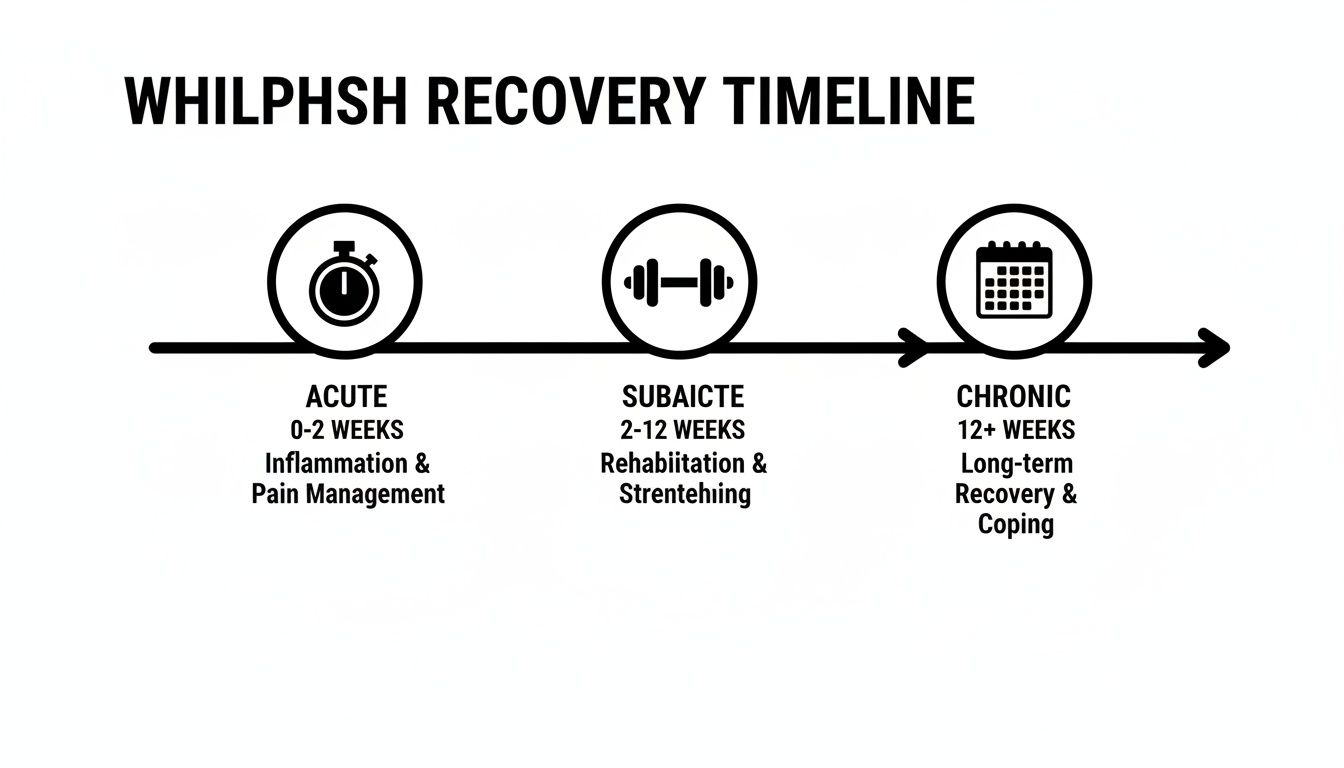
It shows inflammation peaking in the first two weeks, gradual strength gains in weeks 2–6, and lingering stiffness beyond six weeks.
Documenting Disability And Work Impact
Evidence of how whiplash disrupts daily life strengthens your case.
- Log missed workdays and reduced hours to demonstrate income loss.
- Note specific tasks you can’t perform or have to modify.
- Record any help you need for personal care, driving, or household chores.
Including these details supports claims for lost wages and future disability needs. Oregon law generally gives you two years to file a personal injury claim, so start organizing your evidence right away. Store digital copies in a secure cloud folder and keep printed materials in chronological order. Sharing these updates with Bell Law early helps your legal team set proper deadlines and issue demand letters.
Coordinating With Insurers And Attorneys
Once your records are complete, send a full package to both your insurance adjuster and your Bell Law attorney.
- Confirm receipt by follow-up email or certified mail.
- Keep copies of everything you send, noting dates and recipients.
- Ask your attorney about update frequency to stay on track with all deadlines.
Responding promptly to insurer requests prevents claim denials for lack of evidence. If an initial settlement offer falls short, your detailed records provide leverage for negotiations or legal action.
For help preparing your compelling injury documentation package, check out our guide on preparing a bodily injury claim with Bell Law.
Frequently Asked Questions
After a collision, it’s normal to wonder how whiplash will affect you—and when symptoms might show up. This section walks you through common timelines, simple self-care tips, and crucial legal deadlines in Oregon.
How Soon Do Whiplash Symptoms Appear After A Car Accident
Generally, most folks feel neck stiffness or soreness within a few hours of impact. That initial pain comes from soft tissues swelling around your spine.
However, some signs don’t pop up right away. Dizziness, fatigue, or jaw discomfort often surface 1–2 days later as inflammation settles in.
- Within hours: Neck pain or stiffness kicks in.
- After 1–2 days: Dizziness, jaw ache, or tiredness may follow.
- Why it matters: Tracking daily changes strengthens your medical notes and any future claims.
What Steps Can I Take At Home To Reduce Neck Pain
Start with cold therapy—think ice packs for about twenty minutes, three times a day. After 48 hours, swap out ice for a moist heat pack to soothe tight muscles.
Next, gently move your neck through stretches—no heavy lifting or sudden twists. Keeping a simple symptom-and-relief log helps you spot patterns.
- Ice packs: 20 minutes, three times daily to cut swelling.
- Moist heat: After two days, relieve tension with warm compresses.
- Symptom journal: Note pain levels, stretches, and what really helps.
When Should I See A Doctor For Whiplash
If you experience severe pain, numbness, or headaches that won’t quit, don’t wait. An early checkup—ideally within 48 hours—can catch nerve involvement before it becomes chronic.
Expert Insight
Getting a prompt diagnosis can lower your risk of long-term whiplash by up to 30%.
Remember, Oregon insurance policies often demand you file a claim within 30 days of your accident. Review your policy right away and start documenting every doctor visit and expense.
- Monitor From Day One: Log neck, head, or jaw symptoms as they evolve.
- Apply Self-Care First: Use ice, heat, and mild stretches to control pain.
- Seek Medical Help Quickly: Red flags like numbness or intense headaches need prompt attention.
- File Claims On Time: Report your injury within 30 days to protect coverage.
Want to make sure you haven’t missed a step? Reach out to the team at Bell Law Offices for experienced support and guidance.
Disclaimer: The information on this page is provided for general informational purposes only and is not legal advice. Reading this content does not create an attorney-client relationship. For advice about your specific situation, please contact a licensed attorney.