
Can You Get SSI for COPD? A Guide to Winning Your Claim
"I was satisfied once John Bell took over my case."
"Communication was always timely."
Can You Get SSI for COPD? A Guide to Winning Your Claim
Yes, you can get Supplemental Security Income (SSI) for COPD, but it’s not as simple as just having a diagnosis. To qualify, you’ll have to prove to the Social Security Administration (SSA) that your condition is severe enough to keep you out of the workforce, and you must also meet their strict financial limits.
Understanding SSI Eligibility for COPD
Living with Chronic Obstructive Pulmonary Disease (COPD) can feel like a constant struggle, making even simple tasks—let alone holding down a job—feel impossible. If this is your reality, SSI is designed to provide a financial lifeline.
To get these benefits, you need to paint a clear picture for the SSA. It’s not enough to say you have COPD; you must show, through medical evidence, how profoundly it limits your ability to function every single day. COPD is a common reason people receive disability benefits, but to grasp its full impact, it helps to review the detailed explanation of the health risks of smoking cigarettes, since smoking is a primary cause.
The Two Pillars of an SSI Claim
Think of your SSI claim as a structure supported by two essential pillars. If one is missing, the whole thing falls apart.
- Medical Eligibility: First, you have to prove your breathing problems are so severe that you can't perform what the SSA calls substantial gainful activity (SGA). Your case will hinge on medical records, doctor’s notes, and specific breathing test results.
- Financial Eligibility: Second, SSI is a needs-based program. This means you must have very limited income and few assets to your name, falling below strict government thresholds.
A successful claim tells a compelling story, backed by hard evidence, of how your COPD stops you from working. The SSA needs to see a direct line between your medical diagnosis and your inability to earn a living.

To give you a quick overview, here's a table summarizing what it takes to qualify for SSI with COPD.
COPD and SSI Eligibility at a Glance
| Medical | Your COPD must be severe enough to prevent you from working, proven by spirometry tests (FEV1 values) and other medical evidence that meets or equals the SSA's Blue Book Listing 3.02. |
| Functional | You must show how symptoms like shortness of breath, fatigue, and coughing limit daily activities and prevent you from performing any type of full-time work, not just your past job. |
| Financial | You must have very low income (from work, pensions, etc.) and limited resources (assets like cash, bank accounts, and property). These amounts are set annually by the SSA. |
This table provides a snapshot, but remember that each element requires detailed documentation to build a strong case.
While getting approved can be tough, the numbers offer some hope. Respiratory disorders see an initial approval rate of around 47%. For those who are denied and choose to appeal, the odds get better. In fact, applicants with COPD who go to a hearing before a judge have their approval rates jump to about 66%.
This guide will walk you through exactly what you need to do to build a winning claim.
Understanding SSI vs. SSDI for COPD Applicants
When you're trying to get disability benefits for COPD, the Social Security system can feel like a maze. You’ll hear two acronyms thrown around a lot: SSI and SSDI. They sound alike, and while both provide support, they are completely different programs. Getting a handle on this distinction right from the start is one of the most important things you can do.
The easiest way to think about it is this: SSDI is an insurance program, while SSI is a safety net. You paid into the SSDI "insurance policy" with every FICA tax deduction from your paychecks over the years. To cash in on that policy, you need to have a solid and recent work history, which the Social Security Administration (SSA) measures in "work credits."
SSI: The Needs-Based Program
On the other hand, SSI has zero to do with your work history. It's a needs-based program, pure and simple. It's designed to provide a basic income for people who have very limited financial means and are disabled, blind, or over age 65.
To be eligible, your income and assets have to fall below some very strict caps.
- An individual can’t have more than $2,000 in countable resources.
- A married couple living together is limited to $3,000.
What counts as a "resource"? Think cash, money in the bank, stocks, and bonds. The good news is the SSA doesn't count everything. For instance, the house you live in and usually one car are exempt. You can find a more detailed breakdown in our guide to Supplemental Security Income (SSI).
Same Medical Rules, Different Financial Paths
Here’s where it gets interesting. Even though the financial rules for SSI and SSDI are worlds apart, the medical rules are exactly the same. For either program, you have to prove your COPD is so severe that it keeps you from being able to work. The SSA will use the same medical guidelines—the Blue Book listings and functional capacity assessments—to evaluate your breathing impairment no matter which program you apply for.
The key takeaway is this: Your medical evidence proves you can't work due to COPD. Your financial situation and work history determine which program will provide you with benefits.
Knowing the difference also matters for your healthcare coverage down the line. SSDI eligibility eventually leads to Medicare, while SSI often qualifies you for Medicaid. If you want to get into the weeds, understanding the nuances between Medicare vs Medicaid coverage is really helpful.
Choosing the right program from day one can save you from frustrating delays and common application mistakes. It's about setting yourself on the clearest path to getting the support you need.
How the SSA Medically Evaluates Your COPD Claim
When you file for SSI benefits for COPD, the Social Security Administration (SSA) essentially puts on a detective hat. They don't just accept a diagnosis at face value; they need to see hard, objective evidence that your breathing problems are severe enough to keep you from working. The main tool they use for this is a manual called the Blue Book.
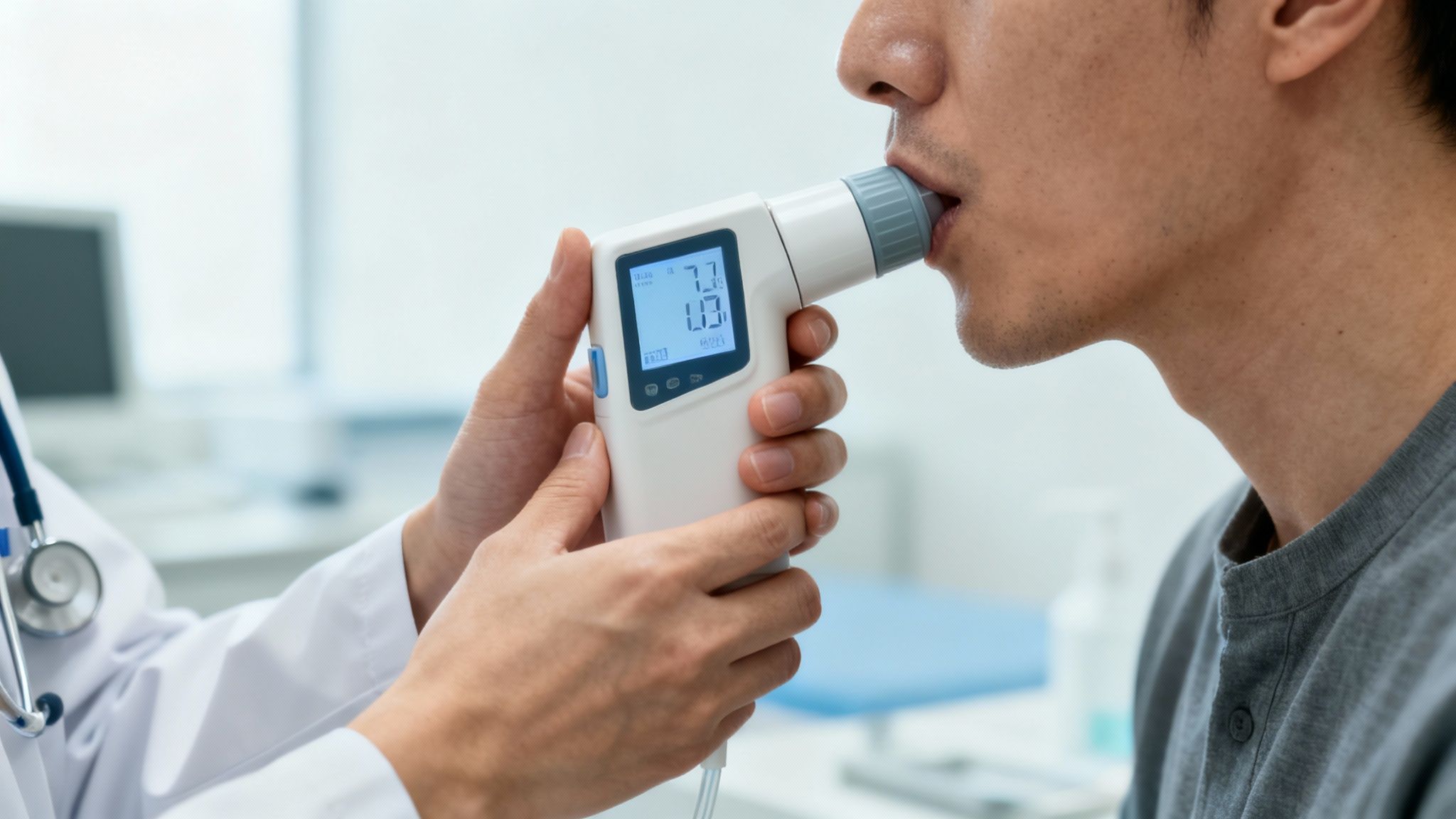
Think of the Blue Book as a detailed checklist of medical conditions and the specific criteria you must meet to be considered disabled. For COPD, your case will be measured against Listing 3.02 for Chronic Respiratory Disorders. If your medical records tick all the boxes on that checklist, you can be approved on medical grounds alone, without them needing to look at your work history or skills.
This is exactly why getting the right medical tests is so important. The SSA's decision hangs on specific measurements from breathing tests that show just how much your lung function has been compromised.
Decoding the Spirometry Test and FEV1 Values
The single most important test for any COPD disability claim is spirometry. It's a straightforward, painless test where you blow as hard and as fast as you can into a machine. The machine measures how much air you can exhale and how quickly you can get it out.
From this test, the SSA zooms in on one critical number: your Forced Expiratory Volume in one second (FEV1).
Your FEV1 is the total volume of air you can force out of your lungs in the very first second of a powerful exhale. For someone with COPD, this number is usually much lower than it should be because damaged airways trap air, making it incredibly difficult to breathe out quickly.
The SSA uses your FEV1 value—factoring in your height, age, and gender—as the main yardstick to measure your disability. A low FEV1 score is the objective proof they need to see that your lung function is severely limited.
To meet the Blue Book listing, your FEV1 has to be at or below a specific value found in their tables. For instance, a person who is 5'10" might need an FEV1 of 1.45 liters or less to automatically qualify. These numbers are strict, which is why precise and repeated testing is absolutely critical for your claim.
To give you a clearer picture, the SSA's Blue Book provides specific FEV1 values based on height. Here are a few examples of what they're looking for:
Sample Blue Book FEV1 Values for COPD
| 64 to 65 inches (5'4" - 5'5") | 1.15 L |
| 66 to 67 inches (5'6" - 5'7") | 1.25 L |
| 68 to 69 inches (5'8" - 5'9") | 1.35 L |
| 70 to 71 inches (5'10" - 5'11") | 1.45 L |
| 72 inches and over (6'0"+) | 1.55 L |
As you can see, the requirements are very specific. An adjudicator will compare your test results directly against these figures to determine if you meet the medical listing.
The Alternative Path: Proving Severe Exacerbations
So what happens if your breathing test scores are bad, but just shy of the rigid numbers in the table? Don't lose hope. There's another way to meet Listing 3.02.
You can also qualify by showing a well-documented history of frequent and severe COPD flare-ups, which the SSA calls "exacerbations."
To use this approach, you must prove you've had three hospitalizations within a single 12-month period. It's not enough just to go to the hospital; each stay must have lasted at least 48 hours, and they need to have occurred at least 30 days apart.
This path helps prove to the SSA that even if your day-to-day lung function is slightly better than their cutoff, your condition is so unstable that it leads to constant medical crises. These repeated hospitalizations make it impossible to hold down a job. For this strategy to work, you absolutely must have detailed hospital records, including admission and discharge summaries, for every event.
Ultimately, winning your disability claim for COPD comes down to meeting these precise criteria. You can learn more about this by exploring how the SSA evaluates COPD claims.
What If Your Breathing Tests Don’t Meet the Blue Book Numbers?
It's a punch to the gut when you find out your breathing test results are just shy of the rigid numbers in the Social Security Administration's (SSA) Blue Book. It’s easy to feel like your claim is over before it even began.
But I want to be very clear: this is not the end of the road. In my experience, many people who successfully get SSI for COPD are approved through a different route, one that looks at the real-world, day-to-day impact of the disease.
Think of the Blue Book as an express lane for approval. If your test scores are severe enough, you get waved right through. If not, you merge into the main evaluation process, which is actually a much more detailed and personalized look at what you can—and can't—do. This is where we build your case around your Residual Functional Capacity (RFC).
Winning Your Claim with a Medical-Vocational Allowance
The goal of the RFC assessment is to paint a complete picture of your limitations for the SSA. This process can lead to what’s called a medical-vocational allowance, which is just the SSA’s formal way of saying they’ve concluded there are no jobs you can realistically do.
An RFC form, filled out by the SSA’s doctors (but heavily influenced by the records from your own physician), tells the real story of your disability. It goes far beyond a single breathing test.
It documents how COPD gets in the way of your ability to function in a work setting, covering limitations such as:
- Exertional Limits: How long can you actually stand? How far can you walk before you’re gasping for air? Can you lift and carry a gallon of milk? For someone with advanced COPD, even lifting a 10-pound bag of groceries can leave you completely winded.
- Postural Limits: Bending over, crouching, or climbing a short flight of stairs might sound simple, but these can become impossible tasks when you’re fighting for every breath.
- Environmental Limits: Workplaces are full of potential triggers. Your RFC will note your inability to be around dust, fumes, strong odors, or even extreme temperatures, all of which could send you into a severe COPD flare-up.
The RFC assessment is where we shift the conversation. We move away from arguing about a single number on a test and start proving how the combination of all your symptoms makes sustained work impossible.
The ultimate question the SSA tries to answer is, "Given all of these restrictions, is there any full-time job out there this person can still do?"
If we can show that your collective limitations prevent you from doing your old jobs and any other kind of work that exists, you can be approved. This is often how claims are won for people whose daily reality is disabling, even if their spirometry results didn't quite make the Blue Book cutoff. Your claim becomes about proving that no reasonable employer could accommodate your need for a perfectly clean environment and your severely restricted physical stamina.
Gathering the Right Evidence for Your COPD Claim
Think of building a successful SSI claim for COPD like constructing a solid house. You need a strong foundation, and that foundation is solid evidence. Just telling the Social Security Administration (SSA) that your condition is severe won't cut it. You have to show them, using clear, objective proof that paints a complete picture of your daily reality.
Your medical records are the blueprints, providing the technical details of your diagnosis. But it’s the combination of different types of evidence that truly builds a convincing case. Your claim file needs to be more than just a diagnosis; it should be a detailed portfolio of your limitations.
Building Your Medical Evidence File
At the heart of any disability claim is your official medical history. This is the first thing an SSA examiner will look at to get a sense of how serious your COPD is and how it has progressed.
Your evidence file absolutely must include:
- Complete Medical Records: This means notes from every single visit to your primary care doctor and, crucially, your lung specialist (pulmonologist). These records should document your symptoms, the treatments you’ve tried, and how you’ve responded over time.
- Pulmonary Function Tests (PFTs): You need to include the results from all your spirometry tests. Having a series of these tests done over several months or even years is incredibly powerful because it can show a measurable decline in your lung function, proving that your condition is getting worse.
- Imaging Reports: Chest X-rays and CT scans provide visual proof of lung damage, like emphysema. This kind of objective evidence makes your medical case much stronger.
A single breathing test only shows a snapshot in time. A collection of tests, doctor's notes, and imaging reports creates a timeline, demonstrating the persistent and disabling nature of your COPD.
Beyond the Test Results
While the objective medical tests are critical, they don’t tell the whole story of how you can get SSI for COPD. The SSA needs to connect the dots between your test results and your real-world functional limitations. This is where personal documentation becomes so important.
A detailed statement from your pulmonologist can be one of the most persuasive pieces of evidence you submit. This letter should go beyond just restating your diagnosis and test scores. It needs to explain, in specific terms, how your COPD limits you. For example, it might state your inability to walk more than 50 feet, lift more than 10 pounds, or tolerate exposure to dust and fumes.
Finally, think about keeping a simple symptom journal. Jotting down your daily battles with shortness of breath, fatigue, coughing fits, and how often you need your oxygen gives your claim the human context that an examiner can't ignore. For more guidance, you can learn about the process for a Social Security medical records request to ensure you're gathering everything the SSA needs to see.
Navigating the Application and Appeals Process
The path to securing SSI benefits can feel like a long and winding road. It's more of a marathon than a sprint, and knowing what to expect can make a huge difference, especially since most people hit a roadblock right at the beginning. The first step is to file your application, which you can do online, over the phone, or in person at a local Social Security office.
Now for some tough but important news: most initial disability claims are denied. It's easy to feel discouraged, but you have to remember that a denial isn't the end. For many, it's just the start of the real process. You have the right to appeal the decision, and that's exactly what you should do next.
Understanding the Four Levels of Appeal
The appeals process has four distinct stages, giving you multiple chances to have your case heard again. Think of it as a ladder you climb to prove your COPD is severe enough for SSI benefits.
- Reconsideration: This is the first rung on the ladder. Someone new at the Social Security Administration (SSA) will take a fresh look at your entire file, including any new medical evidence you’ve gathered since the first decision.
- Administrative Law Judge (ALJ) Hearing: If your reconsideration is also denied, you can request a hearing with a judge. This is often the most critical stage and your best chance for approval. It's an opportunity to personally explain how COPD impacts your ability to function day-to-day.
- Appeals Council: If the judge denies your claim, your next option is the Appeals Council. They won’t rehear your case but will review the judge's decision to see if any legal or procedural mistakes were made.
- Federal Court: The final step, if all else fails, is to file a lawsuit in federal court. This is a less common path but remains an option for claimants.
Building a strong case for your application and any subsequent appeals requires a solid foundation of evidence.
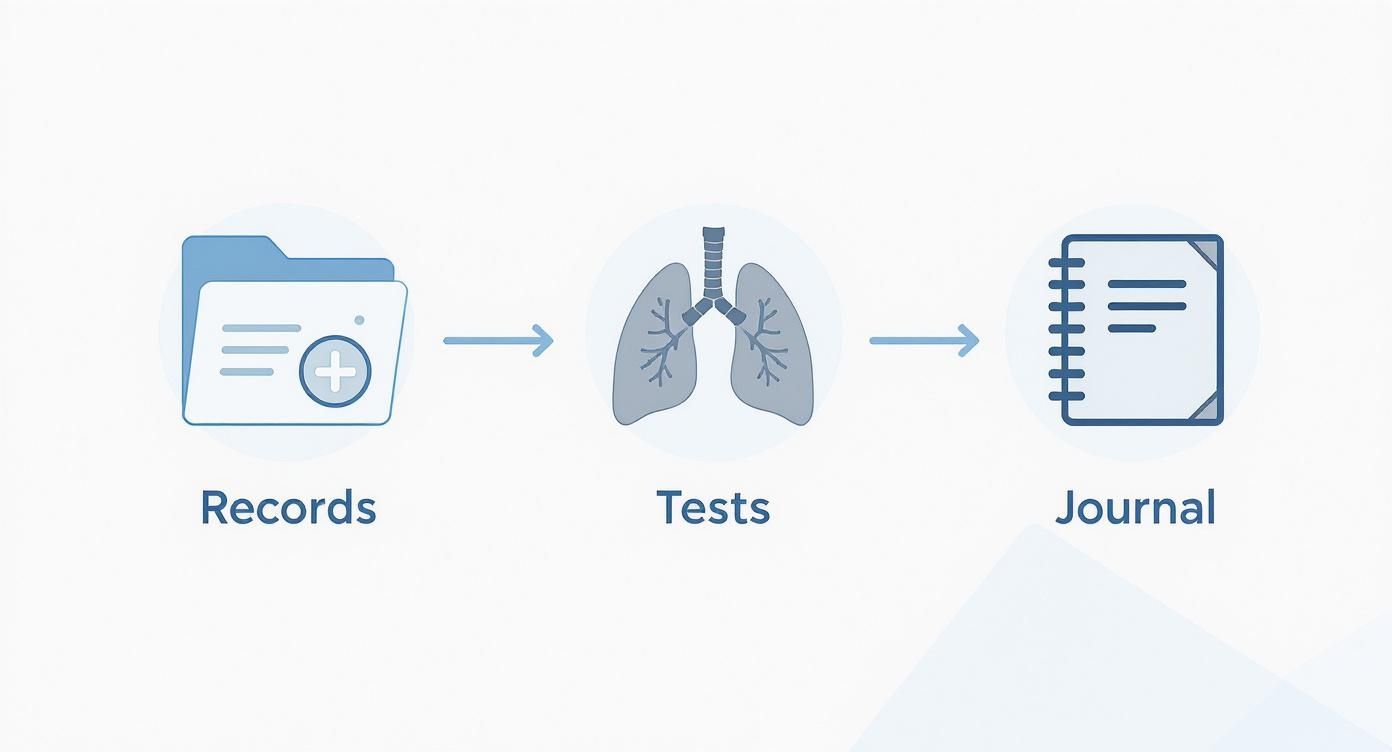
As you can see, a successful claim is built on a mix of official medical records, objective breathing test results, and your own personal notes about how your symptoms affect your daily life.
Why the ALJ Hearing Is So Important
For people with COPD, the ALJ hearing is often the turning point. Statistics show that the approval rate for chronic respiratory disorders like COPD jumps to 66% at the hearing level. That's a massive leap from the initial application stage and shows just how powerful it is to have a judge review your case directly. You can dig deeper into these SSDI approval rates by condition to see how different impairments fare.
Your testimony at an ALJ hearing transforms your claim from a file of paperwork into a human story. It allows a judge to see the person behind the breathing test results and understand the true impact of your condition.
When to Call a Disability Attorney in Oregon
Trying to navigate the Social Security Administration (SSA) system by yourself can feel like an uphill battle, especially when you're already struggling to manage a serious condition like COPD. The rules are confusing, the deadlines are unforgiving, and the paperwork can feel endless. It's easy to get overwhelmed.
Here in Oregon, having a local advocate on your side can make a real difference. A good attorney understands not just the SSA's complex procedures but also knows the local medical community, which can be a huge advantage for your claim.
Think of an experienced disability attorney as your guide through the maze. They take on the heavy lifting—from chasing down critical medical records to making sure every single form is filled out perfectly and submitted on time. This leaves you free to focus on what truly matters: your health.
How an Attorney Can Improve Your Odds
Let's be blunt: the statistics show that your chances of getting approved for benefits increase significantly when you have a hearing before an Administrative Law Judge (ALJ). This hearing is where an attorney's help becomes absolutely essential.
They will meticulously review your entire file, figure out what questions the judge is likely to ask, and coach you on how to clearly articulate the ways your COPD truly stops you from working.
An attorney's real skill is translating your day-to-day struggles into the specific legal and medical language the SSA understands. They connect the dots between your breathing test results and your inability to lift a box, stand for long periods, or even concentrate, building the strongest possible case for your disability.
I know what many people are thinking: "I can't afford a lawyer." This is a common and completely understandable concern. But most disability attorneys work on a contingency fee basis.
This means you pay zero fees upfront. You only pay if you win your case. The fee is simply a percentage of the back pay you are awarded, and it's legally capped by the federal government. There's no financial risk to you.
Hiring a knowledgeable Portland disability attorney removes that financial worry while providing you with the professional support you need. It’s a practical, strategic step toward securing the benefits you deserve.
If your COPD has made work impossible, you don't have to face the SSI process alone. The team at Bell Law is here to help you put together a claim that gets noticed. Reach out today for a free consultation to talk about your situation.
Disclaimer: The information on this page is provided for general informational purposes only and is not legal advice. Reading this content does not create an attorney-client relationship. For advice about your specific situation, please contact a licensed attorney.